

This article first appeared in City & Country, The Edge Malaysia Weekly on July 6, 2026 - July 12, 2026
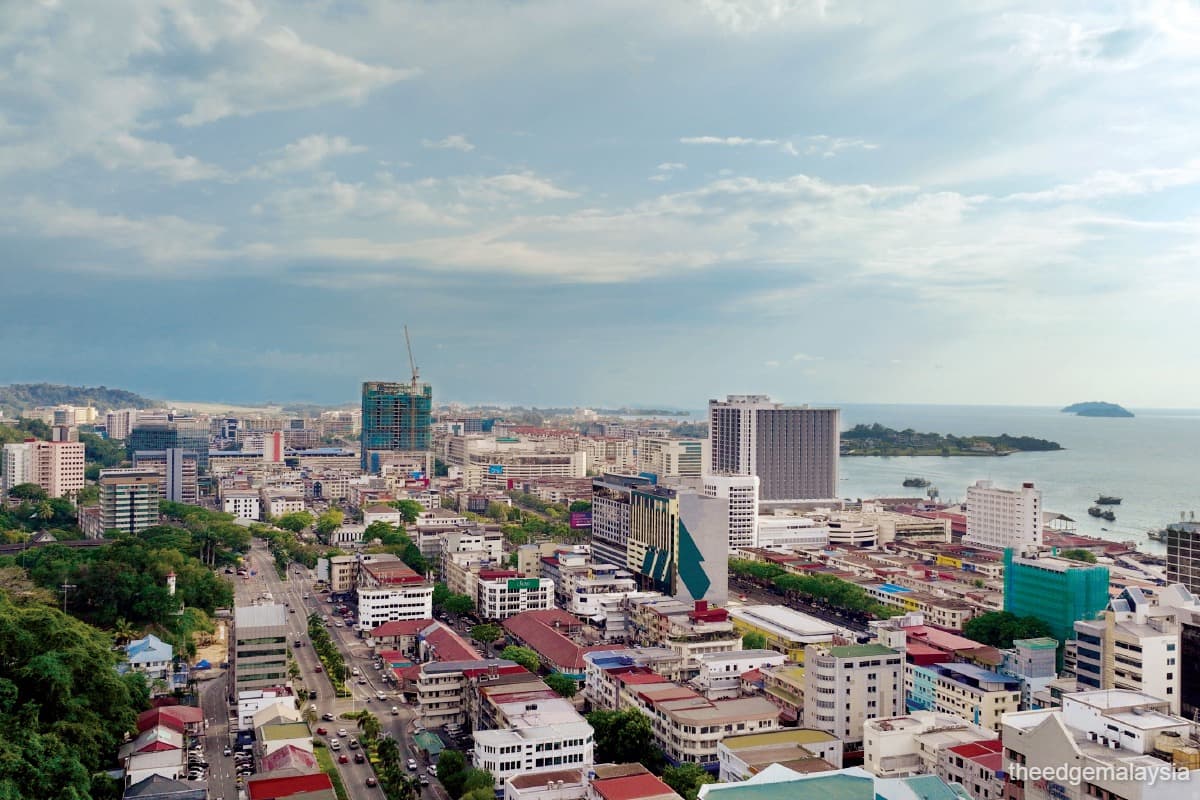
While waterfront developments continue to reshape the skyline of Kota Kinabalu, Sabah, it is the city’s ageing landed housing stock that is quietly delivering stronger capital appreciation.
Limited land availability in the state capital, coupled with sustained owner-occupier demand, has helped established terraced housing schemes outperform condominiums, says Rahim & Co Chestertons Kota Kinabalu director Max Sylver Sintia in presenting The Edge Malaysia | Rahim & Co Chestertons Kota Kinabalu Housing Property Monitor 1Q2026.
The contrast is becoming increasingly apparent. The report found that selected 1-storey terraced housing schemes recorded average year-on-year (y-o-y) price growth of 5.38%, and selected 2-storey terraced houses appreciated by 2.88%. By comparison, selected condominiums registered an average growth of 1.75%.
The stronger performance of landed housing comes even though condominiums and apartments are among the most actively traded residential products in Kota Kinabalu and its surrounding districts.

According to the report, the key differentiator lies in supply. Most 1- and 2-storey terraced houses in Kota Kinabalu are located in mature neighbourhoods and form part of the secondary market.
At the same time, the scarcity of developable land in the city has constrained new landed residential projects, with many recent developments shifting to the outskirts of Kota Kinabalu and neighbouring districts.
As a result, existing landed homes continue to benefit from structural supply constraints that provide enduring support for capital values.
“The consistency of price movements across the selected schemes points to a market underpinned by sound and sustainable fundamentals rather than cyclical volatility,” says Max.

Owner-occupiers remain the dominant force
The broader Sabah residential market remained steady during the quarter. A total of 1,364 residential transactions worth RM593.26 million was recorded in 1Q2026, representing a 1.11% y-o-y increase in volume and an 8.24% y-o-y rise in value.
Although transaction volume moderated quarter on quarter, transaction values continued to climb, suggesting that buyers remain willing to pay for quality residential assets despite a more measured pace of activity.
Max attributes this trend to continued owner-occupier demand rather than speculative buying.

Meanwhile, affordability remains the market’s defining characteristic. Homes priced below RM300,000 accounted for 610 transactions, representing 44.7% of all residential transactions in the quarter. Another 434 transactions were recorded in the RM300,001-to-RM500,000 category. Combined, homes priced below RM500,000 represented more than three-quarters of total residential transactions in Sabah.
Properties valued between RM500,001 and RM1 million accounted for 18.3% of transaction volume but nearly 30% of transaction value, reflecting healthy demand from upgraders. Meanwhile, homes priced above RM1 million accounted for just 5.2% of transactions but generated more than one-fifth of the total transaction value.
Greater Kota Kinabalu still dominates
The combined districts of Kota Kinabalu, Penampang and Putatan remained Sabah’s most active residential market, accounting for 716 transactions worth RM364.24 million.
The area represented 52.5% of the state’s residential transaction volume and 61.4% of transaction value in the quarter.

Within Greater Kota Kinabalu, condominiums and apartments were the most actively transacted residential product, recording 317 transactions worth RM124.84 million. Terraced houses followed, with 209 transactions valued at RM99.96 million.
The figures reflect the growing prominence of high-rise living in urban areas, even as landed homes continue to command stronger capital appreciation.
Condominiums remain resilient
Nevertheless, the condominium segment remained stable. Among the monitored projects, Likas Square posted the strongest y-o-y growth at 3.4%, followed by Jesselton Condo at 3.31%
and The Peak Condominium at 2.21%. Other projects recorded more modest gains, and prices at 1 Borneo Condominium remained unchanged during the period under review.
Max notes that the condominium market is becoming increasingly competitive as waterfront and integrated mixed-use developments continue to enter the market.

“New waterfront projects are typically launched at significantly higher price points than older secondary-market condominiums, with premium developments in selected locations approaching or exceeding RM1,000 psf,” says Max.
“Also, buyers are becoming more discerning, placing greater emphasis on location, build quality, developer reputation, accessibility and overall value proposition.”
As a result, market performance is expected to become increasingly differentiated, with well-conceived projects in strategic locations likely to outperform.
Looking ahead, Max expects Sabah’s residential market to remain stable despite broader economic uncertainties.
“Rising construction costs and limited land availability in established urban areas are expected to exert upward pressure on residential prices. Developers are likely to remain mindful of affordability considerations, however, resulting in measured rather than excessive price growth,” says Max.
Save by subscribing to us for your print and/or digital copy.
P/S: The Edge is also available on Apple's App Store and Android's Google Play.