


This article first appeared in The Edge Malaysia Weekly on June 29, 2026 - July 5, 2026
PENANG-based Oxford Innotech Bhd (KL:OXB) is shifting its focus back to the semiconductor sector after weaker contributions from its modular building systems (MBS) business, and is positioning itself to capture opportunities from the fast-growing data centre industry.
The ACE Market-listed integrated engineering solutions provider saw its net profit fall 55% to RM7.06 million in the financial year ended Dec 31, 2025 (FY2025), down from RM15.6 million in the previous year.
The decline was mainly due to lower revenue contribution from key customer SIBS AB, a Swedish-controlled MBS player with manufacturing operations in Penang.
OXB supplies precision sheet metal parts and metal frames to SIBS under a 10-year agreement signed in January 2024. SIBS had earlier secured multiple orders linked to NEOM, the Saudi Arabian government’s flagship megaproject, but delays due to developments in the kingdom last year disrupted operations and weighed on OXB’s performance.
As a result, SIBS’ contribution to OXB’s revenue fell sharply to 15% in FY2025, from 42% in FY2024.
Following the weaker FY2025 performance, OXB posted a flat net profit of RM3.2 million for the first quarter ended March 31, 2026 (1QFY2026).
Managing director Ng Thean Gin says the group has been versatile, adopting the mentality of “when one door closes, another opens”.
He notes that the group had successfully redirected resources during the semiconductor downturn of 2023 and 2024 by securing long-term contracts in the MBS segment, and is now benefiting from a recovery in semiconductor-related demand.
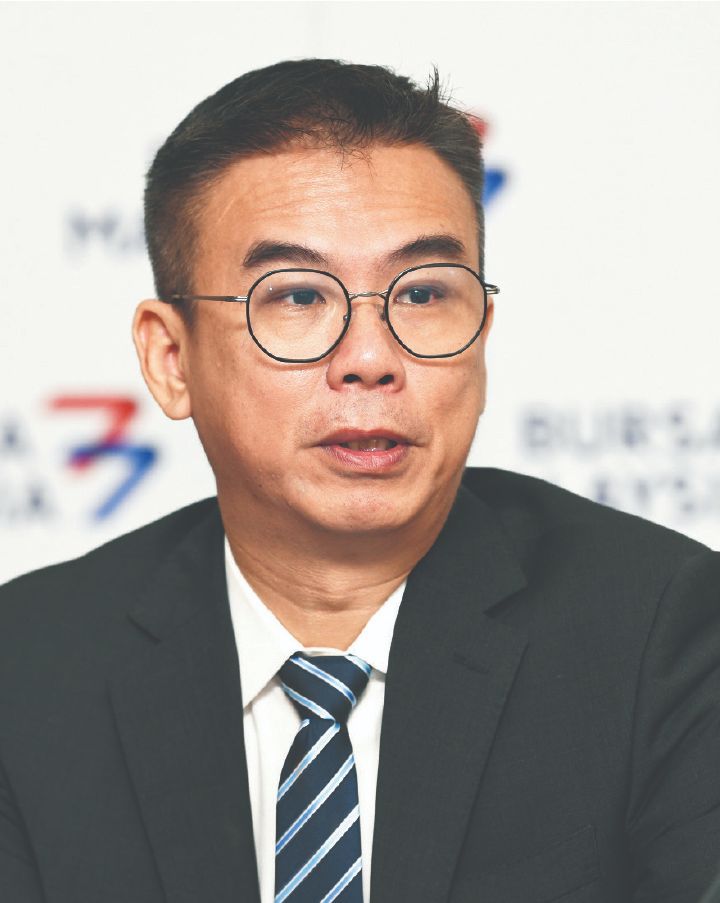
“Last year, we strengthened our semiconductor exposure, as we received more than 700 First Article (FA) parts. Our speedy decision-making and flat organisational structure made it possible to convert most of these parts into mass production by 3QFY2025,” he tells The Edge in an interview. First Article Inspection Report (FAIR) approval is the process by which customers evaluate and approve initial sample parts before committing to mass production orders.
According to Ng, the 12m tube laser cutting equipment that OXB purchased in 2025 to cater to SIBS had also enabled the group to enter the structural data centre components market. This led to OXB’s latest new Australian client, which specialises in airflow management systems for cooling data centres to maintain their efficiency.
“We have the hunger to grow, and we are able to open doors to new sectors, the most recent being MBS and data centre. Our edge is agility and breadth, with the ability to serve multiple segments and pivot quickly as demand shifts across semiconductors, data centres and MBS,” he says.
Ng, 50, began his career as a process engineer with Motorola Technology — now Motorola Solutions Malaysia — in 1998 and later became a commodity manager in 2002. He left in 2008 to join CG Solutions Enterprise Sdn Bhd — one of the entities that was later consolidated under OXB — as a sales engineer and was later appointed as a director.
Ng and his wife, executive director Lee Lai Chan, together hold a 42% stake in OXB. Executive directors Oh Yen San and Teh Teng Wah own 7.8% and 9% respectively.
It is worth noting that Ng and Oh had on June 15 divested 16 million shares and 12 million shares respectively to institutional investors in off-market transactions. Ng sold his block of shares at 35 sen apiece but Oh’s transaction price was undisclosed.
Headquartered in Penang, OXB was formed through the merger of several businesses started by the three founders more than 15 years ago. The merger in 2023 brought together different capabilities, customer relationships and technical experience into a one-stop engineering platform.
Today, OXB is involved in the design and manufacturing of precision metal and plastic engineering parts, assembly of equipment and machinery, as well as smart factory systems using automation and robotics solutions.
Listed in July last year, the group serves clients mainly in the semiconductor, electrical and electronic (E&E), telecommunications, mechatronics and automotive industries. These are largely multinational and foreign-owned companies operating in Malaysia.
An ‘execution year’
For FY2026, Ng expects the semiconductor sector to contribute about 50% of OXB’s revenue, with the majority coming from the memory segment. “Data centre will likely account for 25% of our FY2026 revenue, with even bigger opportunities to come in FY2027. MBS, consumer, automotive and other segments will make up the balance.”
He believes data centre construction activity in Malaysia will continue to accelerate, creating significant growth opportunities for OXB.
“Currently, we are only supplying components for a single customer focused on [its] airflow management system, but we see many more opportunities coming up. Our track record has already allowed us to replenish orders in Malaysia and Singapore.”
OXB’s order backlog stood at about RM30 million as at March 31, 2026, up from RM21 million as at Dec 31, 2025, driven by semiconductor mass production orders following FA approvals, as well as new data centre orders.
“We are actively engaging with customers on prospective orders, with current indications pointing to strong order visibility throughout the year and into the first half of 2027 for certain customers,” he says.
Among other things, OXB makes automatic probe-pin insertion machines, as well as ultraviolet and heater reflow curing conveyor machines for semiconductor customers. The group also supplies fabricated sheet metal components and equipment structure.
Ng says OXB operates alongside larger Penang-based precision engineering companies, including UWC Bhd (KL:UWC) and SFP Tech Holdings Bhd (KL:SFPTECH), which have longer track records and greater scale in semiconductor equipment manufacturing.
“We differentiate ourselves through our one-stop capabilities, speed and, more importantly, versatility. In sheet metal operations, we are known for fast turnaround customised solutions.
“This is supported by our in-house design team that helps bridge the gap between architect drawings and actual production feasibility. It allows us to respond quickly, suggest practical design adjustments where needed and move faster from concept to production,” he notes.
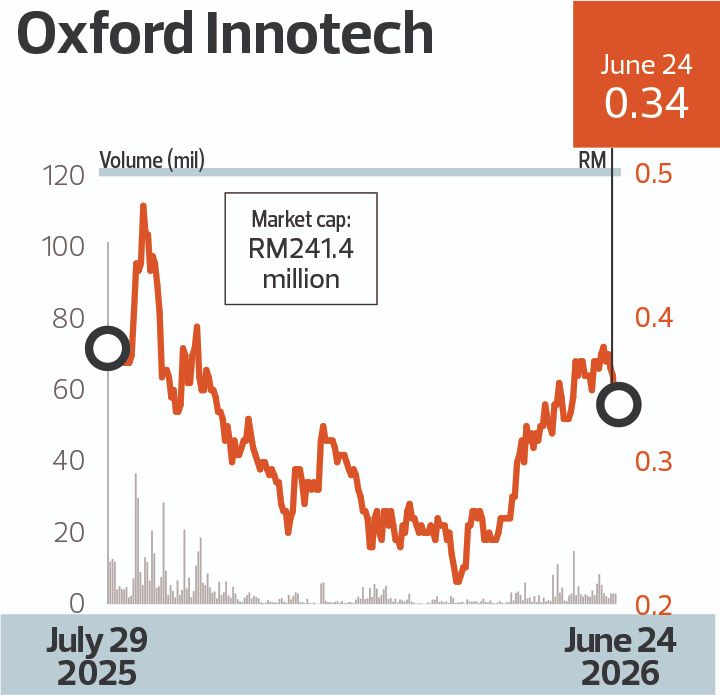
Shares of OXB have gained 13% year to date to close at 34 sen last Wednesday, giving it a market capitalisation of RM241.4 million. A check on AskEdge shows that the counter is currently trading at a historical price-earnings ratio (PER) of 34.1 times, below UWC’s 95.9 times.
Ng describes 2026 as an “execution year”, where the priority is to build on the momentum and translate it into stronger operating and financial performance.
“Investors should monitor our progress in converting semiconductor approvals into mass production, delivering on our existing data centre orders, securing additional data centre orders and deepening our presence in high growth segments.
“We also expect continued contributions from our existing customer base. As we execute through the year, we believe the market should be able to see an improved financial performance,” he says.
As at April, OXB had 262 employees, comprising 171 production staff, 22 engineers and 69 administrative staff.
“About 36% of our workforce are foreign workers, which means the majority are local employees. We are actively strengthening our talent pool in production, engineering, design, quality control and technical roles to support higher-order flow and future expansion,” says Ng.
As at March 31, OXB had cash and cash equivalents of RM53.8 million and total borrowings of RM22.5 million, giving it a net cash position of RM31.3 million.
“Our balance sheet remains healthy, with a current ratio of 7.7 times and gearing of 0.2 times. We believe this gives us sufficient flexibility to support our planned capacity expansion, machinery investments and working capital needs,” he adds.
Save by subscribing to us for your print and/or digital copy.
P/S: The Edge is also available on Apple's App Store and Android's Google Play.