

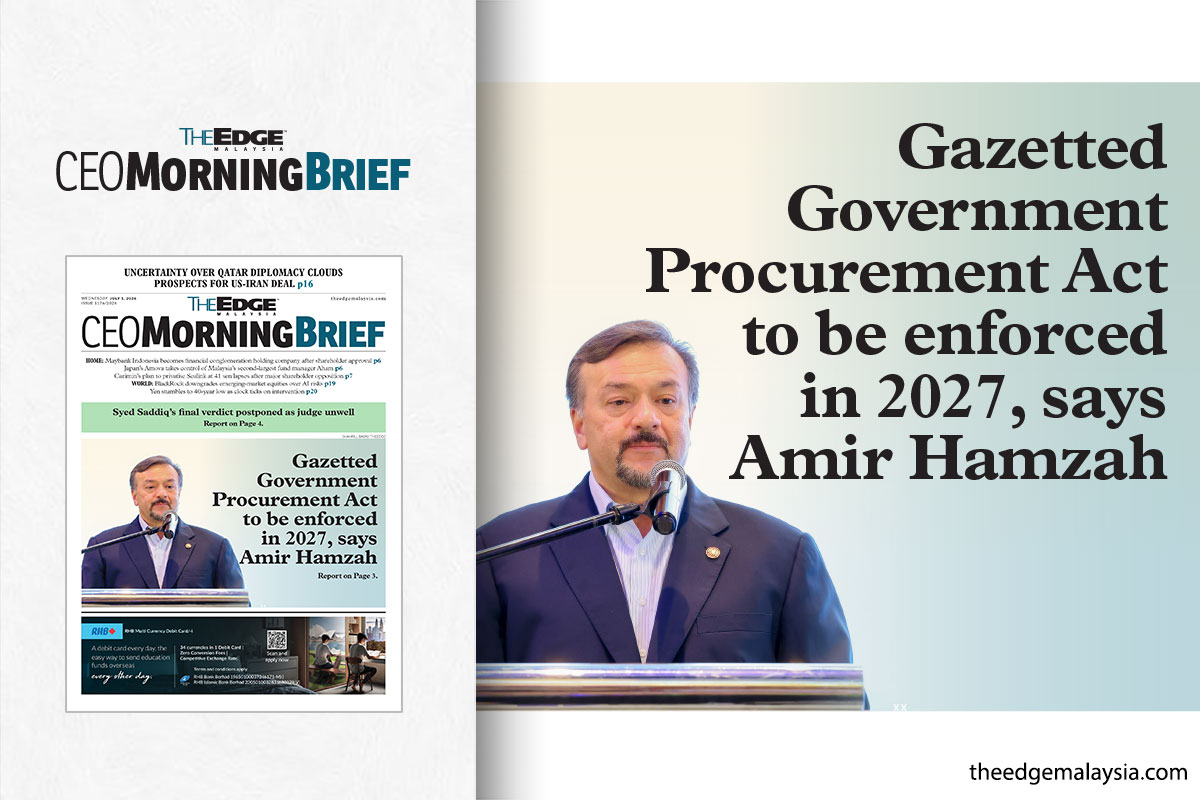
KUALA LUMPUR (June 30): Some 10 months on from being passed in Dewan Rakyat, the Government Procurement Act is only expected to be enforced in 2027, according to Finance Minister II Datuk Seri Amir Hamzah Azizan.
The Bill received royal assent earlier this year after being passed by the Dewan Rakyat in August 2025 and the Dewan Negara in September 2025. It was gazetted on May 26, 2026.
“The enforcement of the Government Procurement Act…is expected to commence in 2027 to help prevent leakage, wastage and mismanagement of public funds,” Amir Hamzah told Dewan Rakyat on Tuesday, without providing a reason behind the decision to enforce the Act only in 2027.
The Government Procurement Act, Malaysia’s first-ever dedicated legislation governing public procurement, is slated to introduce oversight provisions on government procurement, as well as punitive measures for any breach of procurement rules.
The minister mentioned the expected enforcement timeline when answering Simpang Renggam member of Parliament Datuk Seri Hasni Mohammad’s question on whether the Ministry of Health’s (MOH) budget cut would affect the implementation of the Reset framework and the basic medical and health insurance and takaful (MHIT) plan.
Amir Hamzah in response said the budget cut, which was limited to RM500 million, will not affect the implementation of the Reset healthcare reform agenda or the basic MHIT plan. Instead, reforms such as Diagnosis-Related Group (DRG)-based payments and electronic medical records (EMR) are expected to improve efficiency, reduce wastage and help contain long-term healthcare costs.
“This fiscal situation makes the Reset agenda even more significant and relevant. The objective of Reset is to ensure that healthcare costs remain sustainable in the long term,” he said.
The Reset framework comprises a revamp of medical and health insurance, enhancements to price transparency, a transition towards a nationwide integrated electronic medical records platform, and the expansion of cost-effective care options.
The base MHIT plan, which is expected to undergo a pilot by end-July, is aimed at offering a basic medical insurance plan aimed at expanding healthcare coverage.
Amir Hamzah said MOH’s operating expenditure cuts were capped at RM500 million as compared to the initially pegged RM3.1 billion. Under Budget 2026, the MOH was allocated RM46.5 billion.
“This amount does not involve major expenditures such as emoluments, medical supplies, overtime allowances, including on-call duties and so on,” he said on the RM500 million reduction.
He also noted that the allocation for medicine had been increased to RM6.5 billion in 2026 from RM6 billion in 2025, and the MOH continues to target the recruitment of more than 18,000 healthcare personnel with no reduction compared to the previous year.
The Ministry of Finance (MOF) issued guidelines to government ministries and agencies to reprioritise operating expenditure as the country’s coffers faced mounting pressure from a ballooning subsidy bill.
The government spent RM11.2 billion on fuel subsidies under the Budi Madani programme between January and May 31, benefitting 14 million Malaysians. This was three times higher than the amount spent during the same period in 2025, according to the MOF.
For more Parliament stories, click here.