

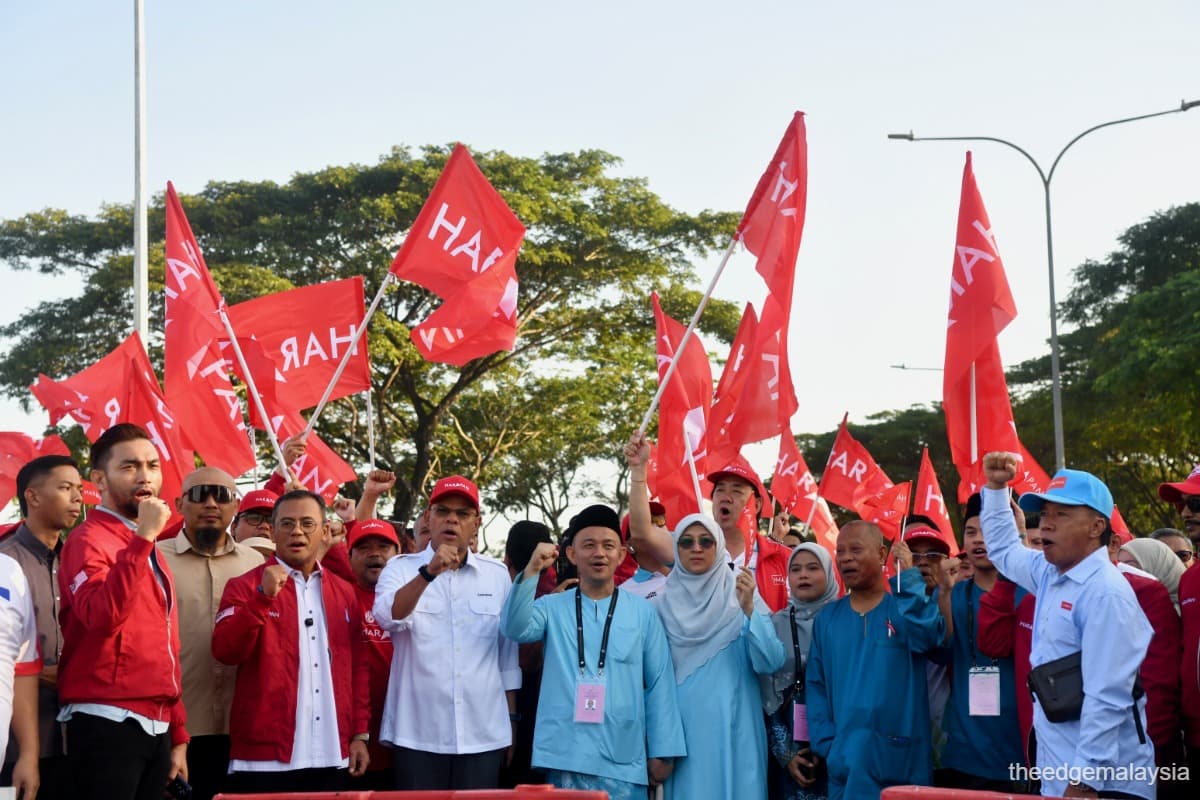
JOHOR BAHRU (June 27): The battle lines have been drawn for the high-stakes Johor state election after the nomination process concluded on Saturday morning, paving the way for a fierce contest that will pit federal unity government partners Barisan Nasional (BN) and Pakatan Harapan (PH) against each other.
According to the Election Commission (EC), all 56 state seats will be contested, meaning that no candidate will secure a seat unopposed. Of the total, 14 seats will see straight fights, 27 will feature three-cornered contests, 12 will witness four-way races, while the remaining three seats will be five-cornered fights.
Notably, BN and PH — allies in the federal government led by Prime Minister Datuk Seri Anwar Ibrahim — will clash in all 56 seats as both coalitions seek to form the next Johor state government.
Federal opposition coalition Perikatan Nasional (PN), meanwhile, has adopted a more selective strategy by fielding candidates in only 33 constituencies.
The Johor election is being closely watched as an early gauge of the political landscape under Anwar’s administration, particularly after the prime minister publicly acknowledged last month that the prospect of an early general election had crossed his mind.
With nominations now over, campaigning officially begins and will run for the next two weeks as political parties vie for the support of some 2.7 million eligible voters ahead of polling on July 11.
To secure a simple majority and form the next Johor government, a party or coalition must win at least 29 of the 56 seats.
Below are the key facts and things to watch from nomination day:
Key parties
Incumbent BN is defending 40 seats in the current 56-member state assembly, while PH holds 12, PN four and Muda one.
Although BN and PH govern together at the federal level, they remain political rivals in Johor, where PH has served as the opposition throughout the current state assembly term.
BN has fielded candidates in all 56 seats, with Umno contesting 37 seats, MCA 15 and MIC four.
PH has likewise mounted a full-state challenge, with PKR contesting 20 seats, Amanah 19 and DAP 17.
PN, on the other hand, has chosen to contest only 33 seats, with Bersatu fielding 16 candidates, PAS 11, the Malaysian Indian People’s Party (MIPP) five and Pejuang one. Gerakan has opted out of the election following a dispute over seat allocations within the coalition.
Smaller parties
While the election is widely expected to be dominated by BN and PH, several smaller parties could still emerge as spoilers in closely contested seats.
Among the most closely watched is Bersama, led by former Cabinet ministers Datuk Seri Mohd Rafizi Ramli and Nik Nazmi Nik Ahmad, which is making its electoral debut.
The party is focusing on 15 constituencies, largely in southern Johor, an area often viewed as politically progressive and home to a sizeable bloc of swing voters.
Eight of the targeted seats are currently held by Umno — Bukit Naning (N.14), Mahkota (N.29), Tiram (N.40), Permas (N.43), Larkin (N.44), Kempas (N.47), Kota Iskandar (N.49) and Bukit Permai (N.50).
Another five — Johor Jaya (N.42), Stulang (N.45), Perling (N.46), Skudai (N.48) and Senai (N.52) — are held by DAP, while the remaining two are Muda-held Puteri Wangsa (N.41) and PKR-held Bukit Batu (N.51).
Muda, meanwhile, will contest four seats. Besides defending Puteri Wangsa, it is also fielding candidates in Maharani (N.15), Simpang Jeram (N.13) and Bukit Batu.
Mano-a-mano battles
This election will feature 14 straight fights between BN and PH — a relatively rare occurrence in Malaysia’s fragmented political landscape since the watershed 2018 general election.
Of the 14 seats, 10 are held by BN incumbents and the remaining four by DAP.

Among the most closely watched contests is in Machap (N.26), where caretaker Menteri Besar Datuk Onn Hafiz Ghazi will face Amanah candidate Nor Hafiz Roslan.
Machap is a Malay-majority constituency, with Malays making up about 66% of the electorate, followed by Chinese (28.1%) and Indians (4.9%). In the last state election, Onn Hafiz secured about 57% of the votes and won by a majority of 6,543 votes in a four-cornered contest.
Another key straight fight is in Yong Peng (N.19), where Johor MCA chairman Ling Tian Soon will defend his seat against DAP newcomer Yong Hui Yi.

With non-Malay voters accounting for about 65% of the electorate, Yong Peng is expected to be closely watched as a barometer of whether support among non-Malay voters has shifted since the last election.
Battleground
Among the 42 seats that will see multi-corner fights, 12 recorded winning margins of less than 10% in the 2022 state election.
These include Jementah (N.02), Kemelah (N.04), Bukit Kepong (N.07), Bukit Pasir (N.08), Serom (N.11), Maharani, Tenggaroh (N.33), Tiram, Johor Jaya, Perling, Kota Iskandar and Bukit Batu.
Most notably, Bukit Batu will see a five-way contest. The seat was won by PKR’s Arthur Chong in the last election by a narrow 137-vote majority in a four-cornered fight.
The constituency has a mixed electorate, with Chinese voters making up 53.7%, Malays 37.2% and Indians 8.1%.
This time, Chong will face challenges from BN, Bersama, Muda and an independent candidate.

Puteri Wangsa in the Tebrau area will also see a five-cornered contest, where PH has fielded former education minister Dr Maszlee Malik in an attempt to wrest the seat from Muda.
Muda president Amira Aisya Abdul Aziz, who is also the incumbent for Puteri Wangsa, has chosen not to defend the seat, with the party instead fielding Rashifa Aljuneid, who is part of the constituency service centre team.
Likewise, PN’s Bersatu stronghold in Bukit Kepong will see a three-cornered fight, while PAS’ sole seat Maharani will also see a four-cornered contest.
Find out all you need to know about 2026 Johor Elections here.