

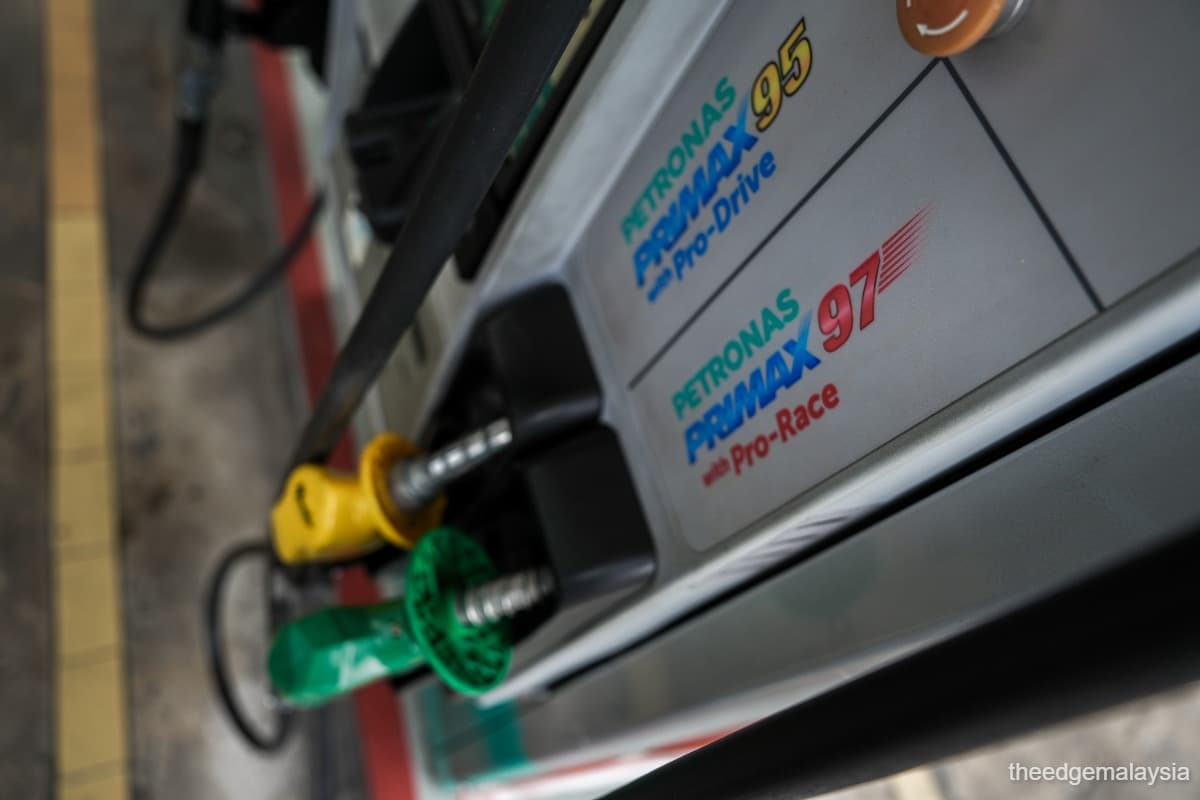
KUALA LUMPUR (June 24): Malaysia may need to adjust its RON95 petrol subsidy to keep its 2026 fiscal deficit target on track, after higher energy prices pushed the government’s monthly fuel subsidy bill tenfold to RM7 billion, according to HSBC Global Investment Research.
Subsidies for RON95 petrol and diesel have increased from RM700 million a month before the Middle East conflict, placing significant pressure on the government’s finances, HSBC senior Asean economist Yun Liu said in a quarterly report.
The total subsidy bill is expected to balloon to RM58.4 billion in 2026 from the RM15 billion allocated under the federal budget, raising questions over how the additional spending will be funded.
“A potential fiscal adjustment on RON95 is likely to be required to keep the 2026 fiscal deficit at 3.5% of gross domestic product,” HSBC said.

However, the research house said the government faces a difficult balancing act, as any increase in the subsidised petrol price could raise inflation, weaken private consumption and carry political implications as the next general election approaches.
Malaysia’s subsidised RON95 petrol is priced at RM1.99 per litre, about half the estimated market rate, according to HSBC.
The research house estimated that spending cuts across government ministries could generate RM10 billion in savings, while another RM10 billion could come from windfall revenue arising from higher oil prices.
Additional dividends from Petroliam Nasional Bhd (PETRONAS) could also help to cover the shortfall, though HSBC said it remains uncertain whether the national oil company will contribute more.
Despite the energy shock, HSBC maintained its Malaysian economic growth forecast at 4.5% for 2026 and 4.7% for 2027, citing the country’s status as a net energy exporter and its exposure to the sustained artificial intelligence (AI)-driven technology cycle.

Malaysia entered 2026 on a strong footing, with GDP expanding 5.4% year-on-year (y-o-y) in the first quarter, supported by manufacturing and service growth.
Electronics exports surged about 30% y-o-y on a three-month moving-average basis, providing a buffer against external uncertainties. Electrical and electronics products make up about two-fifths of Malaysia’s total exports, HSBC said.
Tourism and a relatively tight labour market are also supporting domestic consumption, although higher energy and food prices could weaken consumer sentiment.
HSBC raised its inflation forecast for Malaysia to 2.5% in 2026 from 2.1% previously, and to 2.7% in 2027 from 2.3%.
Inflation averaged just 1.7% in the first four months of 2026, among the lowest rates in Southeast Asia, partly due to the country’s heavily subsidised fuel prices.
Nevertheless, HSBC does not expect the anticipated increase in inflation to be strong enough to prompt Bank Negara Malaysia to raise interest rates.
It expects the central bank to keep the overnight policy rate unchanged at 2.75% throughout 2027.
While BNM recently said inflation would “edge higher”, it continued to expect both headline and core inflation to remain contained, HSBC noted.
The research house also forecast the ringgit to end 2026 at 4.15 against the US dollar before weakening to 4.20 by end-2027.