

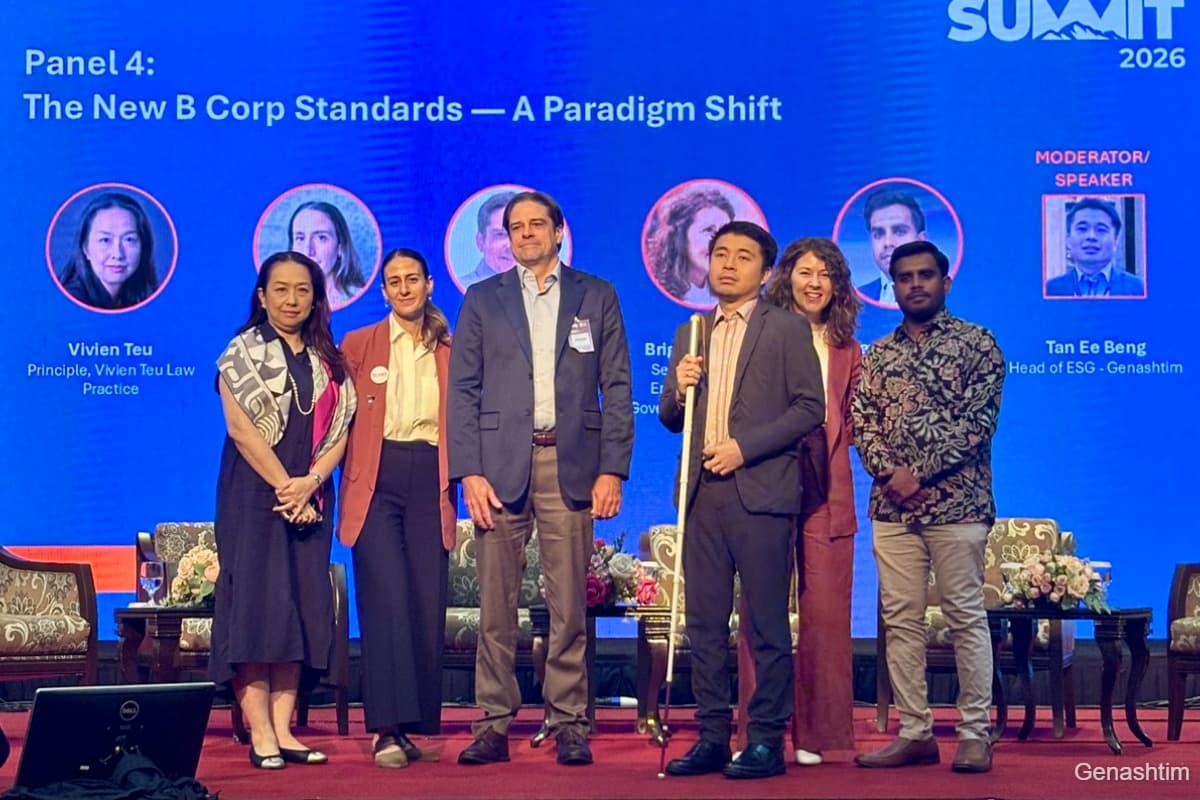
KUALA LUMPUR (June 24): The new B Corp Certification standards, which assesses and verifies a company’s environmental, social and governance (ESG) impacts, were designed with interoperability to other standards in mind, said speakers at the B Corp Summit 2026 held in Kuala Lumpur on June 22 and 23.
This means that B Lab, the non-profit behind the B Corp Certification, has mapped out its standards against other major sustainability frameworks, such as the Global Reporting Initiative and the International Financial and Climate Reporting Standards, so that companies will be able to pinpoint matching data points.
“The intent here is to ease the documentation burden. If companies are already preparing to meet one of these disclosure standards, then they can use that type of evidence to support what’s needed to meet the requirements of the B Lab standards,” said Brigitta Nemes, senior manager of environmental governance standards at B Lab, during a panel session on day two of the summit, which was held in Royale Chulan Kuala Lumpur.
She added that by meeting B Lab standards, companies can also accelerate their readiness to comply with the mandatory disclosures.
These new changes are a result of B Lab’s revamp of the B Corp certification standards last year to move from its previous point-based system to a system of mandatory requirements across seven areas.
The areas include: climate action, human rights, fair work, environmental stewardship and circularity, JEDI (justice, equity, diversity and inclusion), governance and collective action, and lastly, purpose and stakeholder governance.
On top of strengthening rigorous standards, B Lab shifted to a third-party certification system with To-Cert and SCS Global Services for more secure verification.
The new standard has also introduced an equity mechanism to consider the different economic and market situations of companies.
“Doing business in Myanmar is very different from doing business in the Netherlands, so that’s something that the standards also acknowledge. Companies that operate in countries with more operational barriers, can actually skip certain sub-requirements in the standards,” said Nemes.
This mechanism extends to a company’s size and sector. The new standards differentiate responsibilities expected of larger companies compared to the small and medium-sized companies, and the same goes for companies in the manufacturing sector compared to companies in the service sector.
Vivien Teu, founding principal at Vivien Teu Law Practice, commented that the new B Corp standards better prepare companies in complying with policies and regulations by providing pathways to meet the necessary requirements.
“One gap that I’ve picked up over the years is that companies are required to report on [compliance] items, but they don’t really know how they’ll get there and what is actually expected… I see the next phase of development being grounded [management and processes]
to be able to reach the baseline [for regulatory pressures and stakeholder expectations,” she said.
Companies impacted by international regulations, such as the European Union’s Carbon Border Adjustment Mechanism and the Corporate Sustainability Due Diligence Directive, will also be better positioned to navigate standards like supply chain and human rights, which are expected to be introduced across various European countries’ legislation.
“With the new B Lab standards, which includes very specific baselines on climate, as well as on human rights, companies can be better prepared to be able to meet these European requirements,” said Teu.
B Lab’s decision to make changes to the B Corp certification standards stemmed from an understanding that companies must be structurally resilient to survive in a world that is becoming increasingly uncertain.
Clay Brown, chief standards officer at B Lab, shared that 95% of B Corps, which are companies certified by the B Lab standards, showed more resilience during the Covid-19 pandemic. In comparison, the resilience of non-B Corps stood at 88%.
“The bar needs to move, and not just higher, but in a genuinely different direction. In the old model, you could be strong in one area and weak in another… Every company should perform across all seven, that’s the shift,” said Brown during his opening keynote.