

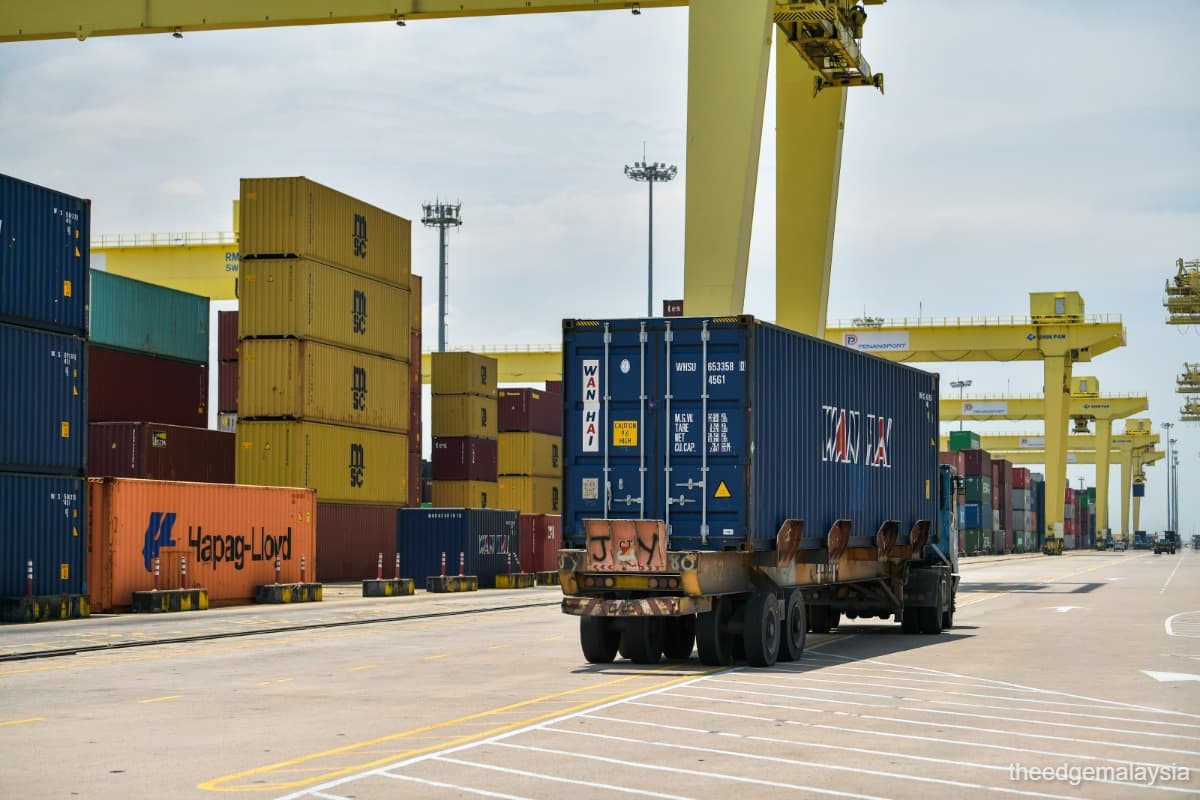
KUALA LUMPUR (June 19): Malaysia's strong export performance in May has prompted economists to become more optimistic about the country's trade outlook, with some raising their full-year forecasts, although risks from US tariffs, lower commodity prices and the normalisation of front-loading effects remain on the horizon.
Exports rose 45.3% to a near four-year high in May from a year earlier, accelerating from April's 36.9% growth and exceeding the 29.7% median estimate in a Bloomberg survey of economists.
The strong exports were driven by robust shipments of electrical and electronic (E&E) products, refined petroleum products, and liquefied natural gas, according to the Department of Statistics Malaysia on Friday.
On a month-on-month basis, exports edged up 0.4% to RM183.3 billion. For the first five months of 2026, exports grew 24.3% from a year earlier, more than four times the 5.4% expansion recorded in the corresponding period last year.
Meanwhile, import growth moderated to 14.1% in May from 20% in April, helping lift the monthly trade surplus to a record RM40.38 billion. The May trade surplus is 38% higher than RM29.23 billion in April.
For the first five months of the year, the cumulative trade surplus nearly tripled to RM132.77 billion from RM46.93 billion a year earlier.
Export growth forecast raised
The stronger-than-expected trade performance has prompted economists to reassess their export outlook.
UOB Global Economics & Markets Research has raised its 2026 export growth forecast to 25% from 2.5% previously, driven by year-to-date export growth of 24.3% and robust diverted trade flows.
"May's export performance was largely driven by robust electrical and electronics shipments and strong re-export activity, supported by the ongoing AI upcycle and demand for automotive technologies amid supply chain reconfiguration and Middle East disruptions," it said in a note.
RHB Research said the strong export performance suggests further upside to its current export growth forecast of 15.3% for this year, underpinned by resilient external demand and sustained strength in the E&E sector amid the ongoing technology and AI investment cycle.
Despite the improved outlook, economists cautioned that part of the recent strength could be temporary.
BIMB Securities Research said while the solid year-to-date performance points to upside risks to its 2026 export growth forecast of 15.8%, some moderation is likely in the latter part of the year as front-loading effects gradually ease and global demand normalises.
Similarly, UOB said earlier front-loading of orders amid supply concerns may lead to a normalisation in export growth in the coming months, while uncertainty surrounding prospective US semiconductor tariffs remains a key wildcard for Malaysia's external trade outlook.
However, RHB Research believes the impact of US tariffs under Section 301 of the Trade Act of 1974 on Malaysia is likely to be manageable, as products exempted under the proposed measures broadly mirror those already exempted under the existing Section 122 tariff regime.
This, it noted, limits the impact on Malaysia's major export categories, covering 68.9% of the country's exports to the US.
"Most of Malaysia’s key exports to the US, particularly machinery and electrical products, remain largely unaffected,” said RHB Research.
Meanwhile, lower energy prices following easing geopolitical tensions in West Asia present a double-edged sword for Malaysia.
While softer oil prices could weigh on commodity export earnings, they may also help ease cost pressures.
“If sustained, lower oil prices and improving global energy supply conditions could help moderate cost pressures in the coming months,” said RHB Research.
Brent crude has fallen 37% to US$79.71 per barrel on Friday from its peak of US$126.41 in April, though it remains about 31% above its end-December level of US$60.85.