


This article first appeared in City & Country, The Edge Malaysia Weekly on June 22, 2026 - June 28, 2026
As one of the quieter, mature suburbs in Selangor, Damansara Jaya has often been overshadowed by its busier commercial neighbours in Petaling Jaya, such as SS2 and Damansara Utama. Some locals attribute this to its less commercially stacked profile.
Developed in the mid-1970s by See Hoy Chan Group via its then-property development arm Paramount Garden — now listed as Paramount Corp Bhd (KL:PARAMON) — the township has evolved into a settled, affluent enclave whose commercial life turns on the surrounding community.
Its commercial area is best known for the centre catchment, Atria Shopping Gallery, which began in the early 1980s as Gardenia Town Centre. Lion Group bought it in 1987 and renamed to Atria Shopping Gallery. After being purchased by Lien Hoe Corporation in 2001, it was sold again in 2007 to OSK Property Holdings Bhd, which redeveloped it into the current neighbourhood mall.
The complex continues to draw steady footfall with its tenant mix of lifestyle services, daily conveniences, and food and beverage (F&B) offerings from not only the Damansara Jaya area, but also nearby neighbourhoods such as Damansara Utama (SS21) and Taman Mayang (SS25), according to Metro Rec head of agency Terence Yap.
Damansara Jaya’s quieter commercial profile, however, is now beginning to shift, according to commercial property experts.
As rents in the nearby busier hubs climb and the supply of ground-floor space tightens, more operators are looking to Damansara Jaya, drawn by its established catchment, accessibility and affordability.

Nawawi Tie Leung executive director and head of research and consulting Saleha Yusoff places the suburb in a particular niche.
“I would position Damansara Jaya as a high-income neighbourhood commercial hub. It does not compete directly with regional retail such as 1 Utama Shopping Centre or The Curve; instead, it serves as a highly accessible community-centric commercial node catering to affluent residents from Damansara Jaya, Damansara Utama, Damansara Kim and, to some extent, Bandar Utama and parts of TTDI (Taman Tun Dr Ismail),” she says.
Its appeal lies partly in its accessibility. The suburb is compact, under 1.5 sq km, bordered by the Sprint Highway to the north and the Damansara-Puchong Expressway (LDP) along its eastern and southern edges, with the Penchala Link and New Klang Valley Expressway close by. The Kajang Line MRT stations at TTDI and Phileo Damansara sit nearby, though neither is within the township itself.
Two clusters, two characters
Around Atria, commercial stock divides into two distinct pockets. The first is the cluster of 4-storey
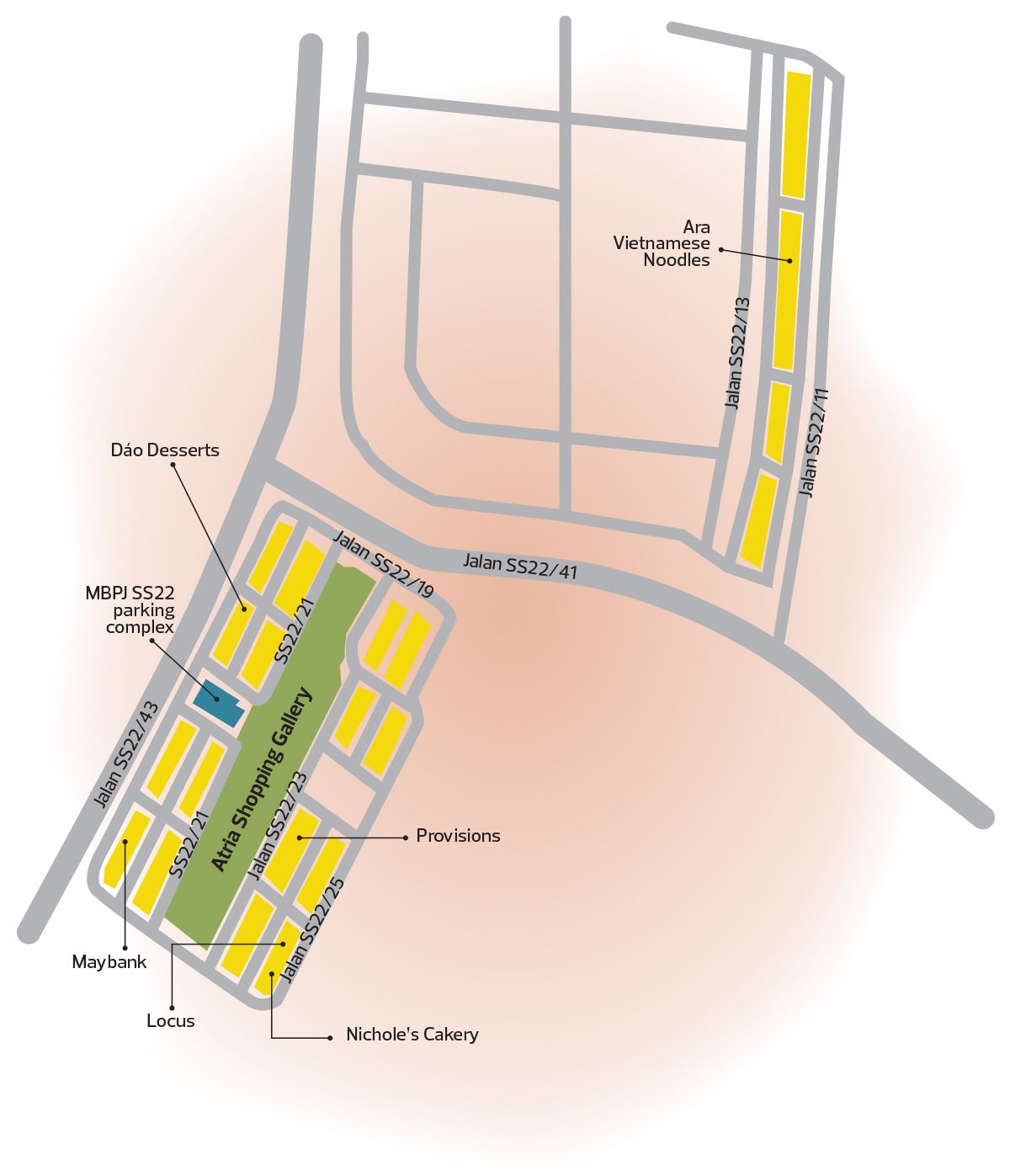
shoplots in the immediate Damansara Jaya area. Comprising about 160 units across four rows along Jalan SS22/19, SS22/21D, SS22/23 and SS22/25, it houses banks, pharmacies, entertainment and F&B outlets. Maybank, Public Bank and RHB Bank are anchors for their respective rows.
The second is the older line of 2-storey shoplots along Jalan SS22/11, known colloquially and fondly as the Mewah shops. It stands at about 48 units and has long held the staples of neighbourhood trade, coffee shops, sundry stores and hardware shops, though Metro Rec’s Yap notes that in recent years, newer ground-floor occupants have been F&B operators.

“Owing to the relatively limited number of shops compared with SS2 and Damansara Utama, commercial activities in this area remain primarily centred around the local residential population and are less extensive,” says Yap.
Healthy occupancy, defensive demand
While limited in its comparative quantity, Damansara Jaya’s commercial area shows healthy occupancy, which stands at between 85% and 95% in the prime pockets around the shopping gallery, with low vacancy at the ground level and slightly higher on the upper floors.
“The occupancy rate of shoplots in Damansara Jaya is considered very healthy,” says Yap. “A quick drive-through only shows a couple of vacant units. [There are some] ground-floor lots for rent, with a few more on the upper floors. But this is generally reflective of the healthy overall property market sentiment. After all, vacancy is likely caused by higher rent revision.”
He also highlights that the occupancy rate for Mewah shops is higher despite these being older and further away from the mall, which is the key footfall pulling factor to the area.
“We expected the Mewah cluster to have higher vacancies but to our surprise, the [newer] 4-storey shoplots seem to have a few more vacant units,” says Yap.
However, average rents are higher in the 4-storey shoplot cluster, where an intermediate lot on the ground floor can fetch a monthly rent of RM8,000 to RM10,000, with better-positioned shops commanding a premium.
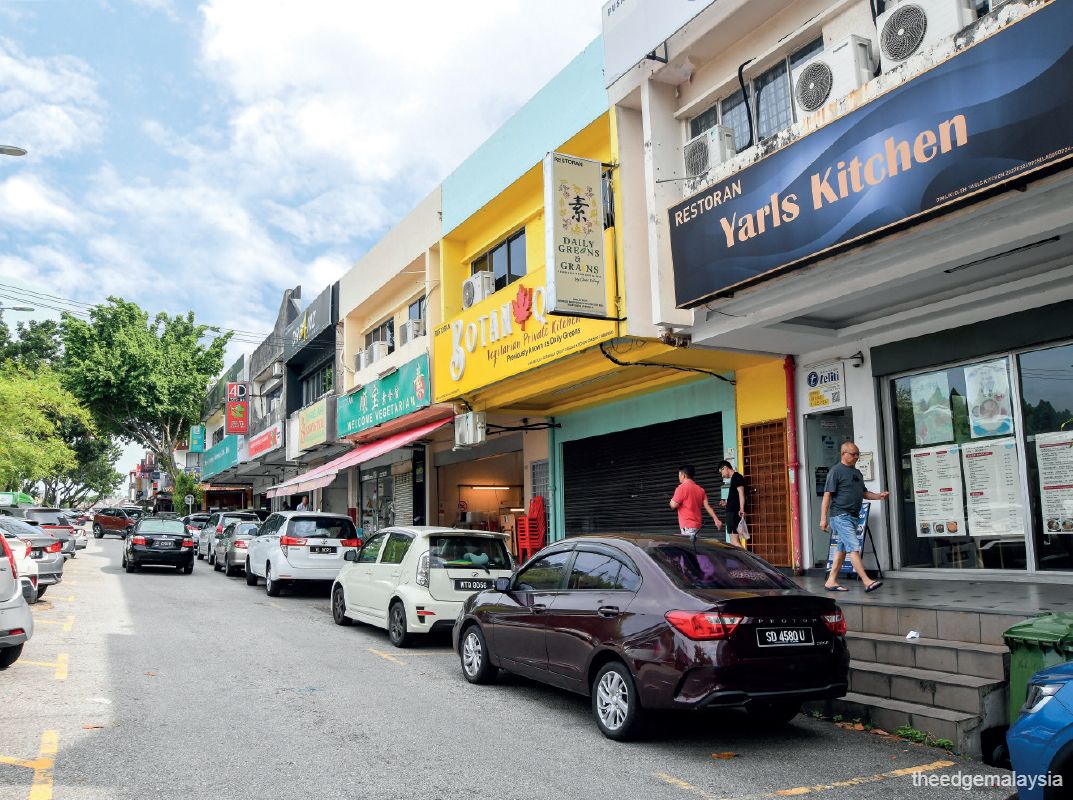
On the Mewah side, ground-floor rents are more moderate, at around RM5,500 to RM6,500. Upper-floor space across both clusters is steadier, ranging from RM1,500 to RM2,000.
In two recent deals, a Mewah shop in Jalan SS22/21 changed hands in late 2025 for about RM2.6 million — a gross yield of 3.6% — while a unit in Jalan SS22/23 in the immediate area sold in early 2025 for RM3.2 million, a yield of 4.68%, according to Metro Rec’s data.
What the figures represent, Yap says, is a market that is stable but inward-looking.
“Damansara Jaya, while stable and well occupied within its neighbourhood retail
framework, remains comparatively more defensive and locally driven in its commercial performance.
“While more residential in its overall character, its shoplots primarily serve the immediate catchment, with a tenant mix skewed towards neighbourhood services such as F&B, clinics, convenience retail, tuition centres and professional services. Demand is relatively stable but largely driven by localised spending,” he says.
In comparison with Damansara Utama and SS2’s stronger rental demands and higher achievable rents, Damansara Jaya remains relatively defensive, Yap adds.
A market built on loyalty
Damansara Jaya is home to a large base of long-time homeowners, many of whom are multigenerational families and working professionals with relatively high disposable incomes. Their spending habits shape the kind of businesses that take root there.
“The customer profile is generally discerning, quality-conscious and convenience-driven. Unlike catchments that are highly price-sensitive, consumers in Damansara Jaya tend to place greater emphasis on service quality, product differentiation and overall experience. This has created a favourable environment for businesses that offer specialised products and services rather than mass-market offerings,” says Nawawi Tie Leung’s Saleha.
Overall, it is better positioned as a neighbourhood commercial destination for middle- and upper-income consumers, rather than driven by discount retail or high-volume trade.
One defining factor, Saleha says, is its evolving preference for a more sophisticated consumer base.
“What differentiates Damansara Jaya is not the size of its catchment but the quality. The area continues to attract businesses that value purchasing power, customer loyalty and repeat patronage over sheer footfall.”
The local dining landscape has gradually transitioned to more contemporary cafés and lifestyle operators aimed at younger professionals, among which are Provisions, Locus, Nichole’s Cakery and Dáo Desserts.
Drawn by the area’s mix of homes and shops, Andrew Goh opened Ara Vietnamese Noodles in the Mewah shops in 2015.
“Damansara Jaya felt like a good mix of residential and commercial. There are a number of long-time residents here, and people are familiar with the area. It felt more like a community rather than just a business district,” Goh tells City & Country.
He acknowledges that while rent in the Mewah side is more affordable, it also has lower footfall than the newer stretch nearby Atria.
“[However,] we felt that if our food was good, customers would eventually find us, and thankfully many did,” Goh says, adding that his regulars span the gamut of residents nearby, office workers and students — some of whom have been coming long enough that the shop has watched their children grow up.
The drawbacks, he says, are visibility and parking. As the outlet is located off the main road, footfall has eased as it becomes harder to find parking during the day. Costs have risen too, he notes, with rent climbing steadily over the years.
“That said, the area has character. It may not be the trendiest place in Petaling Jaya, but it has a loyal following and a neighbourhood feel that many appreciate,” says Goh.
Ziyan Lee, who grew up in the area and runs Provisions bakery (started in 2019) and Locus wine bar and restaurant (started in 2023), echoes this sentiment. “We chose Damansara Jaya quite intentionally. We grew up here and knew that it is a strong neighbourhood.”
She noticed the neighbourhood lacked a modern, casual yet thoughtful dining concept.
“Compared with other shoplot clusters, Damansara Jaya felt less saturated, yet seemed to be full of potential for building long-term relationships with customers,” she shares.
Many of her customers began as walk-ins and now return weekly or daily, coming not just to eat but to spend time, she says, and over time the relationship turns personal. The café and restaurant are busiest during weekend brunch and lunch, and quietest on weekday afternoons.
“What stands out most is the strong community base — it’s an area where people return regularly — more towards building within a community that values familiarity and consistency.
“Growth here is slower and more relationship-based, which can be challenging if someone is expecting fast scaling or viral traction,” she says, with parking and peak-hour congestion adding to the strain.
Even so, for her, the strength of community outweighs the limitations.
Reinvention over expansion
As both Goh and Lee remarked, Damansara Jaya carries the all too familiar strains of a mature suburb — traffic congestion and insufficient parking bays.
Parking is the most common grouse, with demand being especially high on weekends and at peak dining hours, leading to congestion in parts of the commercial area.
Saleha points to the ageing shoplots there needing an upgrade when compared with newer mixed-use developments in the vicinity, which offer a better retail environment with structured parking spaces.
Nonetheless, she has a positive outlook on the market. Saleha says, “The challenge for Damansara Jaya is not one of obsolescence, but one of reinvention,” adding that the qualities that matter most as an affluent resident base — good connectivity, limited land and a strong sense of place — seem to be disappearing in Petaling Jaya.
Such qualities, in her view, should keep the township relevant even as newer centres rise around it.
She further sees the suburb slowly evolving as a lifestyle and service hub, shaped by the upgrading and reuse of existing buildings rather than by major redevelopment, with healthcare, wellness, education and speciality dining remaining its main demand drivers. She also points to a broader shift, as more people seek quality experiences closer to home, a trend that favours mature neighbourhood centres like this one.
Meanwhile, Metro Rec’s Yap expects the value of and rent for shoplots in Damansara Jaya will continue to rise with more modern branded cafés and premium F&B outlets moving in, all with the footfall well supported by the nearby mature residential properties market and amenities.
According to data from Metro Rec, terraced houses in Damansara Jaya recorded median prices of about RM1.47 million in 2025, against RM1.18 million in Damansara Utama and RM1.127 million in SS2, reflecting its robust market demand in the vicinity.
The suburb is also served by long-established schools, among them SMK Damansara Jaya and Nobel International School. The latter occupies the former KDU College campus on the LDP fringe and has more than 1,000 students.
Save by subscribing to us for your print and/or digital copy.
P/S: The Edge is also available on Apple's App Store and Android's Google Play.