

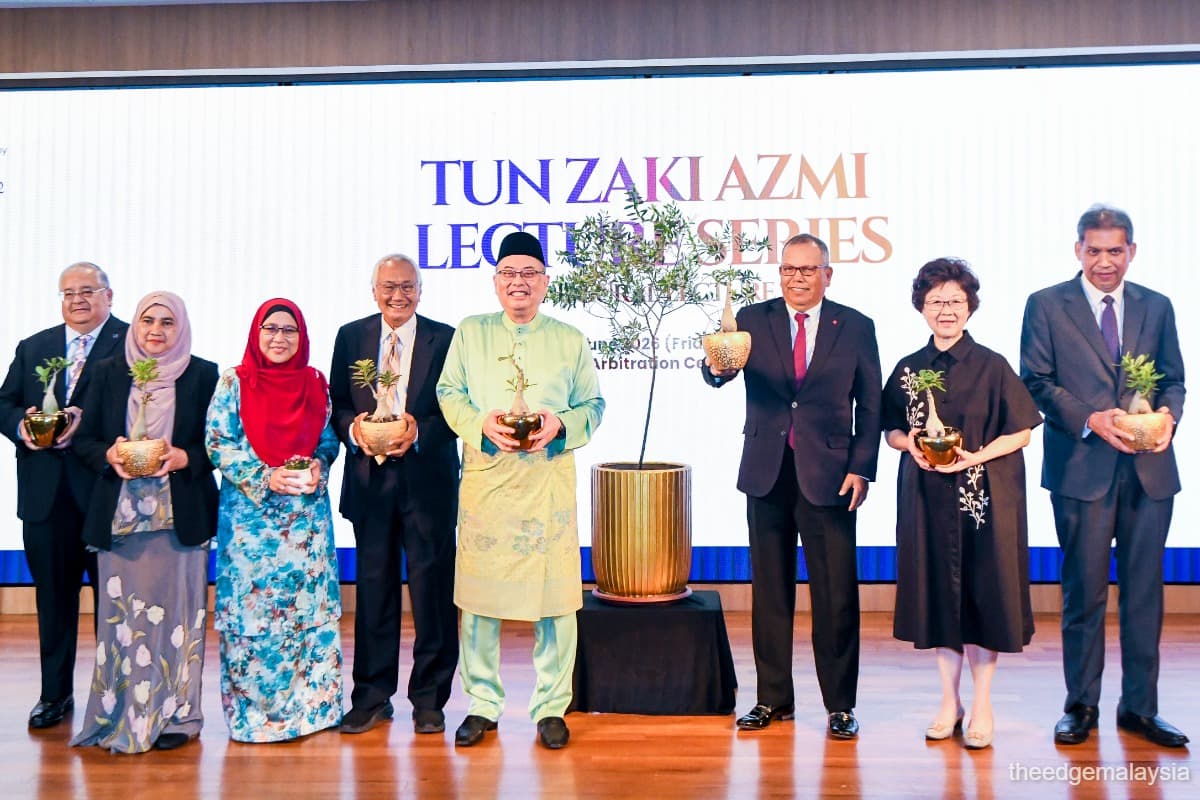
KUALA LUMPUR (June 19): Chief Justice Tun Wan Ahmad Farid Wan Salleh has commended former chief justice Tun Zaki Azmi’s contributions, recognising his “adventurous” and hands-on nature in leading the judiciary.
Wan Ahmad Farid, who was officiating the Tun Zaki Azmi Lecture Series on Friday, described Zaki, who was the CJ from 2008 until 2011, as possessing exact and bold characteristics in managing the judiciary.
“He adventured into it. He shaped a fiercely reformed legal institution, one that broke boundaries and earned the international recognition it holds today. He did not lead by cultivating an image. He led by doing the work, quietly, directly, and always with his eye on something larger than himself.
“He took the helm of this judiciary at a time when the questions being asked of our courts were not easy ones. Questions about independence, about credibility, about whether the public could look at our institutions and find in them something they could genuinely trust. These were not questions that invited comfortable answers, and they were not questions a leader of lesser conviction would have engaged with the honesty they deserved,” he said.
Wan Ahmad Farid said Zaki engaged these issues directly and courageously, at the risk of being unpopular, so long as he got the job done.
WATCH: CJ commends Tun Zaki Azmi’s ‘bold and adventurous’ leadership
Zaki, who is the son of former Lord President Tun Azmi Mohamed, succeeded former CJ Tun Abdul Hamid Mohamad.
During Hamid and Zaki’s time, the judiciary was still faced with the notion of what is now known as the Royal Commission of Inquiry over the Lingam video clip, over allegations of judiciary fixing.
The CJ said Zaki was not a man who tolerated pretence or inefficiency.
“He went where the work was, visiting courts unannounced, sitting across from judges and officers, asking directly why cases were delayed, why justice was being made to wait. I remember asking him why he was holding his BlackBerry phone all the time? And he said, he needed to keep abreast with the postponed cases on a daily basis.
“He used to ask the judges to justify postponing the case — sometimes at 2am. I asked him why. Then came the answer, ‘If I am awake, they must be awake, too’.”
Wan Ahmad Farid said that while some may describe it as micro-management, when public trust is being eroded by backlogs, there is nothing excessive about a leader who refuses to look away.
“Zaki governed from the ground up, because that is where the problems lived, and that is where they had to be solved. He understood something that I think about often — that the judiciary's greatest asset is not its legal framework, as sophisticated as that is.
“It is public trust. And public trust is not inherited. It is not assumed. It is earned, slowly and painstakingly, through the consistency of conduct and the integrity of outcome, day after day, in courtroom after courtroom, across every level of our judicial system,” the CJ said.
That, Wan Ahmad Farid said, is leadership, and he said Zaki had left a legacy which must continue for the judiciary, including by himself.
He added that he often asked himself, more times than he could count as a leader, “Am I leaving this better than I found it?”
“Is it better? More trusted? More worthy of the faith placed in it by people who have nowhere else to turn? That question has never left me. And I suspect it has never left you (Zaki) either, not if you have been paying attention to what this work truly asks of us being tested. You know the loneliness of a decision that is right, but not popular. You know the discipline it takes to serve the long term when the short term is pressing in from every direction,” Wan Ahmad Farid said in describing Zaki’s leadership.
The CJ said leaders retire, and when they do, something goes with them, quietly, without announcement.
“The wisdom of how they navigated a particular crisis. The instinct they developed over years of facing institutional pressure. That wisdom lives in memory, and when memory steps down, it is gone. This is what it is all about today.
“We cannot afford to lose that. And the people who built this initiative have understood that, with a clarity I find genuinely admirable,” he added.
To inaugurate the lecture, Securities Commission Malaysia executive chairman Datuk Mohammad Faiz Azmi delivered the talk.