


This article first appeared in Capital, The Edge Malaysia Weekly on June 15, 2026 - June 21, 2026
FEW newly listed companies have captured the imagination of investors quite like Sunway Healthcare Holdings Bhd (KL:SUNMED). The private healthcare operator debuted on Bursa Malaysia on March 18 with a market capitalisation of RM16.7 billion, large enough to secure immediate entry into the FBM KLCI under the bourse regulator’s fast-entry rules.
The listing was one of the most anticipated initial public offerings (IPOs) in recent years. Investors were not only buying into a hospital operator, but also one run by a successful conglomerate, with a long runway for expansion to ride structural trends such as an ageing nation, rising healthcare spending and medical tourism.
The market’s initial verdict was emphatic.
SunMed’s share price surged as much as 60% above its IPO price of RM1.45 within days of the healthcare group’s debut on the local bourse, propelling its market capitalisation to a peak of RM27.3 billion, making it the 18th largest company on Bursa. Its valuation has reached a level that its peers have yet to attain despite being listed much earlier.
At one point, SunMed’s shares were trading at 108 times it trailing 12-month earnings, dwarfing the valuations of established hospital operators such as IHH Healthcare Bhd (KL:IHH) and KPJ Healthcare Bhd (KL:KPJ), whose shares were trading at roughly 38 times and 42 times earnings respectively, despite operating significantly larger hospital networks.
On a forward enterprise value/Ebitda (earnings before interest, taxes, depreciation and amortisation) basis, SunMed was valued at 34.8 times, compared with IHH’s 13.8 times and KPJ’s 13.4 times.
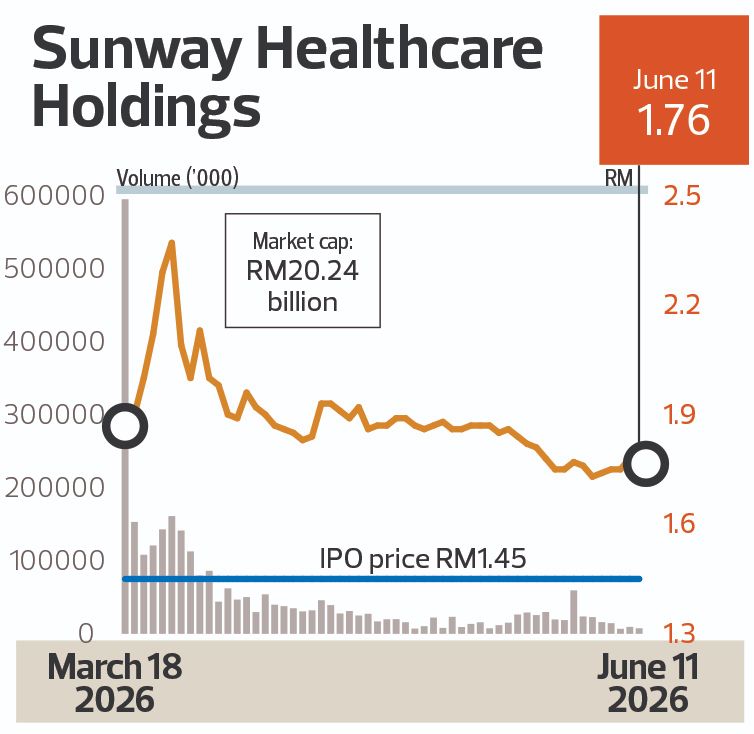
But nearly three months after listing, reality appears to be catching up with expectations. SunMed’s share price has retreated more than 25% from its March peak of RM2.37, reducing the hospital operator’s market capitalisation by almost RM7 billion.
The decline in share price has prompted investors, particularly those who missed the boat earlier, to wonder whether the sell-off is creating a good bargain-hunting opportunity or if SunMed is still expensive despite the pullback.
More buyers, fewer shares
Few investors may disagree with SunMed’s growth credentials. The lack of shares available on the open market also provided a tailwind for the strong price rally following the company’s listing.
Apart from the healthcare group’s entry into the FBM KLCI, the relatively limited free float of 18%, which is below the minimum requirement of 25%, added fuel to the surge in share price, according to a fund manager.
“Why did it [the share price] spike post-IPO despite institutional flow data showing limited buying? Some government-linked funds bought the stock for benchmarking purposes. But it was mainly traders who started the momentum. Once the share price started moving, benchmarked funds effectively had to chase the stock,” he says, noting that the limited supply of shares on the open market amplified the price movements.
“With a low free float, it was easier to push the share price higher. But not all institutions are willing to pay that kind of premium valuation. I think it could be dead money for a while until earnings catch up with valuation,” the fund manager cautions.
Six-month moratorium
It is worth noting that there is a six-month moratorium imposed on Sunway Bhd’s 73.1% equity interest, amounting to 8.4 billion shares. The moratorium expires on Sept 18.
Sunway owns 69.4% through Sunway City Sdn Bhd, while individuals and entities linked to its founder and chairman Tan Sri Dr Jeffrey Cheah hold another 3.7%. There is no indication that Sunway or Cheah intend to reduce their shareholdings.
Speaking shortly after the company’s listing, he argued that the market’s willingness to assign a premium multiple reflects SunMed’s differentiated business model and proven execution capabilities. “Even without the high share price, our people are always on board to deliver what we have promised,” he said.
Cheah pointed out that SunMed could develop hospital capacity at about RM1.5 million per bed. That compares favourably with acquisition opportunities that imply a cost of about RM6 million per bed.
The economics help to explain why the company has largely avoided competing for hospital assets despite the active consolidation environment in the healthcare sector.
Nevertheless, expiry of the moratorium will be closely watched by investors because it will increase the availability of shares on the market. Even if no selling occurs, the removal of restrictions often creates uncertainty and can weigh on sentiment. Furthermore, SunMed’s premium valuation has been supported by the relatively low free float.
Growth story remains compelling
While some analysts concur that SunMed’s growth prospects over the next several years have already been priced in, others say its growth potential can hardly be matched by its peers.
CIMB Securities healthcare analyst Chun Sung Oong agrees that SunMed’s current valuation already reflects much of its earnings upside, but he also acknowledges that the company possesses growth characteristics that are rare among listed healthcare operators.
CIMB forecasts SunMed’s core earnings to grow at a compound annual growth rate (CAGR) of 23.6% between 2025 and 2028. That compares with an average earnings growth rate of about 9% among its Malaysian healthcare peers. The company is also expected to command an Ebitda margin of around 13% by 2027, compared with about 8% for its peers.
Furthermore, SunMed’s capacity expansion plans are among the most ambitious in the sector. The group intends to increase its operating bed count to 2,443 by 2028 from 1,982 in 2025, representing a CAGR of 7.2%, which exceeds that projected for both IHH and KPJ at about 5%.
Unlike many healthcare operators that are already constrained by their mature asset base, SunMed is still in expansion mode. The group’s immediate focus is on brownfield expansion, with plans to add 461 beds across its five operating hospitals — in Sunway City, Kuala Lumpur, Kota Damansara, Ipoh and Penang.
These projects are generally viewed as lower risk because they leverage existing infrastructure, management teams and patient ecosystems.
Beyond 2028, however, management intends to embark on a new phase of growth. The company plans to add about 985 beds through greenfield developments in Putrajaya, Seremban and Iskandar Puteri, Johor. If executed successfully, the expansion will further cement the group’s position as one of the country’s fastest-growing healthcare providers.
Financials prove the strategy works
SunMed’s first-quarter results offer encouraging evidence that its investment in its growth is beginning to bear fruit.
Although earnings accounted for only 15% of consensus full-year forecasts, most analysts viewed the performance as broadly within expectations, citing seasonal factors and timing effects, and noted that the group’s operational metrics remained healthy.
Licensed bed capacity increased 22% year on year (y-o-y), supported by an additional 323 beds. Much of the increase came from Sunway Medical Centre (SMC) Ipoh.
Patient spending also continued to trend higher. Average revenue per inpatient rose 10% y-o-y to RM12,548, while revenue per outpatient and daycare patient increased 5% and 3% respectively.
More importantly, the group’s newer hospitals are beginning to demonstrate operating leverage. SMC Ipoh and SMC Damansara generated a combined Ebitda of RM4 million during the quarter, compared with a negative Ebitda of RM8 million a year earlier. SMC Ipoh achieved Ebitda breakeven in January, achieving an important milestone in its development.
As utilisation rates continue to improve, analysts expect these newer facilities to increasingly become meaningful contributors to group earnings.
Valuation versus execution
Ultimately, the debate surrounding SunMed comes down to valuation versus execution.
The bears say the company is accurately priced even after the recent downtrend. They point out that institutional ownership remains relatively limited, the expiry of the moratorium on Sunway could create an overhang and the hospital operator’s earnings may require several years to fully justify the valuation.
The bulls note that SunMed is among the handful of Bursa-listed companies that offer promising earnings growth coupled with margin expansion and capacity expansion. The recent share price correction represents a healthy reset rather than a broken investment thesis, they say.
The analysts tracking the stock are divided. Of the 12 analysts covering the counter, there are four “buy” recommendations, seven “hold” and one “sell”.
Their target prices range from RM1.25 to RM2.30, with a consensus target price of RM1.92. That suggests a modest upside from current levels but hardly the explosive gains investors enjoyed immediately after the listing.
Save by subscribing to us for your print and/or digital copy.
P/S: The Edge is also available on Apple's App Store and Android's Google Play.