

This article first appeared in The Edge Malaysia Weekly on June 15, 2026 - June 21, 2026
Venture capital firms in the region are paying closer attention to clean technology-linked businesses as climate risks, energy demand and industrial growth accelerate. Falling cost curves for key technologies, policy momentum and corporate demand for decarbonisation are also giving the sector long-term momentum.
ESG speaks to these investors about how they are approaching cleantech investments in Southeast Asia.
Radical Fund bridges gap between idea and commercialisation
The Radical Fund, an early-stage venture capital fund backing climate technology founders in the region, aims to help Southeast Asian founders navigate the commercialisation phase — the period between proving a technology works and scaling it into a repeatable, profitable business.
Many early-stage climate start-ups today are able to attract initial capital around a compelling problem and strong founding team. The more important question is how they bridge the next 18 to 36 months, when companies are at a stage deemed too early for large-scale growth capital but require meaningful support to scale operations and customer adoption, says J J Erpaiboon, head of portfolio at The Radical Fund.
The fund focuses on companies from pre-seed to pre-Series A, where start-ups may have a compelling problem, strong founding team and early proof of concept, but are still too early for large-scale growth capital.
The fund also makes follow-on investments in Series A rounds for existing portfolio companies, rather than exiting early. It invests directly in Southeast Asian companies, rather than US or European businesses with a passing Southeast Asian angle.
Its value proposition to founders goes beyond capital, according to the fund. The Radical Fund is part of a wider platform, Utopia Capital Management, which also runs A-Typical Ventures, a Middle East-focused fund, and The Utopia Studio, an artificial intelligence (AI)-native venture builder launched in December 2025.
Through the platform, portfolio companies can access AI and machine-learning engineering support, product development capabilities, and a proprietary AI infrastructure layer called Utopia OS. They also gain cross-border market access to the Middle East, where demand for energy, water and industrial AI solutions is rising.
Its investment thesis is that commercial returns and climate impact are intertwined.

“What’s worked is backing founders with deep domain expertise who best understand the commercial constraints of their market and customers,” says Erpaiboon.
Its six investment themes are energy transition, clean mobility, circular economy, sustainable built environment, agrifood and health, and carbon and nature-based solutions. These were selected based on where commercial returns and climate outcomes are most aligned in Southeast Asia.
Since its launch in 2023, The Radical Fund has invested in 10 companies across Singapore, Indonesia, Malaysia and Vietnam.
These include Okapi in Malaysia, a residential solar financing and installation platform; Altern in Vietnam, which is developing thermal energy storage for industrial heat; and Dash in Indonesia, a white-label electric vehicle fleet electrification provider.
“We understand climate markets in Southeast Asia operationally, not just financially. We’ve done the work on the regulatory landscape, on the customer archetypes, on the procurement dynamics. When a founder needs to navigate a government tender or a corporate off-take negotiation, we’re useful not just on the cap table, but in go-to-market and execution,” says Erpaiboon.
Gobi sees opportunities in circular economy, batteries and decentralised energy
Venture capital firms such as Gobi Partners, which do not have a dedicated cleantech fund mandate, are increasingly seeing opportunities in the space as climate, resource scarcity and energy security become bigger investment themes.
However, these companies must balance environmental and social impact with the commercial return expectations of venture capital investing, says Carlo Chen-Delantar, partner and head of sustainability at Gobi.
Large-scale renewable energy generation, such as hydro or other infrastructure-heavy projects, may be important for the energy transition but does not always fit the venture capital model because of its heavy capital expenditure. Such projects are often better suited to private equity or infrastructure investors, says Chen-Delantar.
What is more compelling from a venture capital perspective are technologies that can scale without being capital-intensive, says Chen-Delantar. These include circular economy and recycling businesses, marketplace models for refurbished goods, battery-related technologies and decentralised energy storage systems that reduce dependence on the central grid.
For instance, decentralised storage, which is distributed across homes, businesses and microgrids rather than concentrated on the main grid, could create new opportunities by allowing communities and businesses to operate with less reliance on centralised energy systems.
Battery technology and critical minerals are other interesting areas for Chen-Delantar.

“Battery is something that we really need more than ever, because we don’t waste the capture of energy. There’s no day off for that, and it’s becoming more efficient,” he says.
“Critical minerals are now a question of how do we do it ethically? How do we find these minerals and keep them on the value chain rather than lose them over time? More so is this idea of when we recycle, how do we have an increased yield or a rate of recyclability over time?”
The firm’s recent investments include Lymow, which makes electric robotic lawnmowers; Stellerus, an artificial intelligence (AI)-driven satellite meteorology and climate intelligence provider; and Soy-Sky, which develops soybean seed food products that contribute to food security, sustainable agriculture and carbon neutrality.
In 2024, Gobi invested in Yuan Planet, an e-commerce platform for recycled automotive parts; and Lanxiao, a green aerospace technology company developing large hybrid-electric vertical take-off and landing aircraft.
Circulate Capital sets its sights beyond plastics
Circulate Capital, a circular economy investment management firm focused on emerging markets, is broadening its mandate beyond plastics recycling to include materials such as paper, rubber, textiles, e-waste and batteries.
Its new fund Circulate Capital Asia II will deploy growth capital to scale circular supply chains and recycling businesses across the same region, with a focus on plastic solutions and packaging as well as electronics and apparel. Fund II will invest in markets including India, Indonesia, Thailand, Vietnam, the Philippines and Malaysia.
The firm’s first fund, the Circulate Capital Ocean Fund, financed waste management and recycling infrastructure to prevent plastic from leaking into the oceans of South and Southeast Asia.
In Southeast Asia, the opportunity spans textiles — given the region’s large textile waste streams and manufacturing base — paper and rubber, as Indonesia and Malaysia are among the world’s largest natural rubber producers, says Dondi Hananto, investment partner at Circulate Capital, who leads the firm’s investment activities in Southeast Asia.
The firm is also looking at e-waste and batteries as future areas of interest.

“It’s a very nascent industry at the moment but we know that in four or five years, there’ll be a lot of these huge EV (electric vehicle) battery waste that is going to be overwhelming if we don’t do anything about it,” says Dondi.
Circulate Capital’s approach is to go deep into specific supply chains and identify companies that can turn waste into new input.
Most of the companies it backs have already been operating for several years, are generating revenue and, in some cases, already profitable. The purpose of the investment is usually to help these companies scale production by improving how waste is sorted, processed and converted into higher-quality recycled materials that can re-enter industrial supply chains.
“For example, before we invested, a company was not doing food-grade recycling [for plastics]. After we invested, it built its capability for food-grade recycling so that it can now recycle food-grade materials. And that means, for example, the water bottle that you have right now will be recycled and utilised in new water bottles in the future,” says Dondi.
Technology is used to improve sorting, processing efficiency and the quality of recycled materials.
In sorting, much of the work has traditionally been done manually, with workers separating plastics by hand. Dondi says newer machines can now do some of this through a combination of artificial intelligence and mechanical systems.
In textiles, technology can help process materials that were previously difficult to recycle.
“I met with a company in Vietnam that’s specifically working on this. It’s a very interesting solution, a little bit of novel technology that it uses to be able to process these textiles that was not possible in the past,” says Dondi.
In e-waste, proper recycling requires technology to separate materials embedded in circuit boards and other components inside phones, laptops and other electronic devices.
“We’re looking to help develop that infrastructure for emerging Asia. And that’s why I said, that’s a huge opportunity because we can see that all these batteries will come into the waste stream in four or five years,” says Dondi.
However, these technologies must be adapted to local conditions. Waste in Europe is typically cleaner and better segregated, meaning a machine that works there may not work as effectively in Southeast Asia.
Wavemaker Impact creates own climate ventures
Wavemaker Impact, a climate-tech venture builder and venture capital firm in Southeast Asia, works with experienced entrepreneurs to build companies from the ground up. The firm aims to build what it calls a “100 by 100” venture: a company that can potentially abate 100 million tonnes of carbon dioxide equivalent and grow into a US$100 million (RM398 million) revenue business at scale.
“Most of our entrepreneurs have seen an exit, so they know how to build businesses. And they’re serial entrepreneurs, so they’re crazy enough to want to do it again. And this time they want to do it with something that has an impact,” says Wavemaker founding partner Marie Cheong. “Part of our thesis is that we believe that carbon emission reduction and profit is not a trade-off. It’s a multiplier.”

Wavemaker expects to create 28 climate-tech companies in Southeast Asia by July this year, all of which did not previously exist. It is also building its first company in Malaysia, which is expected to be a solar business.
Portfolio companies include Agros, a solar irrigation start-up helping farmers cut diesel use; Helios, a rooftop solar financier for homeowners; Octayne, which turns agricultural waste into a coal replacement; and WasteX, a biochar producer working with biomass waste.
Cheong says many climate solutions already exist and are ready to be deployed, but what is missing are companies that can solve the adoption challenge and build scaleable business models around them.
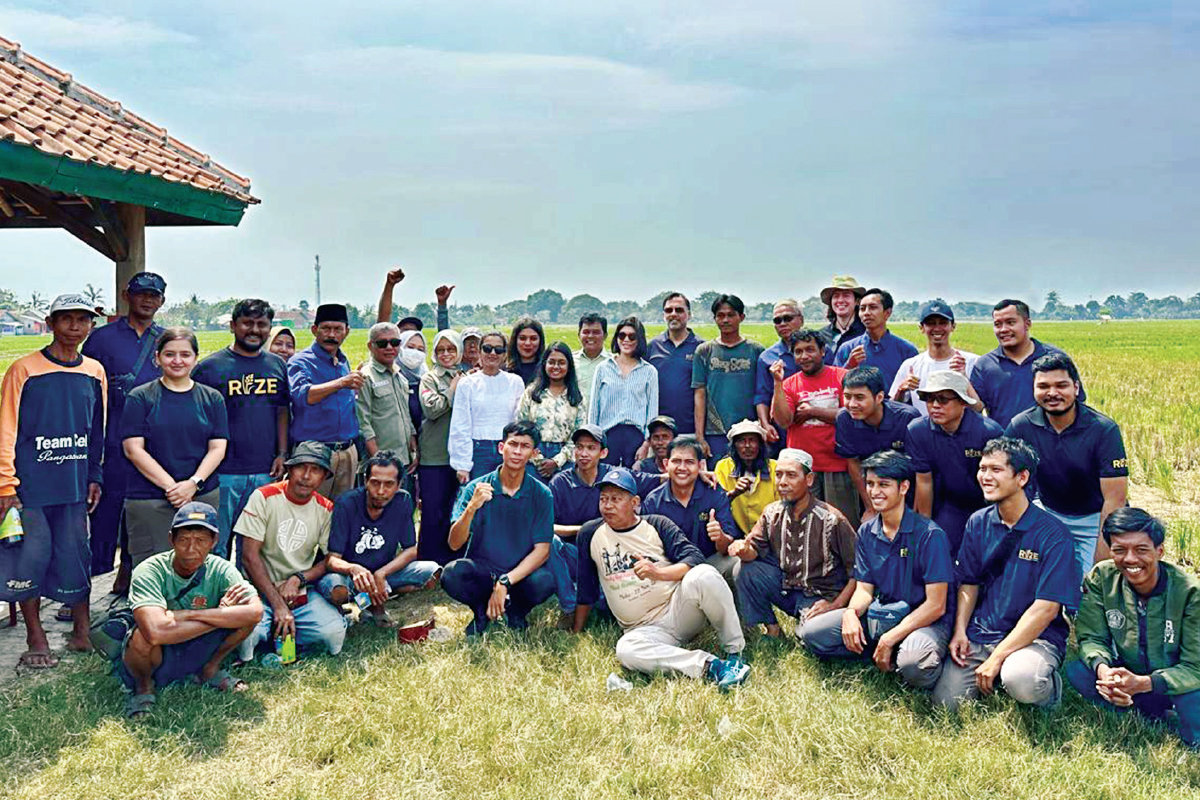
An example from Wavemaker’s portfolio is Rize, which aims to decarbonise Asia’s rice industry by reducing methane emissions and improving farmer livelihoods. Rice cultivation is a major source of agricultural emissions because flooded paddy fields create conditions for methane-producing bacteria.
One green technology that can reduce these emissions is alternate wetting and drying, where paddy fields are drained and irrigated again to interrupt methane production. The problem is not that the technique is new or unproven, but that farmers need the right incentive to adopt it, says Cheong.
Rize addresses this by offering smallholder farmers cheaper and better input financing, in exchange for adopting alternate wetting and drying with support from an agronomist.
She says the biggest challenge for Wavemaker’s portfolio is the financing stack. Companies need working capital to deploy technology, infrastructure or physical assets to reduce emissions, but early-stage debt remains difficult to access.
Biora, an Indian company that turns agricultural waste into a drop-in replacement for coal, is one example. The company needed to deploy capital to build out its manufacturing facility and buy agricultural waste from surrounding farmers.
Wavemaker stepped in to support its next round and provide some of that working capital, which should allow the company to grow revenue before it next raises funds. The firm’s first cheque is typically about US$500,000, with follow-on investment as companies grow.
“The implication here is that if we don’t step in as a fund to help support the working capital needs of these companies at this point in time, then they have to go to market with a limited amount of revenue. They’ll get a lower valuation, and so their equity round will either be small or highly dilutive. Then they run into the same challenge again because they’re using equity for working capital needs. So, that makes the progress of the company much, much slower,” she says.

Save by subscribing to us for your print and/or digital copy.
P/S: The Edge is also available on Apple's App Store and Android's Google Play.