

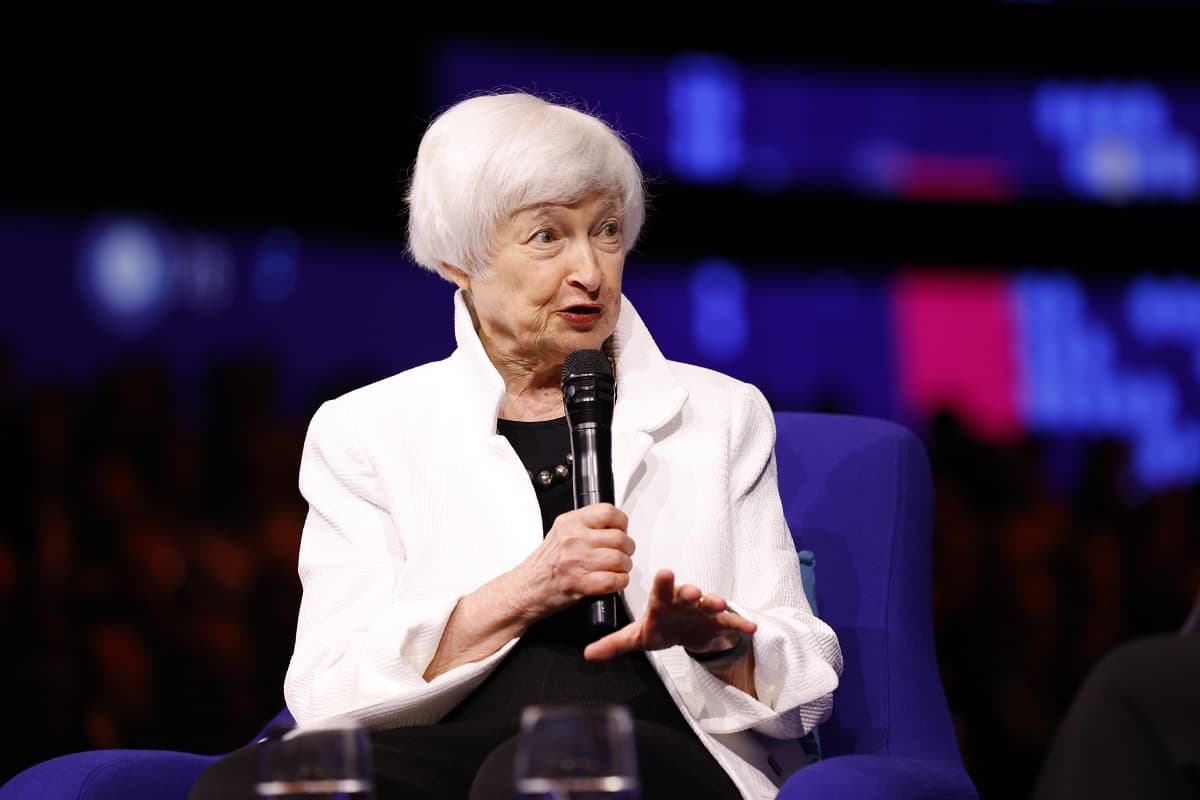
PARIS (June 11): The US government is on an unsustainable fiscal path and faces mounting financial stability risks from rising sovereign debt, former US Treasury secretary Janet Yellen warned on Thursday, adding that markets could abruptly reassess fiscal risk and drive long-term interest rates sharply higher.
Yellen, who served as Treasury secretary from 2021 to 2025 and chaired the US Federal Reserve (Fed) from 2014 to 2018, said years of ultra-low interest rates had encouraged governments, companies and investors to accumulate debt and take on duration risk, leaving balance sheets vulnerable in a higher-rate environment.
“I'm particularly worried about financial stability risks from sovereign debt,” Yellen said at the Amundi World Investment Forum 2026 in Paris.
“The US is running very large deficits, the largest outside of wartime and outside of a recession, around 6% of GDP. We’re on an unsustainable course with respect to fiscal policy, and now interest rates are higher,” she said. "At the same time, we have been issuing, and will continue to issue, a lot of debt. There's no serious discussion of deficit reduction, which cannot be done in a painless way."
Yellen noted that while there was no immediate crisis, investors may be underestimating the risks posed by rising debt levels and borrowing costs.
"We're in an environment where the interest burden now exceeds US defence spending. I could imagine an abrupt rethinking by market participants about what the appropriate level of longer-term interest rates are, and that could affect valuations [and] leveraged investors in many sectors of the economy, that could trigger financial instability.”
US President Donald Trump had repeatedly pressed the Fed to cut interest rates and publicly criticised the central bank's former chair Jerome Powell for keeping monetary policy restrictive despite signs of moderating inflation.
Trump nominated former Fed governor Kevin Warsh to succeed Powell after the latter's term expired in May this year.
Case for rate cuts has ‘really disappeared’
Yellen said the prospect of near-term US interest rate cuts had largely vanished as policymakers grapple with a series of supply-side shocks that threaten to keep inflation elevated.
She cited the inflationary effects of tariffs, higher energy prices following geopolitical tensions in the Middle East, and rising electricity and semiconductor demand linked to rapid investment in artificial intelligence.
“Certainly any case for cutting rates has really disappeared,” Yellen said. “The market is now pricing that in.”
At the same time, Yellen warned against political interference in monetary policy, saying threats to central bank independence in the US were the most serious she had witnessed.
“I have never seen before threats to central bank independence that come close to those that we've seen over the last year or so,” she said.
Without naming Trump directly, Yellen pointed to efforts to pressure the Fed into cutting rates despite persistent inflation concerns.
“The explicit reason he’s (Trump) given for [the rate cut] is because the interest burden on the federal debt is really problematic,” she said. "He thinks the US is a great creditor and we should be rewarded by low interest rates."
While the US is not currently operating under a regime of fiscal dominance — where monetary policy is subordinated to government financing needs — Yellen warned that the risk is real if central banks lose their independence.
“If you look around the world, it's hard to find any prolonged episode of high inflation or hyperinflation that is not driven by fiscal dominance [and a] lack of central bank independence,” she said.
Yellen stressed that monetary authorities must retain the freedom to pursue their inflation and employment mandates without political pressure.
“Central banks were made independent in order to be able to focus on price stability and to resist pressures from elected political leaders to charge interest rates that help manage fiscal debt,” she said.