

This article first appeared in The Edge Malaysia Weekly on June 15, 2026 - June 21, 2026
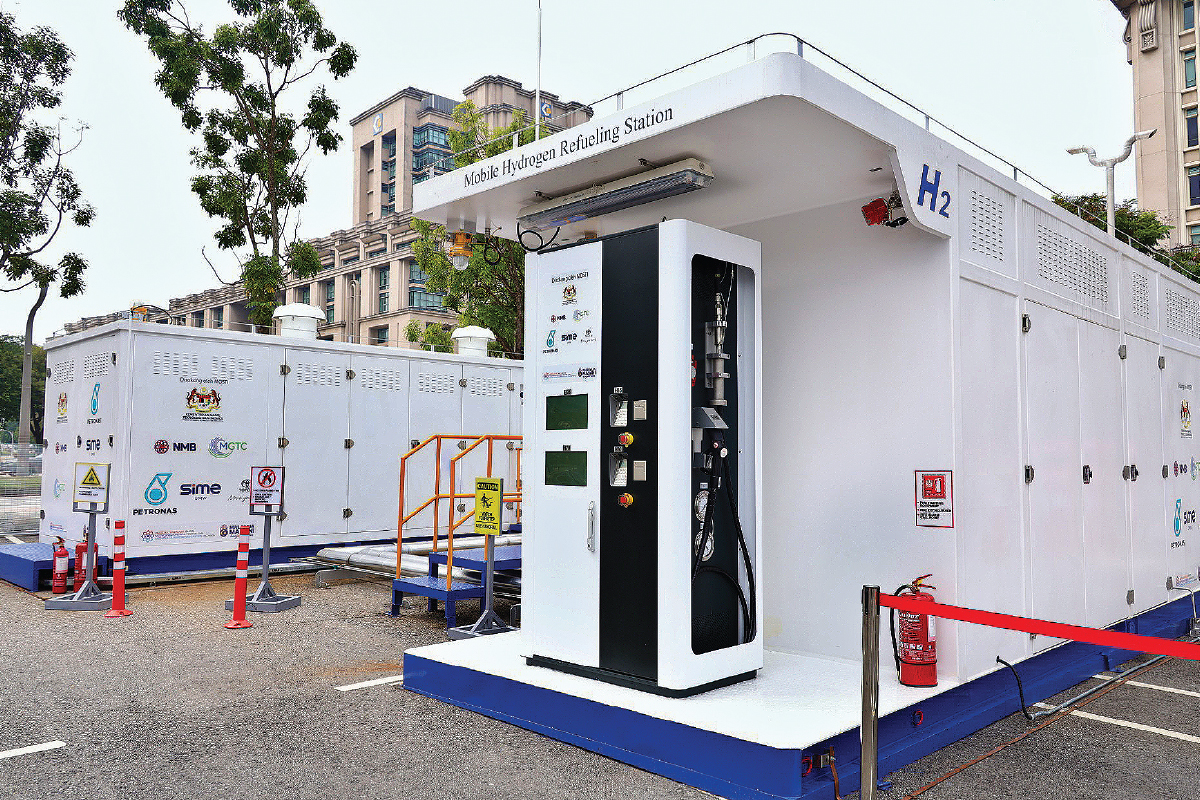
Peninsular Malaysia’s only operating hydrogen refuelling station in Precinct 2 of Putrajaya has quietly entered its second year, serving a small but symbolic ecosystem of early adopters.
Several Toyota Mirai hydrogen fuel cell vehicles loaned by UMW Toyota are used to shuttle between government agencies — one of which is reportedly used by Prime Minister Datuk Seri Anwar Ibrahim — while two converted buses operated by Prasarana and Sarawak Metro assembler SKS, as well as a converted truck run by logistics company Biforce, make up most of the peninsula’s visible hydrogen mobility footprint.
Overall, the hydrogen ecosystem in Peninsular Malaysia is still fragmented, tentative and struggling to reach a commercial scale. Ambitions in the peninsula remain modest, unlike in Sarawak, where state subsidiaries such as Petroleum Sarawak Bhd (Petros), Sarawak Energy Bhd and SEDC Energy Sdn Bhd (which comes under the Sarawak Economic Development Corporation) are building hydrogen refuelling stations, export corridors to Japan and South Korea, and gigawatt-scale projects backed by the state’s abundant hydropower resources.
Hydrexia Southeast Asia CEO George Gan describes the peninsula’s hydrogen economy as being in “a very early stage”, with major gaps still present across the value chain. “If we break down the supply chain into three parts — generation, transport and storage, and the infrastructure for using the gas — almost everything in Peninsular Malaysia is still missing, except for the one station the government built in Putrajaya,” he says.
NanoMalaysia Bhd CEO Rezal Khairi Ahmad argues that the slow pace reflects the industry’s current stage of development rather than a lack of direction.

He says under the National Hydrogen Economy and Technology Roadmap launched in 2023, the first five years are intended to validate commercial use cases by bringing in “catalytic users” such as Prasarana, Biforce and, eventually, DHL through government co-financing arrangements designed to reduce early-adoption risks. The result is a sector that is still being pushed into existence rather than pulled forward by organic market demand, he notes.
NanoMalaysia, originally established as a nanotechnology commercialisation agency under the Ministry of Science, Technology and Innovation (Mosti), has since evolved into the government’s de facto hydrogen technology coordinator. Last year, it convened the Hydrogen Industry Alliance Malaysia to organise the fragmented private-sector landscape.
Yet one of the peninsula’s central paradoxes is that hydrogen production already exists at industrial scale, just not for energy use.
According to Rezal, companies such as Air Products, Linde and Petroliam Nasional Bhd (PETRONAS) already produce substantial volumes of hydrogen for fertiliser, petrochemical and electronics manufacturing, while PETRONAS’ ammonia facilities in Gurun and Kerteh rely heavily on hydrogen generated via steam methane reforming, a carbon-intensive grey hydrogen process.
Gan agrees that the existing industry remains overwhelmingly tied to industrial feedstock rather than focused on energy transition goals.
“All the hydrogen facilities available currently are mainly for the chemical, petrochemical and electronics industries. There is no hydrogen production plant specifically meant for hydrogen energy applications,” he says.
Rezal says even though Malaysia currently produces about 0.6 million tonnes of hydrogen annually, that is still far below the 16 million tonnes targeted under the roadmap by 2030.
More importantly, while production capacity may still be small by global standards, domestic demand for hydrogen as an energy carrier is even smaller, leaving the sector trapped in what industry players repeatedly describe as a chicken-and-egg problem.
Without guaranteed buyers, producers struggle to secure the financing needed to scale operations. Yet without larger-scale production, hydrogen remains too expensive for potential users to adopt commercially, giving existing grey hydrogen producers little reason to transition to greener alternatives.

Navigating the high cost of producing green hydrogen
Beneath that commercial deadlock lies another structural constraint — electricity supply.
Gan argues that Peninsular Malaysia simply does not yet have enough renewable energy (RE) capacity to support large-scale green hydrogen production, which depends heavily on access to low-cost renewable electricity. Green hydrogen is produced via electrolysis of water, using RE.
He also points to what he sees as a structural bottleneck in the peninsula’s RE ecosystem, where developers still depend heavily on approvals tied to Tenaga Nasional Bhd’s grid system.
Rezal says the economics becomes even more difficult once wheeling charges are factored in. Producers using off-site RE must still pay to move electricity through Tenaga’s grid to their electrolysers, adding another layer of cost pressure on an already expensive production process.
Electricity already accounts for between 60% and 70% of hydrogen’s levelised production cost, with electrolysers contributing another 20%, he says. Once transport and storage losses are added on top, the economics of centralised production becomes increasingly difficult to justify.
Rezal’s proposed solution is the development of hydrogen hubs or integrated industrial zones where hydrogen is produced, stored and consumed in the same area to minimise transmission and logistics costs. The Klang Valley, northern corridor and southern corridor have all emerged as potential candidates for such clusters, he says.
G Hydrogen Sdn Bhd, the green hydrogen arm of investment holding group Cavalier Capital, is attempting to engineer around those grid constraints from the supply side.
The company is developing a polymer electrolyte membrane electrolyser prototype with Universiti Kebangsaan Malaysia’s Fuel Cell Institute, backed initially by a research grant of RM500,000 and a broader project cost estimated at about RM3 million. Its strategy centres on attaching electrolysers directly to solar plants whose excess generation capacity cannot be absorbed by the national grid.
According to G Hydrogen business development manager Benjamin Koay, solar developers are willing to supply surplus electricity at between US$0.15 and US$0.50 per kWh, a pricing dynamic driven partly by the relatively low rates paid by Tenaga for electricity exported back to the grid. Even so, he says true green hydrogen price parity would likely require electricity input costs to fall to around two US cents per kWh.
Offering a safer way to transport hydrogen
Hydrexia, headquartered in Shanghai, China, with a Malaysian office in Putrajaya, occupies another segment of the hydrogen value chain. Besides operating the refuelling station in Putrajaya, it supplies purification systems capable of upgrading industrial-grade hydrogen to the 99.97% purity required for fuel cell mobility applications.
The company’s larger commercial bet, however, lies in solid-state hydrogen storage and transport technology developed together with SEDC Energy in Sarawak. It says by using metal hydride systems, a standard 20ft intermodal freight container can transport up to one tonne of hydrogen at just five bar of pressure, which is significantly lower than the roughly 200-bar compressed cylinders commonly used in the industry.
Metal hydrides comprise hydrogen atoms that are chemically bonded to a metal alloy lattice. Traditional methods of storing hydrogen involve high pressure tanks or extremely cold liquid systems, both of which require large amounts of energy, with the risk of explosion from compressed gases.
That proof of concept is already being tested across the region. The first shipment route moved hydrogen from Shanghai to Kuching, while the next phase — scheduled for early June — will travel from Kuching to Putrajaya before continuing to Singapore, Hong Kong and Vietnam.
Hydrexia is in preliminary discussions with Keretapi Tanah Melayu Bhd on the possibility of establishing a rail corridor linking Perlis to Singapore, with the capacity to move at least 30 hydrogen containers or roughly 30 tonnes per shipment.
“Storage and transport of hydrogen has always been a challenge. This is something we need to solve,” says Gan, noting that the issue is specifically highlighted in the National Energy Transition Roadmap.
Encouraging industries to switch to green hydrogen
Still, solving logistics problems alone will not be enough without the corresponding market demand.
Rezal believes that some of the sector’s biggest future demand drivers may already exist quietly in Malaysia’s industrial base, describing heavy manufacturing as hydrogen’s “unsung hero”. Industries such as steelmaking, semiconductor fabrication and electronics manufacturing already consume hydrogen in significant quantities for processes ranging from steel treatment and wafer production to hydrogenated oils.
The moment even a portion of that existing grey hydrogen demand transitions to green hydrogen, the peninsula’s longstanding offtake problem could begin to ease, he says.
Koay says G Hydrogen has identified that opportunity in Penang’s semiconductor cluster. “We know the semiconductor industry is a very big user of hydrogen, but it is using grey hydrogen,” he points out.
“We are trying to introduce the concept of a centralised green hydrogen production facility in Penang to serve semiconductor customers. That’s our goal for next year.”
Two newer sources of hydrogen demand are beginning to emerge beyond heavy industry.
The first is power generation. Existing gas turbines at several power plants in the peninsula — including Tenaga’s Paka station — are already capable of operating on a blended hydrogen fuel mix, co-firing with up to 30% hydrogen.
The second emerging demand source is data centres, particularly as the hyperscale operators expanding across Johor and Selangor run up against growing grid constraints. Hydrogen fuel cells could provide off-grid electricity generation while addressing future emissions requirements increasingly demanded by international customers.
Hydrexia is currently exploring hydrogen-powered backup systems for telecommunications towers with local partners, positioning these as an alternative to the diesel generators currently used during outages.
With commercial demand slowly taking shape, the industry is rethinking how it classifies hydrogen, says Rezal. The colour-coded taxonomy that has dominated hydrogen policy discussions in recent years — green, grey, blue, pink, turquoise and brown — is gradually giving way to a system focused more on carbon intensity.
Certification agencies such as TÜV and Bureau Veritas already assess hydrogen based primarily on life cycle carbon emissions rather than production categories, claims Gan, who says standards today are still largely determined by customer requirements rather than any single international regulatory framework.
Across the peninsula, industry players are now organising their next phase of projects around the gaps they believe they can realistically address.
NanoMalaysia plans to roll out industrial validation projects in Perak and Johor this year, alongside the launch of a locally developed battery manufacturing facility in Subang in July that the agency hopes can help cross-subsidise the slower pace of hydrogen development.
G Hydrogen is focusing its near-term ambitions on Penang’s semiconductor ecosystem, while Hydrexia is awaiting approvals from Mosti and the Ministry of Transport to bring its solid-state hydrogen transport demonstration to the peninsula by year end.
Save by subscribing to us for your print and/or digital copy.
P/S: The Edge is also available on Apple's App Store and Android's Google Play.