

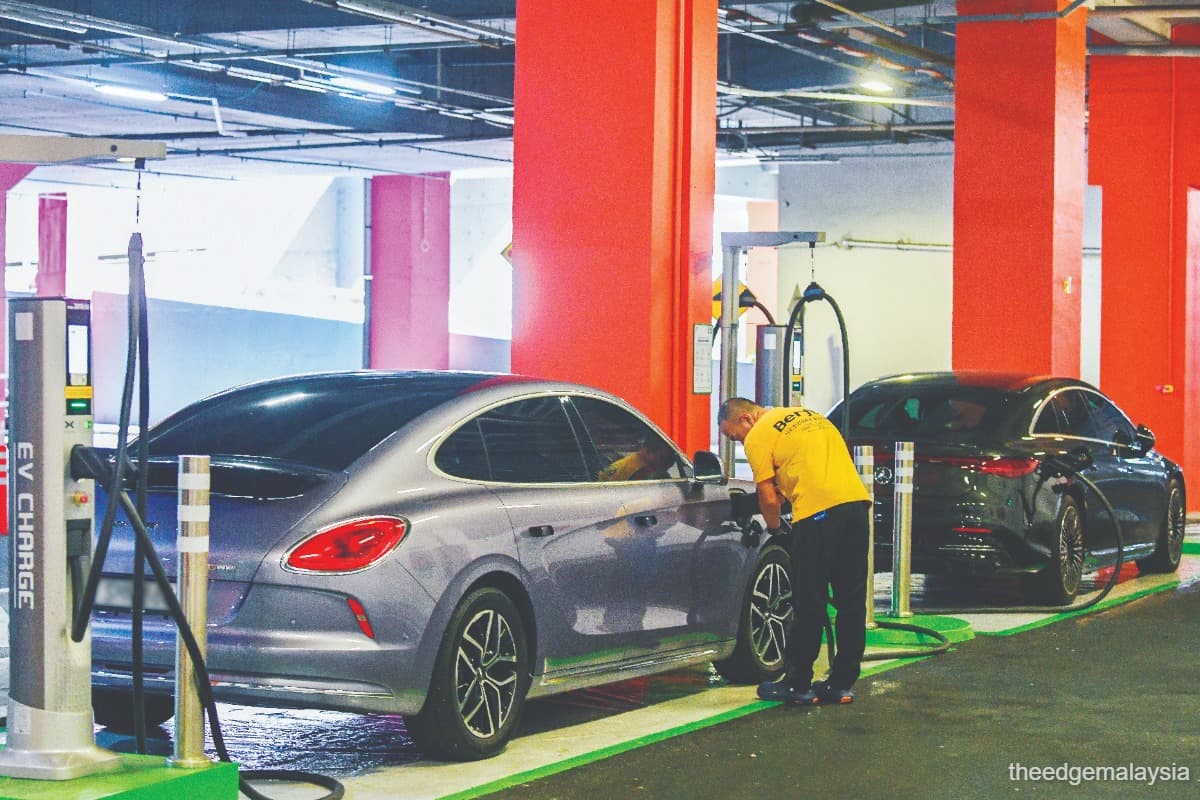
This article first appeared in The Edge Malaysia Weekly on June 8, 2026 - June 14, 2026
MALAYSIA’S ambition to become a regional electric vehicle (EV) hub is facing a crucial test as the government recalibrates the balance between attracting foreign investment and safeguarding domestic automotive players.
Fresh guidelines have sparked debate across the industry, with supporters arguing that stronger localisation requirements are necessary to develop Malaysia’s automotive ecosystem, while critics warn that tighter rules risk undermining investor confidence and slowing the country’s EV transition.
The policy shift comes at a time when several major Chinese automakers, including BYD and Chery, are expanding their presence in Malaysia amid intensifying competition among Southeast Asian nations to attract EV-related investments.
Among the new requirements is a minimum selling price of RM200,000 for imported completely built-up (CBU) EVs, whose motor output must be at least 180kW.
New completely knocked down (CKD) entrants are also required to export up to 80% of locally assembled vehicles, with only 20% allocated for the domestic market. The regulations will take effect from July.
While the government maintains that affordable EVs can still be offered through local assembly programmes, industry observers argue that the latest measures could complicate investment decisions and affect the economics of setting up manufacturing operations in Malaysia.
Chinese automotive giant BYD is expected to set up a CKD plant in Tanjung Malim, Perak, a project widely viewed as a significant foreign investment for Malaysia. The policy shift has introduced fresh uncertainty, however, over the development of the domestic EV industry. Market observers suggest that the tighter investment requirements may have prompted BYD to reassess its Malaysian manufacturing plans.
Even neighbouring Thailand — the region’s automotive manufacturing hub — is facing a similar dilemma, with 10 automotive associations calling on the government to introduce urgent measures to protect the country’s vehicle production base.
Thailand’s The Nation reported that a key concern is that some carmakers are increasingly opting to import CBU EVs from China under a zero-tariff regime rather than manufacture vehicles in Thailand. As a result, industry groups are calling for an excise tax of at least 32% on fully imported EVs.
In Malaysia, fully imported CBU EVs have been subject, since the start of this year, to a 30% import duty, 10% exercise duty and 10% sales tax, marking the end of the duty-free period previously introduced in 2022 to promote EV adoption.
Deputy Investment, Trade and Industry Minister Sim Tze Tzin has downplayed the impact of the RM200,000 minimum price requirement for imported EVs, saying carmakers could still offer EVs priced between RM100,000 and RM200,000 through local assembly operations in Malaysia. They could also work with contract manufacturers if they wished to market EVs within that range. The Ministry of Investment, Trade and Industry (MITI) did not respond to queries from The Edge.
When contacted, BYD Malaysia declined to comment on the policy changes and the implications for its proposed CKD operations, citing the absence of definitive information from MITI.
“BYD Malaysia has recently announced its commitment during the launch of BYD Mansion Macalister, and that is currently the only update we are able to provide,” it says in response to queries from The Edge.
Its plan to set up the Tanjung Malim plant was announced last August, with production set to begin this year. BYD is the anchor investor for Phase 1 of Kuala Lumpur Kepong Bhd’s (KL:KLK) integrated industrial hub, KLK TechPark, which spans 1,500 acres.
On the other hand, Chery says its Malaysian expansion plans remain firmly on track. Chery Automobile Co Ltd, through Chery Malaysia, has committed to investing RM2.2 billion to develop a 200-acre assembly plant at the Beringin High-Tech Auto Valley in Hulu Selangor.
Slated for completion this year, the plant will have an initial annual production capacity of 100,000 units, which can be expanded to 300,000 units in subsequent phases.
In response to queries from The Edge, Chery Corporate Malaysia executive vice-president Men Lin Bo assures that the construction of its Chery Smart Auto Industrial Park is progressing well.
Noting that the company has adopted a deliberate, long-term approach to building its presence here, Men says this commitment has been evident since its partnership with Inokom began in 2023.
“We have continued to strengthen this commitment through further investments, including our facility in Shah Alam and the upcoming plant at Beringin High-Tech Auto Valley. Our plant in Lembah Beringin will create employment opportunities for the local community while supporting knowledge transfer through collaboration with Malaysian talent — particularly fresh graduates in the automotive field,” he explains.
“By working closely with Chery’s automotive and robotics experts in China, we aim to nurture and develop a new generation of skilled Malaysian professionals, contributing to the growth of local capabilities and strengthening the industry as a whole. Ultimately, our goal is not only to grow our brand presence but to become a long-term partner in Malaysia’s automotive development journey.”
Chery’s portfolio includes four brands — Chery, OMODA/JAECOO, iCAUR and the upcoming Lepas.
At its Shah Alam plant, launched in mid-2024, OMODA/JAECOO and iCAUR models are assembled for both the domestic and export markets. Men says Chery began exporting vehicles to Vietnam in 2025 before expanding into Brunei early this year.
Safe zone for national carmakers
Andrew Woon, senior lecturer at Monash University Malaysia’s School of Business, says the government is effectively carving out a “safe zone” for national carmakers by clearing the sub-RM200,000 segment — a move that provides breathing room for Proton’s e.MAS series and Perodua’s QV-E.
“In practice, this price floor effectively sidelines middle-market champions like the BYD Atto 3, MG4 and GWM Ora Good Cat, which are essential for mass adoption. Unless these models pivot to local assembly, they face a forced price hike that will push retail tags beyond the RM250,000 mark,” he tells The Edge.
On MITI’s assertion that affordable EVs can still be offered through local assembly, Woon argues that the claim overlooks a critical temporal and structural mismatch.
“Setting up CKD facilities takes years, and this creates a supply vacuum for affordable EVs when the regulations take effect,” he explains.
He adds that expecting global automakers to commit heavy capital to localised manufacturing is commercially challenging, given that the current CKD tax exemption expires in December 2027.
To promote healthy growth in the automotive industry, Woon advocates a model of “conditional protectionism” backed by a clear exit strategy, or “sunset clause”, for these new EV measures.
“The government can continue supporting Proton and Perodua in the sub-RM100,000 mass-market segment, but the RM100,000 to RM200,000 middle-market should remain open to genuine foreign competition. Eroding this middle segment through restrictive CBU policies will weaken the competitive pressure that drives local firms to innovate and improve,” he says.
Woon stresses that protection for local players must be time-bound and performance-driven, with measurable milestones such as meaningful local research and development (R&D) investment and advances in software engineering capabilities, rather than superficial localisation efforts such as basic assembly work.
“With the right support and pressure, local players can catch up quickly. It appears that they are already capable of manufacturing EVs. Proton, for instance, has progressed rapidly, as demonstrated by the deployment of its e.MAS platform.”
He notes, however, that much of the core R&D, battery technology and software stack still originate from China.
“While local manufacturers are ready to produce, they are not yet equipped to lead an independent technological leap. Overprotecting them at this stage risks entrenching reliance on foreign legacy technology, rather than pushing them towards genuine domestic innovation.”
To accelerate Malaysia’s EV ambitions, Woon suggests the pivot from defensive market protection to offensive ecosystem building.
He also calls for the extension of CKD tax incentives beyond 2027 to provide long-term policy predictability for investors, while shifting the focus from strict vehicle export quotas to incentivising localised, high-value component manufacturing, such as batteries and power electronics.
Eighty per cent export rule not commercially viable
An automotive analyst who declined to be named describes the 80% export requirement as a deterrent to foreign EV players, after Malaysia initially adopted a relatively open approach towards attracting them.
“Things are messy. Midway through, the government realised it may have opened up too much and is now trying to tighten its grip on the influx of foreign investment. But I think the move comes a little too late, and it is negative for the EV industry because BYD is the strongest EV player,” he says.
“These are extremely difficult targets to achieve. Companies are coming here partly because of overcapacity issues in China. Both Thailand and Indonesia are competing aggressively to attract investment; so, Malaysia needs a stronger automotive strategy. Bear in mind that Malaysia is generally viewed as a secondary market that benefits from China’s overcapacity rather than as a primary investment destination.”
He warns that the latest measures could further slow the country’s EV development, which is already constrained by inadequate supporting infrastructure, particularly charging facilities.
The analyst also cautions that the policy shift may send the wrong signal to foreign investors about the consistency and predictability of Malaysia’s automotive regulations.
Woon similarly describes the 80% export requirement as a potential “poison pill” for companies such as BYD that have already invested heavily in Thailand and Indonesia.
“In a region where neighbours are aggressively courting EV giants with consistent, investment-friendly frameworks, Malaysia’s rigid and shifting requirements risk driving capital and technology across the border,” he says.
Protection versus competitiveness
Proton deputy CEO Datuk Abdul Rashid Musa says that as the automotive industry enters into its next phase of development, it is natural for policy to place greater emphasis on local assembly, supply chain development and technology transfer.
“This gradual progression helps ensure the industry remains relevant and competitive over the long term, while creating broader economic benefits through investment, high-skilled jobs and stronger local capabilities.”
He notes that Malaysia has a well-established automotive vendor ecosystem, with many suppliers already supporting increasingly sophisticated components and systems.
Abdul Rashid acknowledges, however, that the local EV ecosystem remains at a relatively early stage of development, particularly in critical components and emerging technologies that are not yet widely available in Malaysia.
“The transition from internal combustion engine vehicles to EVs requires significant investments in new equipment, technical capabilities, certifications, talent development and sufficient production volumes to support industrialisation,” he says.
“Critical components involving higher levels of complexity and advanced technology, such as battery systems, power electronics and software integration, are naturally more challenging to localise. This underscores the importance of technology transfer and strategic partnerships to help local companies develop new capabilities over time.”
He adds that bringing more high-value manufacturing processes into Malaysia through effective localisation will not only strengthen the domestic supply chain, but also create more high-skilled jobs and opportunities for TVET graduates, engineers and university graduates.
To support the country’s long-term ambitions of becoming a regional EV and mobility hub, Abdul Rashid calls for policy consistency and long-term visibility for investors; incentives that encourage local assembly, sourcing and capability development; support for vendor upgrading and technology adoption; talent development in areas such as software, electronics, battery technologies and advanced manufacturing; consumer support to improve EV affordability; as well as greater inter-agency coordination to ensure a more efficient and seamless rollout of charging infrastructure.
Ultimately, the debate is not about whether Malaysia should protect its domestic automotive industry or attract foreign investment, but how best to balance the two. While stronger localisation requirements may help nurture local capabilities, industry players caution that policy predictability remains critical if Malaysia hopes to compete with regional rivals such as Thailand and Indonesia in the next EV wave.
EV adoption may lose momentum because of new guidelines
The country’s electric vehicle (EV) adoption rate could slow significantly under recently tightened investment regulations for new foreign EV entrants, even though overall sales are still expected to grow, owing to the low-base effect.
“Consumers who are comfortable owning a second vehicle may still opt for an EV. In addition, there are attractive sales incentives in the market, so we will continue to see growth in EV sales.
“The issue is that adoption may not be as strong or as rapid as policymakers hope,” says an automotive analyst, who notes that higher maintenance costs and lower resale values remain key barriers to EV ownership.
TA Securities observes that consumer demand in the mass-market EV segment remains highly price sensitive amid elevated living costs and cautious discretionary spending.
“As such, limiting the availability of lower priced, imported EVs may narrow consumer choices and slow adoption momentum in the near term, especially as Malaysia’s EV penetration remains relatively low compared with more developed regional markets,” it says in a May 7 note.


Although Proton’s EV rollout has gained encouraging early traction, TA Securities believes broader adoption dynamics in the affordable EV segment remain uncertain.
“This is particularly relevant for entry-level EV offerings targeting Perodua’s mass-market customer base, where affordability and value-for-money considerations continue to play a critical role in purchasing decisions,” it adds.
Malaysia’s EV penetration rate stood at just 3% in 2025, significantly below Singapore’s 45% and Thailand’s 18%. Under the National Energy Transition Roadmap (NETR), EVs are expected to account for an ambitious 20% of new-vehicle sales by 2030, before rising to 80% by 2050.
In the first quarter of 2026, EV sales totalled 13,359 units, after recording 30,848 units in 2025, more than double the 14,766 units in 2024.
Proton’s e.MAS, currently Malaysia’s best-selling EV model, recorded almost 10,000 units in the first four months of the year.
Meanwhile, the overall automotive market continued to reach new highs in 2025, with total industry volume (TIV) rising to 820,752 units, against 816,747 units in 2024. Still, the Malaysian Automotive Association expects the TIV to be lower at 790,000 units in 2026, amid moderating economic growth, rising cost pressures as well as policy changes that could weigh on vehicle affordability.
For the first four months of 2026, TIV rose 2% year on year to 254,318 units, from 250,239 units.
Chinese automotive brands have gained significant traction in Malaysia in recent years. Late last year, TQ Wuling — a partnership between Tan Chong Motor Holdings Bhd (KL:TCHONG) and China’s Wuling — launched the TQ WULING Bingo EV in Malaysia, further intensifying competition in the affordable EV segment.
A less exciting year expected for auto stocks
The year 2026 is shaping up to be a less exciting one for the automotive sector, with vehicle sales expected to soften after four consecutive years of growth.
That said, automotive parts players are still expected to benefit from the ecosystems of Perodua and Proton, which together accounted for nearly 70% of Malaysia’s vehicle sales in April this year.
Most research houses have a “neutral” stance on the sector, citing cautious consumer spending and intensifying competition from Chinese brands, which are eroding market share for non-national marques.
TA Research even maintained the “underweight” call on the sector, expecting the sales momentum to gradually weaken in the coming months as recent growth was partly driven by festive-related deliveries and new model launches.

“In addition, fading order backlogs, cautious consumer spending amid rising living costs and intensifying competition within the auto segment may continue to weigh on overall industry demand,” it says in a May 21 note.
CGS International’s top pick for the auto sector is Sime Darby Bhd (KL:SIME), which is seen as a beneficiary of the potential shift in demand towards electric vehicles (EVs) and the mass market affordable segment in Malaysia’s auto market given its 38% stake in Perodua via UMW Holdings.
“Furthermore, we expect Sime Darby’s industrial division to benefit from increasing mining activity, supported by improving global industrial activity and potential reconstruction-related demand arising from geopolitical conflicts in the Middle East,” it says in a May 20 note, noting that Sime Darby is trading at an undemanding forward price-earnings ratio (PER) of about nine times while offering an attractive dividend yield of 6.7% based on forecast earnings and dividends for 2027.
Kenanga Research favours Bermaz Auto Bhd (KL:BAUTO) for the continued demand for its Japanese domestic market models, and Hong Leong Industries Bhd (KL:HLIND) for its exposure to the higher-margin premium motorcycle segment. The research house notes that both companies are less susceptible to price hikes arising from the open market value (OMV) mechanism and offer attractive dividend yields of 6%.
Meanwhile, Hong Leong Investment Bank Research says the impact of lower sales and rising operating costs in the automotive sector will be largely cushioned by a stronger ringgit against the US dollar and yen.
Its top picks in the sector are MBM Resources Bhd (KL:MBMR) and Sime Darby.
“MBMR benefits from its strong exposure to Perodua, while Sime Darby is supported by sustained strength in its Industrial segment (particularly in Australia), recovering China Motor division and stronger contribution from UMW across all sub-segments. Both MBMR and Sime Darby also offer attractive dividend yields of 5%-6%,” it notes.
One automotive analyst points out that car upholstery manufacturer Pecca Group Bhd (KL:PECCA) is expected to continue to benefit from Perodua’s ecosystem. However, its relatively rich valuations may cap its upside. Trading at a PER of 19.6 times, the stock commands a premium compared with peers such as Feytech Holdings Bhd’s (KL:FEYTECH) 13.1 times and MCE Holdings Bhd’s (KL:MCEHLDG) 11.4 times.
Auto parts players deepen localisation strategy
Connie Go, CEO of automotive seat maker Feytech, is of the view that stricter localisation requirements can benefit local vendors, not as a protectionist measure but as a way to ensure that more of the value created by automotive growth stays in Malaysia.
“The real economic benefit comes when local suppliers participate meaningfully in the value chain, rather than imported supplier networks dominating the market,” she says.
While modern EV interiors are more complex than conventional ones, largely because of the deeper integration of electronics and systems, Malaysia is well positioned for this, given the country’s robust electrical and electronics (E&E) industry that is already operating at global standards, according to Go.
“The capability exists in this country. The opportunity is to connect that industrial strength to the automotive supply chain more deliberately and that is exactly the kind of localisation that creates lasting value,” she notes.
Feytech has formed a joint venture with Wuhu Ruitai Auto Parts Co Ltd to design and co-create seats and covers for some of the vehicles under Chery.
To date, Feytech remains the only total solutions provider for both seat covers and complete seating systems. The influx of new original equipment manufacturers (OEMs) is expected to offer more opportunities for the group to pursue vertical integration into other automotive components, hence further strengthening its position as a Tier-1 automotive parts supplier, says Go.
She adds that deeper localisation creates the conditions for the kind of technical and higher income jobs that Malaysia’s TVET agenda is working to build.
“If procurement stays offshore, those roles would not follow. Malaysia would end up with downstream employment rather than the higher-value and knowledge-based economy the government is investing in developing,” she continues.
Dr Goh Kar Chun, group managing director of MCE, believes localisation in electronics and integrated systems in modern vehicles is highly feasible for Malaysia, which already possesses strong automotive, E&E and semiconductor capabilities.
For example, he says MCE has been designing, engineering and manufacturing automotive electronic and mechatronic systems for carmakers, progressively moving up the value chain into areas such as infotainment systems, technologies related to Advanced Driver Assistance Systems (ADAS), electronic control systems and EV charging solutions.
Apart from supplying to national carmakers, its products are also exported within Asean as well as to Taiwan, Brazil and the US.
MCE has established a joint-venture company in India, serving as a technical provider for the Indian domestic market. This, he says, demonstrates that Malaysian automotive vendors can compete internationally in terms of quality, engineering and cost competitiveness.
As more foreign carmakers, including EV players, expand their presence in Malaysia, he hopes to see the deepening of local supply chain participation that will enable local companies to showcase their capabilities in meeting the required standards for quality, technology, cost and delivery.
“We understand that localisation decisions are ultimately driven by commercial and operational considerations, and OEMs will source locally when suppliers are able to offer the right balance of capability, quality, cost competitiveness and operational readiness,” he says.
To capture the benefits of localisation, Pecca executive director Hugo Teoh Zi Yi says the group has continually invested in automation and upgrading to prepare for this shift.
“Our solutions have grown beyond leather upholstery into full seat assembly and complex integrated interiors. Today, we apply the same high standards to our automotive work as we do for the aviation and locomotive sectors.
“Our ongoing exports to markets like the US and Indonesia demonstrate that our quality is already recognised at a global level. Just as we continually support the growing needs of local automakers, we are ready to provide the same world-class expertise to foreign brands seeking a reliable local production partner,” he explains.
With the upcoming RM200,000 minimum price and 180kW threshold for imported EVs, Teoh says foreign brands now realise that local assembly is the only way to compete in the mass market here.
He also shares that Pecca has seen increased enquiries from foreign brands looking for a partner who can help them hit localisation targets without execution risk.
“To tap into this core segment, they need a partner who is rigorously vetted. While we cannot comment on our peers, our focus remains on our execution. Our future project pipeline reflects healthy interest from both our national partners and other potential new EV entrants who want premium, locally integrated interiors,” he notes.
Teoh believes the country’s auto policy will pave the way for Malaysia to become a regional automotive powerhouse for the electric age in the next three years.
Save by subscribing to us for your print and/or digital copy.
P/S: The Edge is also available on Apple's App Store and Android's Google Play.