


This article first appeared in The Edge Malaysia Weekly on June 8, 2026 - June 14, 2026
THE walls are closing in on Mohammed Saiful Alam, often referred to as S Alam, the Bangladesh-born Singaporean businessman who built a sprawling, multi-billion-dollar empire stretching from Chittagong to the Mediterranean — much of it, authorities allege, on a foundation of laundered money.
In the span of just two weeks in May, a court froze a luxury residential property in Cyprus he owned together with his wife, a Bangladeshi court sentenced him in absentia to five months’ imprisonment, and investigators in Singapore continued probing a business empire that reportedly exceeds US$1 billion (RM4 billion) in assets in the city state alone. Now, attention is also turning to two prominent Kuala Lumpur hotels linked to the S Alam Group, of which Alam is the founder and chairman.
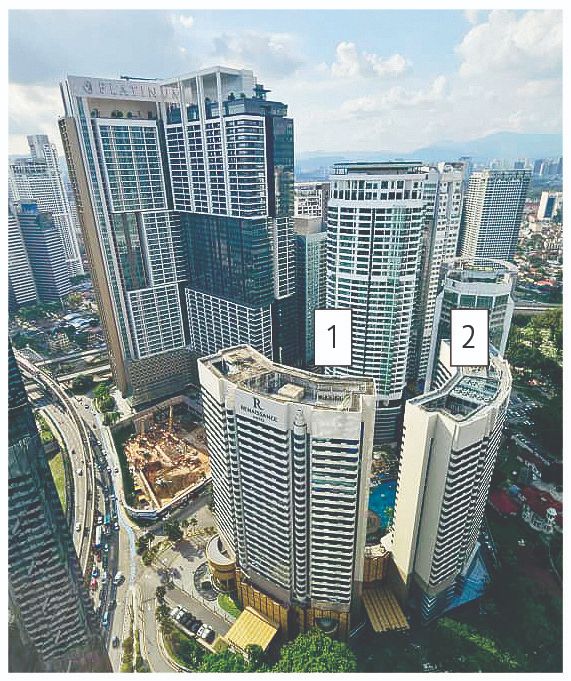
Perhaps one of the most visible pieces of Alam’s international portfolio sits at the corner of Jalan Sultan Ismail and Jalan Ampang in the heart of Kuala Lumpur — the Renaissance Kuala Lumpur Hotel and Convention Centre and the adjoining Four Points by Sheraton Kuala Lumpur City Centre.
Both hotels, which sit on the same land title, are owned by Ventura International Sdn Bhd (formerly Canali Logistics Sdn Bhd), which is reportedly linked to the S Alam Group. In 2016, IGB Bhd (KL:IGBB), then known as IGB Corp Bhd, sold the original Renaissance Hotel property to Ventura International for RM765 million.
A company search on Ventura International shows that YIF Holding Malaysia Sdn Bhd holds a 100% stake in the company, while a search on the latter company shows that Wong Wai Cheong, Poo Sin Yee and Arivalagan Chokalingam are its directors, and that it is wholly owned by Singapore’s YIF Holding Pte Ltd. Another search on YIF Holding Pte Ltd lists its primary activity as that of a holding company for firms engaged in non-financial and insurance-related activities, with Hildrics Asia Growth Fund VCC as its shareholder. Choo Kee Siong is listed as its director and is also the CEO, executive director and chief investment officer of Hildrics Capital.
Hildrics Capital’s portfolio includes Malaysia’s rubber compound manufacturer and distributor GIIB Holdings Bhd (KL:GIIB), in which HAGF Investment (I) Pte Ltd, a wholly-owned subsidiary of Hildrics Asia Growth Fund 1, previously held a 16.56% stake before disposing of some of its shares and ceasing to be a substantial shareholder, according to filings dated May 21. GIIB has been in the news for multiple reasons, including corruption probes, corporate intimidation, legal disputes and financial losses. More recently, Bursa Malaysia queried GIIB after its share price jumped by as much as 50% in a single morning, hitting a more than four-year high on May 4. (See also “Allegations of ‘corporate mafia’ in GIIB court saga” on Page 25.)
In March, Hildrics Asia Growth Fund VCC stepped in as Singapore entertainment company mm2 Asia Ltd’s main rescue investor, signing a term sheet with mm2 Asia to inject new capital via a S$15 million (RM47 million) share placement and a fully underwritten rights issue of up to S$10 million. The deal is still being finalised.
The move came as mm2 Asia — which is involved in content and media production and distribution, and owns Cathay Cineplexes in Malaysia and Singapore — operated under court-approved moratorium orders tied to restructuring under Singapore’s Insolvency, Restructuring and Dissolution Act. Cathay ceased operations in both countries last September.
Meanwhile, Ventura International closed the Renaissance Hotel in 2020 for a major renovation. It was reopened in October 2023 as Marriott’s first dual-branded property in Malaysia: the Renaissance in the West Wing and the new Four Points by Sheraton in the East Wing. Both hotels continue to list Ventura International as their owner on Marriott’s official website and social media channels.
There is no indication at this stage that Malaysian authorities have taken action against the hotels or that any freezing order has been applied to the properties. However, given the breadth of the international investigation — spanning Cyprus, Singapore, the British Virgin Islands and Jersey — sources say Malaysian-held assets linked to the group could come under scrutiny as Bangladesh pursues asset recovery across multiple jurisdictions.
The timing adds a striking layer of diplomatic intrigue. Bangladesh’s newly elected Prime Minister Tarique Rahman — who took office following the BNP’s victory in the 13th parliamentary elections — has chosen Malaysia as the destination for his first foreign state visit. The first invitation for an overseas visit was reportedly from India, followed by invitations from Malaysia and Chinese Premier Li Qiang. Reportedly confirmed last week, the two-day trip to Kuala Lumpur is scheduled for June 21 and 22, with a bilateral meeting with Prime Minister Datuk Seri Anwar Ibrahim expected on the second day.
Tarique Rahman’s visit
According to diplomatic sources, Bangladesh’s High Commission initiated formal discussions with Malaysia’s foreign ministry on May 24 regarding the visit — the same week that Cyprus froze Alam’s property on May 19. Malaysia responded positively and, on June 1, Anwar formally confirmed the invitation. The agenda, which is still being finalised, is expected to cover migration, labour issues, trade, investment and educational cooperation, with more than 10,000 Bangladeshi students currently enrolled in Malaysian universities.
The optics are difficult to ignore. That Bangladesh’s new prime minister should choose, for his inaugural overseas engagement, the very country that hosts what may be the S Alam Group’s most visible international asset — two prominent Marriott-branded hotels at one of KL’s most prestigious intersections — is a coincidence observers are unlikely to overlook.
Another priority at the core of the visit is the reopening of Malaysia’s foreign labour recruitment market to Bangladeshi workers. The market has been closed since 2024, following numerous reports of modern-day debt bondage, with workers incurring substantial debts to secure employment in Malaysia.
The issue came to a head in 2023 when workers arrived in Malaysia after paying up to US$6,600 each, only to discover that the jobs promised by recruiting agents did not exist. When Malaysia closed its doors in early 2024, some 18,000 Bangladeshi workers who had paid agents in their home country were unable to enter Malaysia.
These agents have gone missing amid a crackdown by Bangladesh authorities under the new government. The agents were the legacy of the Sheikh Hasina government where politicians and recruitment agents worked hand in hand to benefit from Bangladesh’s export of labour.
A manpower executive says opening up the corridor between Malaysia and Bangladesh is an important political milestone for Rahman because remittances from overseas are a major economic driver in Bangladesh.
“But Bangladesh does not want the current system of recruiting foreign labour to be continued. They want the Malaysian government to open up the recruitment of foreign labour to more companies in Bangladesh instead of keeping it closed to a handful of firms selected by influential figures in Malaysia,” the executive tells The Edge.
On this score, the Bangladesh government is reportedly looking at 432 recruiting agencies instead of the current list of 102 companies recognised under the Foreign Worker Centralised Management System, a foreign worker management system supplied by Bestinet Sdn Bhd.
The founder of Bestinet is Datuk Seri Aminul Islam Abdul Nor, a Bangladeshi national who is now a Malaysian citizen. Following the fall of Sheikh Hasina, the new Bangladesh government issued an extradition request for Aminul and his associate Ruhul Amin in 2024. The matter is still being handled at a government-to-government level.
Whether asset recovery and financial crime cooperation feature anywhere in the bilateral discussions, formally or otherwise, remains to be seen. But the Bangladesh-Malaysia relationship is clearly operating at a high level of political engagement at precisely the moment when scrutiny of Alam’s Malaysian holdings and pressure to open up the Malaysia-Bangladesh labour corridor are said to be intensifying.
Local sources tell The Edge that while both KL hotels, with a combined total of 919 rooms, were never officially on the market, there was understood to be an asking price in mind a few years ago that could have made a deal possible — a cool RM1.25 billion for both assets. Several agents say the price is perhaps too high and that a valuation of between RM850 million and RM950 million would be more reasonable.
As for the Bangladeshi labour market, the sums involved are said to run into billions of ringgit flowing into the hands of agents, even though the actual recruitment costs are only a fraction of that amount.
Malaysia adopts the employer-pays principle, but implementation remains difficult under the current system.
Human Resources Minister Datuk Seri Ramanan Ramakrishnan has proposed a new system called Turap to eliminate the exploitation of Bangladeshi workers at the village level. Turap is also a creation of Bestinet.
However, it has been met with scepticism in Bangladesh and among some stakeholders in Malaysia, who view it as merely another channel through which the recruitment of Bangladeshi workers remains concentrated in the hands of a few companies.
Save by subscribing to us for your print and/or digital copy.
P/S: The Edge is also available on Apple's App Store and Android's Google Play.