


This article first appeared in The Edge Malaysia Weekly on June 8, 2026 - June 14, 2026
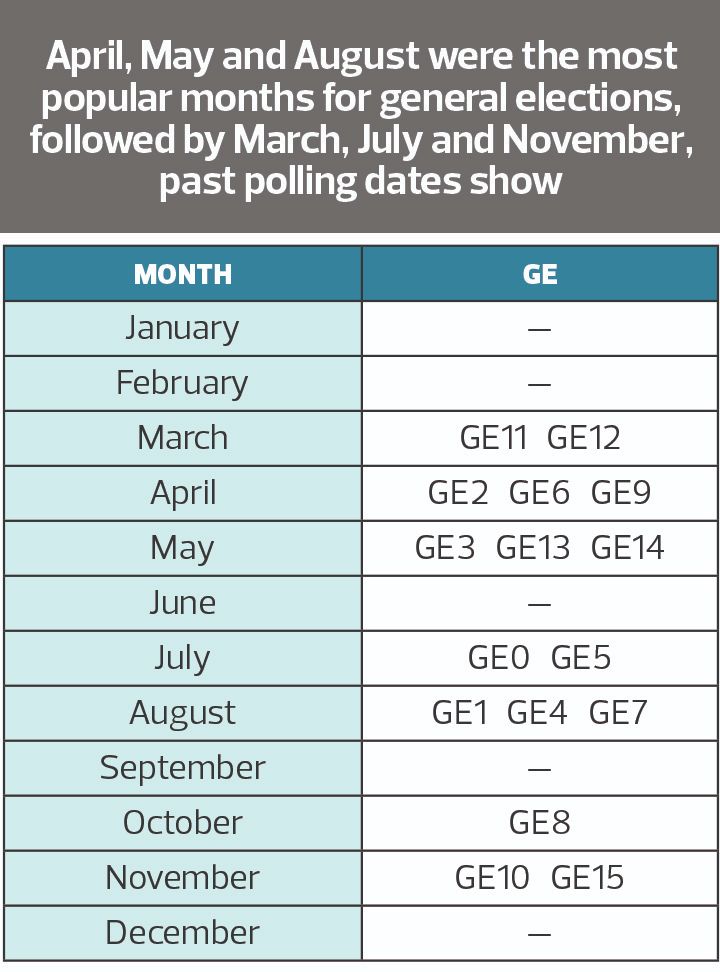
THE outcome of the upcoming snap polls in Johor and Negeri Sembilan and fiscal needs stemming from the Iran war could well determine whether Prime Minister Datuk Seri Anwar Ibrahim will bring forth any special legislation or go ahead with the tabling of Budget 2027, which is currently slated in about four months on Oct 9.
Anwar brushed off speculation of parliament being dissolved soon to pave the way for the country’s 16th general election (GE16), telling reporters last Thursday (June 4): “I am just focusing on my job. The problem is some people do not think about these things. They should be focusing on their jobs.
With Anwar’s Pakatan Harapan (PH) likely to face off with Barisan Nasional (BN) led by Deputy Prime Minister Datuk Seri Ahmad Zahid Hamidi in Johor and Negeri Sembilan state polls that have to take place within 60 days of June 1 and June 5, respectively, some observers reckon that Anwar may choose to table a “mini budget” or dissolve parliament right after tabling a GE16-friendly Budget 2027 to seek a stronger mandate from the people — if there is indeed no saving the fraying ties binding the Madani unity government.
It remains to be seen if the ongoing Iran war will force his hand. Economic Adviser to the Prime Minister’s Office Nurhisham Hussein told business radio station BFM on May 19 that the real impact from the ongoing Iran war and closure of the Strait of Hormuz — where 20% of the world’s oil and liquefied natural gas usually passes through — will hit “in June or July”.
Malaysia needs to have enough revenue to pay for operating expenditures (opex) like subsidies, cash aid, civil service salaries, pensions or debt service charges because Putrajaya can only borrow to pay for development expenditures like building schools, hospitals and other infrastructure but not operating expenses.
If such revenue is insufficient, whoever heads Putrajaya may need to invoke special legislation to create something akin to the special Covid-19 Fund, made possible by the enactment of the Temporary Measures for Government Financing (Coronavirus Disease 2019) Act 2020 (Act 830) that covered RM106.71 billion worth of expenditure between 2020 and 2022 or 14.2% of total federal government revenue for those three years where RM285.9 billion in borrowings was needed to cover fiscal deficit.
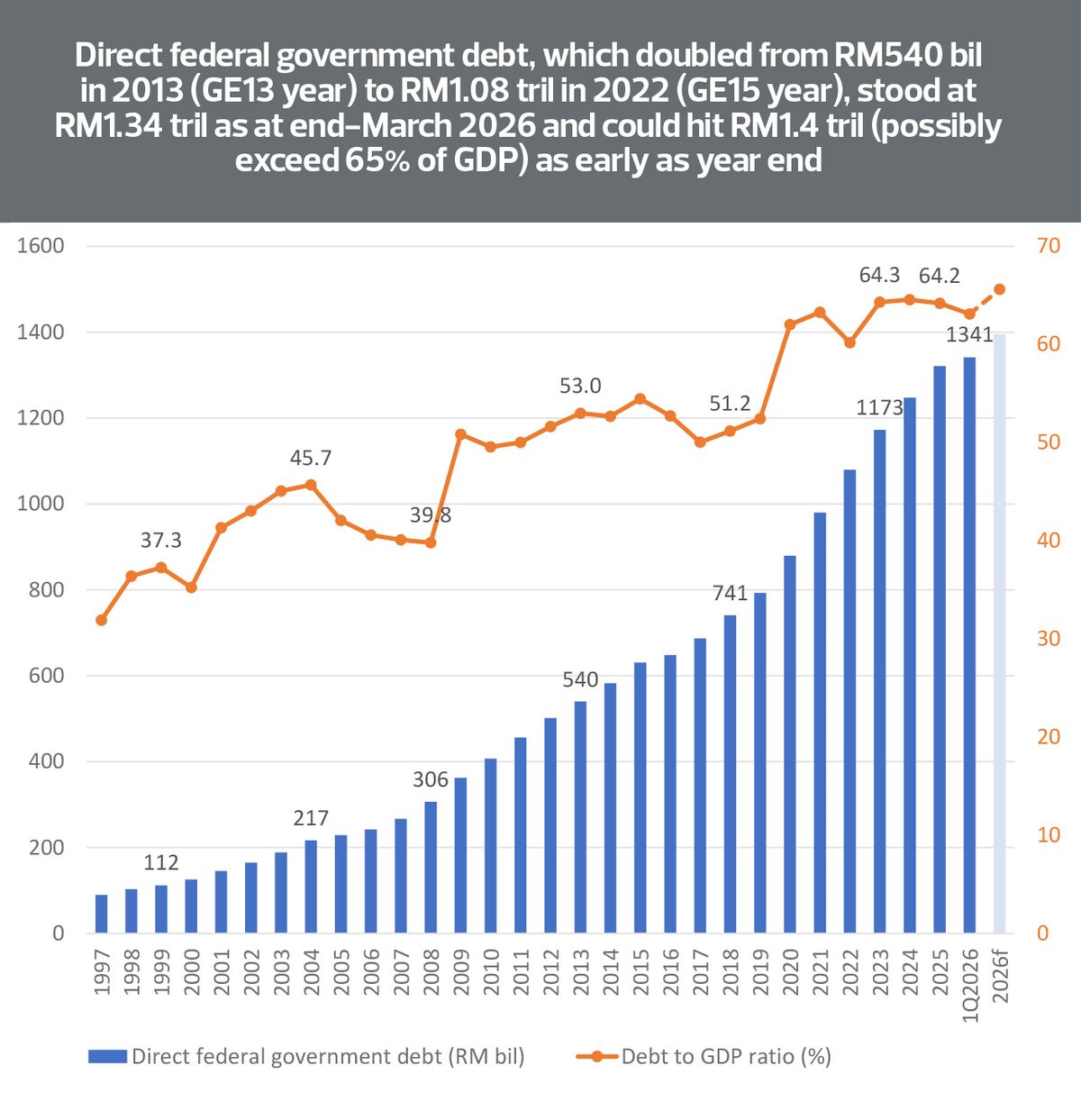
Direct federal government debt rose from RM793 billion or 52.4% of gross domestic product (GDP) as at end-2019 to RM1.08 trillion or 60.2% of GDP as at end-2022.
By end-2025, direct federal government debt had reached RM1.32 trillion or 65.3% of GDP while debt directly guaranteed by the federal government stood at RM352.9 billion or 17.4% of GDP. By end-March 2026, direct federal government debt stood at RM1.34 trillion.
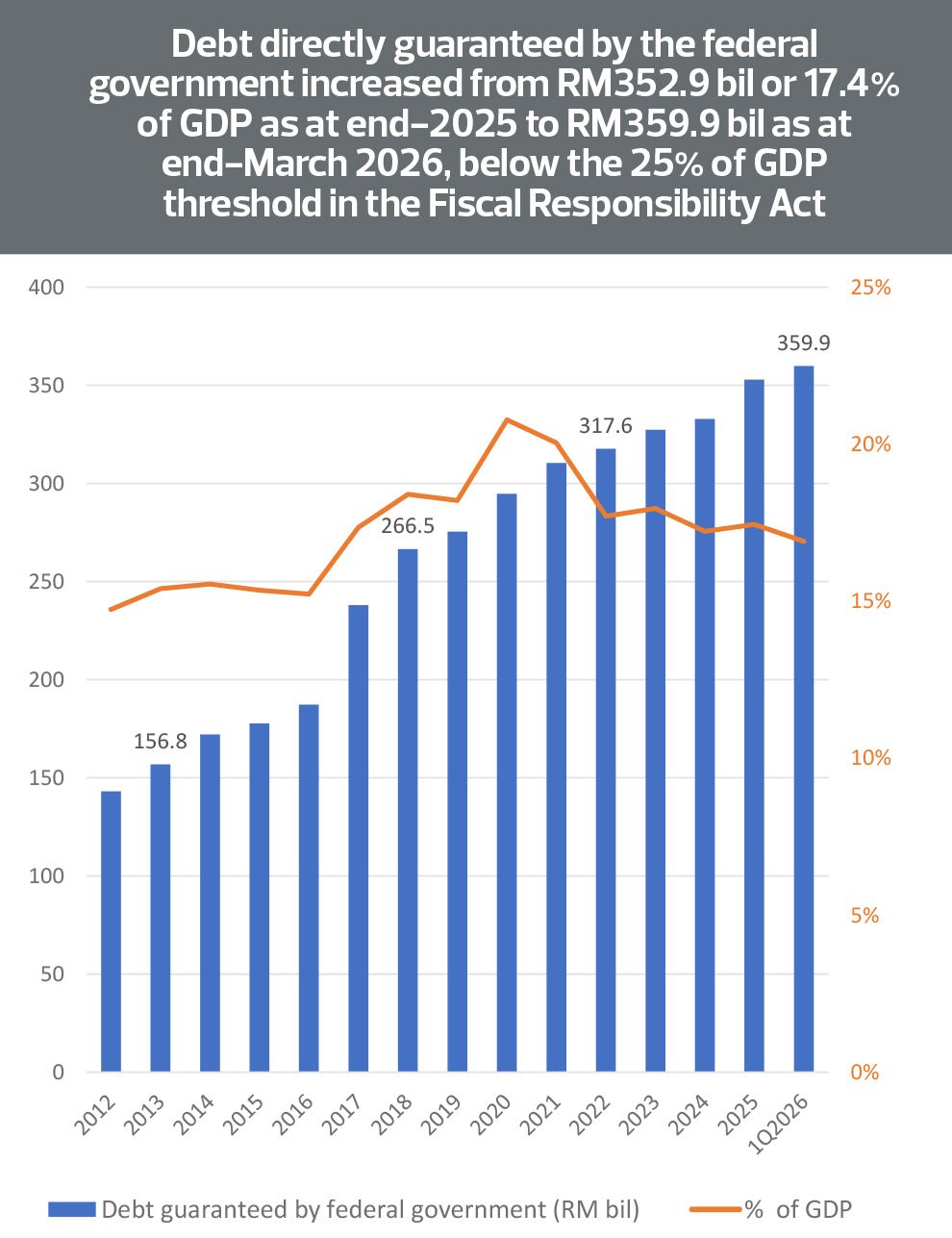
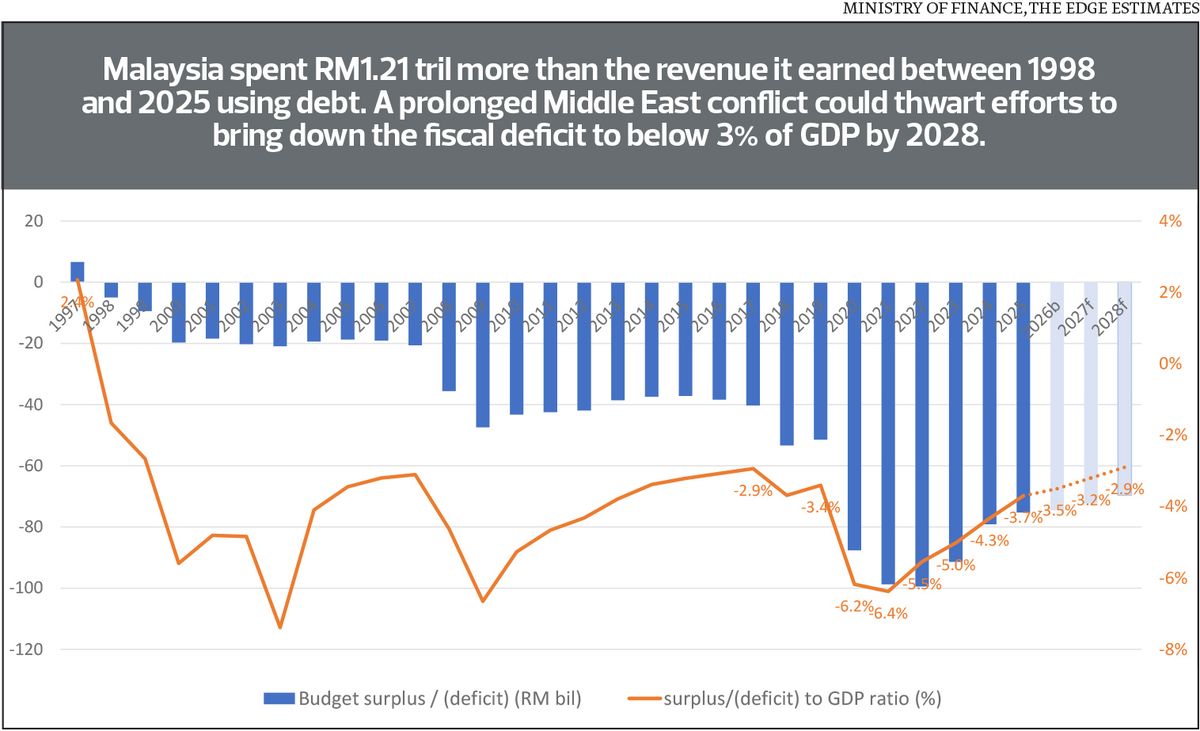
This is above the quantified objective of 60% of GDP under the Public Finance and Fiscal Responsibility Act 2023 (FRA) (Act 850). Other quantified objectives under the FRA include capping the federal government’s financial guarantees to 25% of GDP, bringing down the fiscal deficit to below 3% of GDP over the medium term and spending at least 3% of GDP on development expenditure.
The FRA allows for “temporary deviations from fiscal objectives” in the event of sudden and unpredictable events affecting economic stability and the continued well-being of the people, but a detailed fiscal adjustment plan needs to be tabled in parliament outlining reasons for the deviation, measures and expected time frame to revert to the original fiscal objectives. During the Covid-19 pandemic, for example, the fiscal deficit rose to 6.4% of GDP in 2021 but was subsequently brought down to 3.7% of GDP as at end-2025, better than the expected 3.8%, after the economy grew stronger than expected.
It is understood that the creation of a special fund like the Covid-19 Fund was among options being considered by Putrajaya should economic conditions worsen substantially from a prolonged blockage of the Strait of Hormuz.
The creation of such a fund — which would need parliament’s approval by a simple majority — would be necessary if the ongoing Iran war substantially drives up the need for more borrowings to cover higher operating expenditure — beyond what can be satisfied by trimming discretionary spending, even after getting more income from government-linked institutions like Petroliam Nasional Bhd (PETRONAS) and Khazanah Nasional Bhd.
The Ministry of Finance may have already racked up over RM20 billion in subsidies for RON95 petrol and diesel in the first five months of 2026 alone, our calculations show, above the originally approved RM15 billion for the whole year. Treasury Secretary General Tan Sri Johan Mahmood Merican’s estimate of Putrajaya’s fuel subsidy bill reaching RM58.4 billion points to a shortfall of RM43 billion if monthly RON95 petrol and diesel subsidies stay at RM5 billion a month on average for the rest of this year. That is just fuel subsidies.
“Past elections tend to be preceded by stimulus via higher government spending, particularly subsidies. Two of the last three election cycles saw an acceleration in both private and public consumption in one to two quarters preceding polling, versus gross fixed capital formation, which showed more limited upside in 2018 and 2022. One caveat is [that] the current fiscal space is more constrained than in previous cycles, due to higher commodity prices and fuel subsidies (estimated RM5 billion in May), which we expect to remain intact ahead of national polls,” economists at CIMB Treasury and Markets Research, led by Michelle Chia, wrote in a note dated June 4.
Putrajaya, which had requested each ministry to cut discretionary expenses to save at least RM10 billion, had even considered cutting the salaries of civil servants — which Nurhisham described as the “second absolute last resort”. These questions may come up with Parliament set to resume from June 22 through July 16.
Rather than pay cuts, another observer says Putrajaya can choose to tap the National Trust Fund (KWAN) like it did during the Covid-19 pandemic or have the Retirement Fund, Inc (KWAP) shoulder a larger portion of the annual civil service pension. Putrajaya had previously tapped RM2 billion to RM5 billion a year from KWAP to cover civil service pension and retirement charges, which stood at RM50.48 billion in 2024 and RM54.3 billion in 2025, and are projected at RM58.3 billion for 2026. KWAP’s fund size stood at RM185.6 billion as at end-2024 from RM169.8 billion in 2023. It has yet to release its 2025 annual report, however.
“There is still leeway, but it really depends on how bad the situation gets in the coming months,” the observer says.
Malaysia’s still robust GDP growth of 5.4% in the first quarter, still manageable headline inflation of 1.6% and Putrajaya’s expenses as at April show that Anwar still has some latitude at the moment and would not need to take extreme measures just yet.
“While the current growth-inflation mix remains favourable, stagflation risks could escalate should disruptions to global oil supply persist into 3Q2026. Prolonged reliance on fuel subsidies could also incrementally weigh on Malaysia’s fiscal position. On the domestic front, speculation around a potential snap general election — despite not being due until early 2028 — introduces an additional layer of uncertainty, although its impact on foreign investor sentiment is likely to remain limited until more concrete developments emerge,” economists at UOB Bank told clients in a note on June 5, noting the ringgit is not insulated from external headwinds while supported by fundamentals and policy stability.
“A credible reopening of the Strait of Hormuz would serve as a key catalyst for Malaysia’s favourable idiosyncratic fundamentals to reassert themselves. We reiterate our USD/RM forecasts at 4.00 in 3Q2026, 3.98 in 4Q2026, 3.94 in 1Q2027 and 3.92 in 2Q2027,” they added.
In the event the standoff at the Strait of Hormuz extends past the third quarter and materially affects the economy, Putrajaya would need a united front to convince investors that any emergency measures taken to create buffers are targeted, transparent and temporary to prevent further fallout.
Save by subscribing to us for your print and/or digital copy.
P/S: The Edge is also available on Apple's App Store and Android's Google Play.