

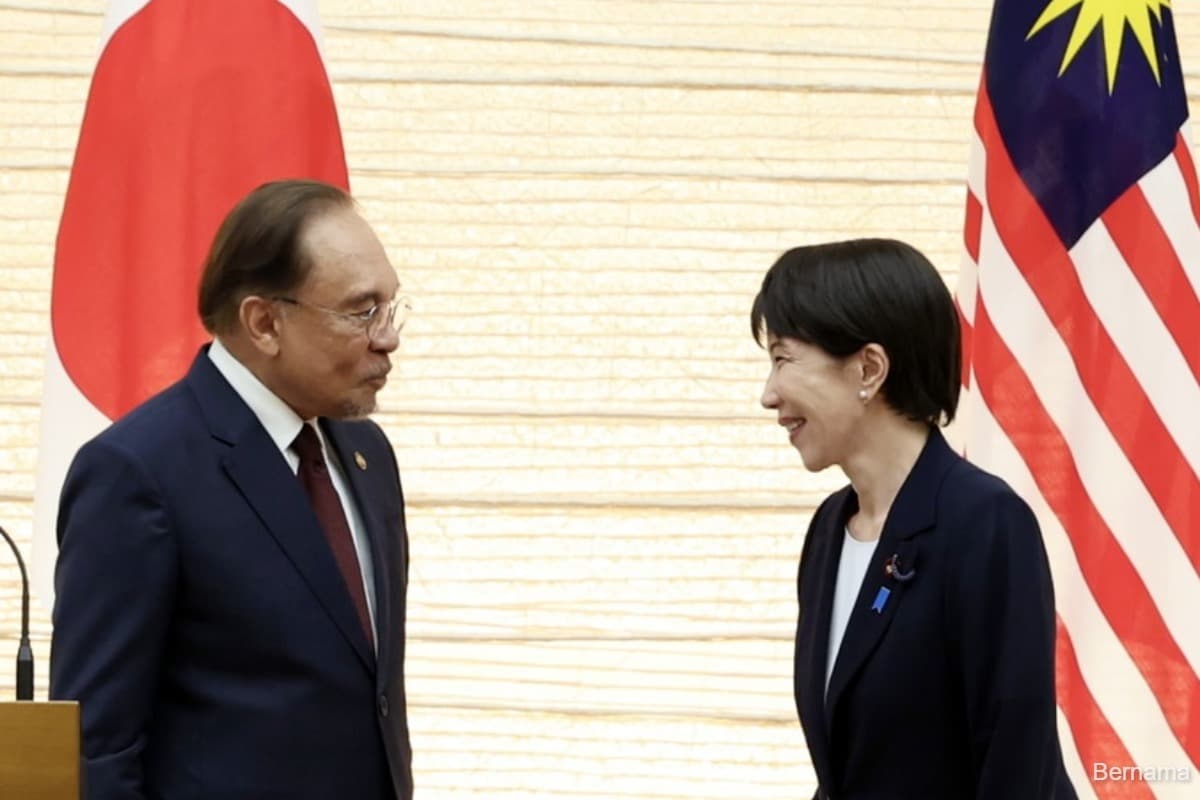
KUALA LUMPUR (June 10): Malaysia and Japan have agreed to deepen cooperation in energy security and critical minerals supply chains, amid concerns over geopolitical risks, export restrictions and disruptions to global supply chains.
The commitment was outlined in a joint statement issued after Prime Minister Datuk Seri Anwar Ibrahim and Japanese Prime Minister Sanae Takaichi held a bilateral summit in Tokyo on Wednesday.
Both leaders reaffirmed the importance of the Partnership On Wide Energy and Resources Resilience Asia (POWERR Asia), which was launched in April, as a platform to strengthen regional energy security amid the destabilisation of global energy supply and geopolitical risks stemming from the Middle East.
Anwar also expressed Malaysia’s commitment to promote open and stable trade flows to Japan, including essential energy supplies such as liquefied natural gas, as well as petroleum and chemical products such as naphtha, urea and medical gloves.
The leaders also agreed to enhance cooperation in this area, including exploring ways to support Japan’s needs in line with Malaysia’s domestic priorities and available surplus capacity.
The statement comes as Petroliam Nasional Bhd (PETRONAS), through its wholly-owned subsidiary PETRONAS LNG Ltd, signed a 20-year agreement to supply up to about two million tonnes per annum of LNG to Japan’s largest power generation company, JERA Co Inc, from 2028.
On economic security, both leaders expressed concern over economic coercion, non-market policies and arbitrary export restrictions that could have a significant negative impact on global supply chains.
They also agreed to deepen cooperation on supply chain resilience, including for critical materials, and to promote transparent, diversified, secured, sustainable and reliable supply chains among trusted partners.
Both countries also agreed to strengthen the resilience of critical minerals such as rare earth supply chains through ongoing cooperation involving the Japan International Cooperation Agency, Japan Organization for Metals and Energy Security, and Japan Bank for International Cooperation.
Malaysia also welcomed Japan’s US$20 million (RM80 million) contribution to the Critical Minerals-to-Manufacturing Financing Partnership Facility launched by the Asian Development Bank to strengthen critical mineral supply chains in Asia, including Malaysia.
Separately, both leaders agreed to establish the Japan-Malaysia AI Platform to link AI-related companies and startups from both countries, while also welcoming private-sector cooperation in AI and semiconductor-related fields.
The leaders also agreed to explore initiatives to promote the use of local currency settlement in bilateral trade and investment, while reaffirming the role of the bilateral swap arrangement as part of the regional financial safety net.