

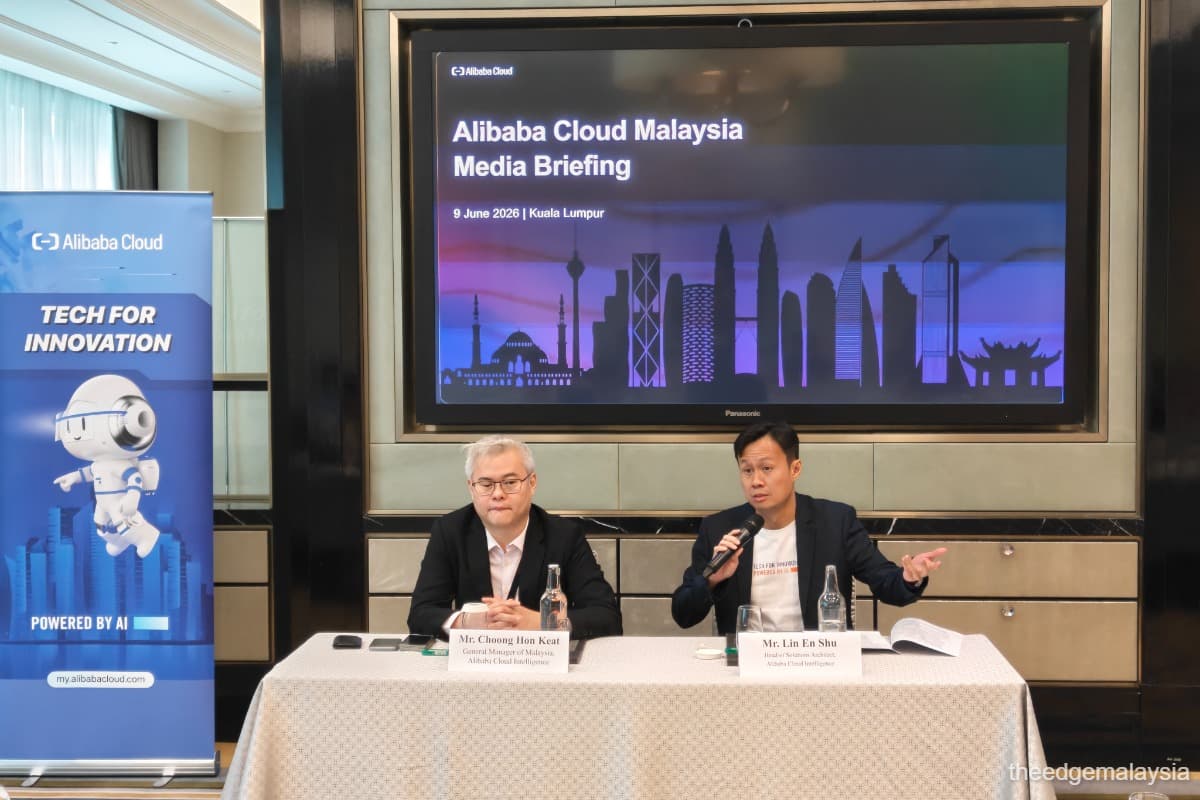
KUALA LUMPUR (June 9): Alibaba Cloud has launched a public cloud region in Johor, its second in Malaysia, in a move the company says will help small and medium enterprises (SMEs) tap artificial intelligence (AI) services at lower cost and with better performance.
The new region comprises two data centres and brings Alibaba Cloud's footprint in Malaysia to five facilities, which the company says is its largest infrastructure presence in Southeast Asia.
It also forms part of Alibaba's previously announced US$53 billion (RM223 billion) investment in AI and cloud infrastructure in 2025, expanding the group's global reach to 104 availability zones across 32 regions.
Alibaba Cloud Intelligence Malaysia general manager Choong Hon Keat says the SME segment remains central to the company's strategy in the country.
"Over the years we have been focusing on serving the SME market, all the SME customers in Malaysia. In fact, not only SME, but we have also been actively involved in micro, small and medium enterprise (MSME) initiatives, and that is something we have always been focusing on in helping the Malaysian communities," he said during a media briefing held at the St Regis hotel here on Tuesday.
He says AI take-up among smaller firms is rising quickly. "We do see AI adoption increasing tremendously, also because the government is driving the initiatives," he says.
While the Johor region is built to meet domestic demand, Choong says its status as a public cloud region means it serves users beyond Malaysia. "A public cloud means it also allows other customers or other countries to use it. So yes, Singapore will definitely also be using it," he says.
On pricing, Alibaba Cloud's head of solutions architect for Malaysia Lin En Shu said cost effectiveness is the company's main pitch against rival models. "Our biggest strength is really a similar level of intelligence at a fraction of the cost," he said, using the Qwen family of models as an example against Western alternatives.
He likens the choice to picking fuel at the pump. "If you are rich enough, you pump RON97 every day, and if your car requires it, you do that. But most of us don't, so you pump RON95," he says, stressing that local business often pick AI models that is sufficient for the task rather the choosing the most advance models, which may cost more.
He frames tokens, the unit of compute that powers AI workloads, as the running cost enterprises now watch most closely. "Tokens are the fuel for AI. We are evolving our capability to match the best while making it much more economical. If you look at our pricing, it is really a fraction of the cost of the best," he says.
On data sovereignty, Lin said Alibaba Cloud keeps Malaysian customer data in-country and runs inference on Nvidia chips configured for the China market. "In Malaysia we do have Nvidia GPUs designed for China, the L20 and H20. This is purpose-built for Malaysians, knowing that data sovereignty is really a big thing here," he says, adding that most local customers want models served locally so that data stays within the country.
Choong also said the company has built out its local channel since entering Malaysia, signing more than 300 system integrators, resellers, distributors and partners, and has stepped up AI training for them over the past one to two years.
He adds that Alibaba Cloud works closely with agencies including the Ministry of Digital and the Malaysia Digital Economy Corporation (MDEC), with whom it has signed a memorandum of understanding to support SME requirements.
The company plans to introduce a suite of agentic AI services to Malaysia in the second half of this year, among them AgentRun, an agent development and build platform, STAROps, ACS Agent Sandbox, Agent Security Center, AI Security Guardrails 2.0 and Agentic SOC.
Local customers already drawing on Alibaba Cloud's infrastructure include TNG Digital, which uses a unified data platform to power search and recommendation in the Touch 'n Go eWallet app, and YTL AI Labs, whose ILMU family of Malay-language models is trained and run on the platform.
Creative AI firms TabSpace.ai and Morphyx.io are also using Alibaba Cloud's Wan and HappyHorse video generation models through Model Studio.