

This article first appeared in City & Country, The Edge Malaysia Weekly on June 8, 2026 - June 14, 2026
As Malaysia’s property market grapples with rising development costs, cautious sentiment and increasingly discerning buyers, Sunsuria Bhd (KL:SUNSURIA) founder and executive chairman Tan Sri Ter Leong Yap believes developers can no longer rely solely on building homes to remain competitive.
He believes the future of property development lies in creating ecosystems — developments supported by education, healthcare, retail and connectivity components that sustain long-term value beyond the cyclical nature of property sales.
That philosophy is increasingly shaping Sunsuria’s next phase of growth. “We want to be a developer that is able to put in the catalysts,” Ter tells City & Country in a recent interview.
While property development remains the group’s core business and primary earnings driver, Sunsuria has steadily expanded in recent years into education and healthcare, while strengthening its development pipeline across Greater Kuala Lumpur.
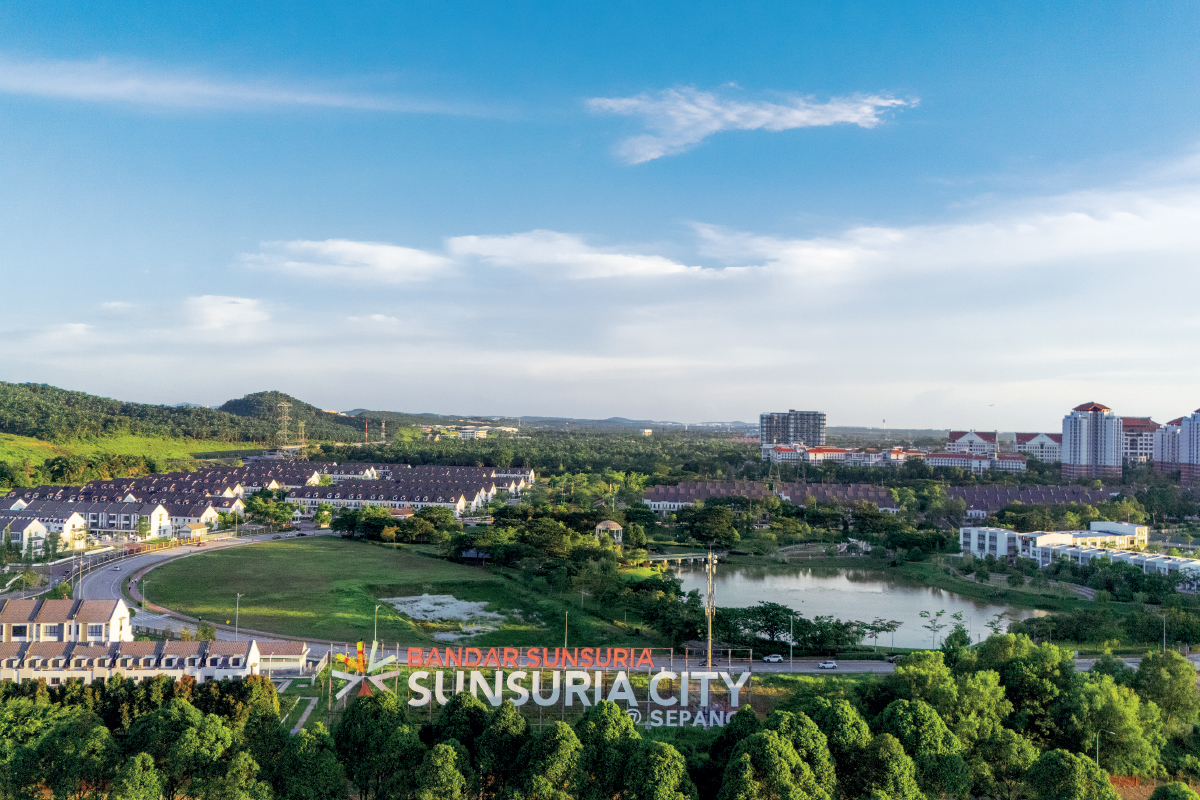
The strategy marks a notable evolution for the listed developer, which built its name on township developments such as Sunsuria City in Sepang, Selangor. Today, the group is positioning itself more aggressively with transit-oriented developments (TODs), as well as urban redevelopment projects and integrated developments, supported by a growing portfolio of businesses that provide recurring income that is intended to complement its property development operations.
Despite the diversification, Ter is quick to stress that property development remains firmly at the heart of the group. “Property development is going to be a business that we take very seriously and will continue for a long, long time,” he says.
This shift in its long-term business direction, however, has not come without short-term financial pressures. In 1QFY2026 ended Dec 31, 2025, Sunsuria recorded softer year-on-year earnings, with revenue at RM118 million and net profit at RM1.69 million, largely due to the timing difference in the completion of several developments in the previous financial year.
Ter says the softer performance also reflects Sunsuria’s ongoing investments in education and healthcare, both of which are in the gestation stage. During the Covid-19 pandemic, the group began restructuring parts of its business and hired dedicated management teams to spearhead its education and healthcare divisions.
Significant resources have been channelled to build up these segments, including schools, staffing and operational infrastructure. “Quite a lot of resources have been put in. It’s a transition period,” says the executive chairman.
Nevertheless, he remains confident that the long-term trajectory will strengthen as the various businesses mature and more projects begin contributing meaningfully to earnings in the coming years.

Urban regeneration takes centre stage
Among the examples of Sunsuria’s evolving ambitions is KL City Gateway (KLCG), a nine-acre urban redevelopment project in Jalan Sungai Baru, Kampung Baru, which the group plans to launch later this year.
Located near the Saloma Link bridge, the project is envisioned as a mixed-use urban development integrating residential, office and retail components in the corridor of the Kuala Lumpur city centre.
To be developed in four phases, KLCG enjoys direct connectivity to the Ampang-Kuala Lumpur Elevated Highway (Akleh) and is located 200m from the Kampung Baru LRT station, reinforcing Sunsuria’s growing emphasis on TODs.
Phase 1 will comprise a 46-storey tower offering 832 units of office suites and serviced apartments. This phase, which will have a gross development value (GDV) of RM2.75 billion, is targeted for completion by end-2030.
“It is beside an LRT station, within walking distance to KLCC Twin Towers, and we managed to get approval to punch directly into Akleh. Technically, if you want to go to KLCC Twin Towers by car, in about two minutes, you’re there,” says Ter, adding that it was a golden opportunity for the developer to obtain this piece of prime land that faces KLCC Twin Towers.
In April, Sunsuria completed the acquisition of an additional 41% equity interest in KL City Gateway Sdn Bhd for RM21.46 million. This increases its stake to 61%. The completion of the transaction enables the group to consolidate the latter as a subsidiary and to take a more active role in executing the KLCG project. It is a move that Ter says had always been part of its long-term plans.
He says one of the project’s defining features will be its planned retail boulevard that will stretch along the highway frontage, a concept he describes as lifestyle-driven rather than mall-centric. The project is also expected to feature smaller-format commercial units, office components and residential products designed to appeal to both owner-occupiers and investors seeking accessibility to the city centre. He highlights that the group’s market studies indicated strong interest from both local and foreign buyers.
For Ter, the project is part of Sunsuria’s broader push into urban redevelopment, a segment he believes is about revitalising ageing urban communities rather than just unlocking land value. Nevertheless, he acknowledges that these projects are significantly more complex than conventional ones, often involving fragmented ownership structures and years of negotiations with residents and landowners.
“It took us about 10 years to talk to them,” he says, referring to negotiations involving legacy urban communities in the land surrounding the KLCG development. He notes that in some instances, a single property involved dozens of beneficiaries across multiple generations.
Nevertheless, Ter believes such projects carry both great commercial and social value. “We are not just doing business for ourselves. We are actually improving lifestyles for people, for the community.”
Ter explains that redevelopment projects often provide existing residents with significantly improved living conditions, larger homes and better facilities, compared with ageing flats and deteriorating buildings. The group has since formed a dedicated urban redevelopment team to focus on such projects, leveraging experience gained from projects such as Bangsar Hill Park in Bangsar and other redevelopment exercises.
Bangsar Hill Park is an ongoing urban redevelopment project with an estimated GDV of RM3 billion. Sunsuria increased its stake in the project to 84% in FY2025 ended Sept 30, strengthening the group’s earnings contribution and giving it greater exposure to the project’s upside.

Banking on liveability
Beyond urban regeneration, the developer is preparing to launch RIA Sunsuria, a new RM580 million project in the Kwasa Damansara master plan in Selangor. The development is expected to be launched in August.
RIA Sunsuria will feature two 21-storey condominium towers with 494 units and 26 units of 3-storey terraced houses. The project is targeted for completion in January 2030.
To be located near the Kwasa Damansara MRT station, the development will primarily cater for owner-occupiers and families seeking practical urban living. Unlike KLCG’s more metropolitan positioning, RIA Sunsuria caters for families seeking a community-centric lifestyle in one of the Klang Valley’s emerging township developments.
“It’s more for those from the surrounding areas who want to live there. We have designed it in such a way to really suit the market,” says Ter.
The developer is placing strong emphasis on efficient layouts, practicality and accessibility — factors that have become increasingly important as buyers become more informed and selective, he adds.
“Customers today have a lot more expectations. They ask more in-depth and intelligent questions,” says Ter, adding that buyer preferences are also reshaping how the group approaches product planning and innovation.
He highlights that Sunsuria’s internal business development and innovation teams regularly study consumer trends, technologies and design concepts, conduct market surveys and go on overseas research trips to identify ideas that could improve future developments.
Among the concepts Sunsuria has explored are elderly-friendly design features, energy-saving technologies and safer construction materials intended to enhance practicality in residential property projects.

Beyond property and the Klang Valley
While the company is actively expanding its footprint across different locations, segments and industries, Sunsuria City in Sepang is the clearest expression of the developer’s long-term business philosophy.
Located near the Kuala Lumpur International Airport and KLIA Express line, the township has evolved steadily over the years into an education-centric development anchored by Xiamen University Malaysia and Concord College International School. The township will soon include SJKC Sunsuria primary school, which is currently under development, as well as healthcare facilities and commercial components.
For Ter, such components are not simply add-ons. Instead, they function as catalysts that generate economic activity, attract residents and strengthen the long-term sustainability of a master plan like Sunsuria City.
The township’s development has not always been smooth. During the Covid-19 pandemic, Sunsuria City’s retail and commercial activity slowed sharply as student populations dwindled amid movement restrictions and remote learning arrangements. But activity has since rebounded strongly.
According to Ter, Xiamen University Malaysia now has more than 10,000 students, while Concord College International School has continued to grow its student intake. The group is also studying other expansion opportunities for its education platform in Malaysia and potentially, over time, across the region.
Meanwhile, Sunsuria’s healthcare business expansion has been making progress and gaining traction. “Our partnership with Australia-based Icon Group continues to progress well. The first Icon Oncology Centre at Island Hospital Penang was launched in 2025, and we are now preparing for a second centre at Prince Court Medical Centre in KL, targeted for launch by end-2026,” he says.
Ter says the group hopes to eventually scale its healthcare business once its operational model has been fully refined. “We want to make sure we already have our optimal operational model before we replicate the business model.”
Although Sunsuria remains primarily focused on Greater Kuala Lumpur, the group has been selectively exploring opportunities beyond its traditional core markets, including industrial-related and mixed-use developments.
One of Sunsuria’s larger land banks outside the Klang Valley is in Tapah, Perak, where the group acquired 1,776 acres of land as part of its longer-term strategy. According to Ter, various parcels are still being evaluated for future concepts and complementary developments that could potentially generate recurring income for the group.
Sunsuria is also studying plans, including industrial and mixed-use concepts, for land in areas such as Banting and Kuala Selangor, even though Ter stresses that the group remains measured in its expansion beyond its traditional core markets. “We are not very aggressive outside the Klang Valley.”
Still, the broader diversification of its land-banking strategy reflects the developer’s efforts to create longer-term value while maintaining flexibility in different market cycles.
Long-term plans
Despite rising concerns about geopolitical tensions, inflationary pressures and surging construction costs, Ter remains fundamentally optimistic about the long-term prospects of Malaysia’s property market, particularly in the Klang Valley. He believes the country continues to have structural advantages compared with the rest of Southeast Asia. “Malaysia has a lot to offer — our infrastructure, people, safety, cost of living.”
Reflecting his confidence in the overall positive market outlook, Sunsuria’s strategic pipeline boasts an estimated GDV of RM10 billion, spanning projects such as Bangsar Hill Park, KLCG, RIA Sunsuria and developments in Sunsuria City.
Consequently, Ter believes the group’s existing land bank of 2,078 acres and deep pipeline projects will provide it with clear earnings visibility for at least the next seven to 10 years. “Even conservatively, we can launch close to RM1 billion worth of properties every year,” he says.
For now, Sunsuria remains in what Ter repeatedly describes as a transition phase — one where near-term profitability may fluctuate as the group invests in new verticals, urban redevelopment capabilities and long-term platforms that provide recurring income.
But even as the company stretches its wings beyond conventional property development, he insists that its strategy will still revolve around the same core principle: creating places where people genuinely want to live, work and build communities.
As for Sunsuria, property development remains the foundation on which the rest of the ecosystem is built.
Save by subscribing to us for your print and/or digital copy.
P/S: The Edge is also available on Apple's App Store and Android's Google Play.