

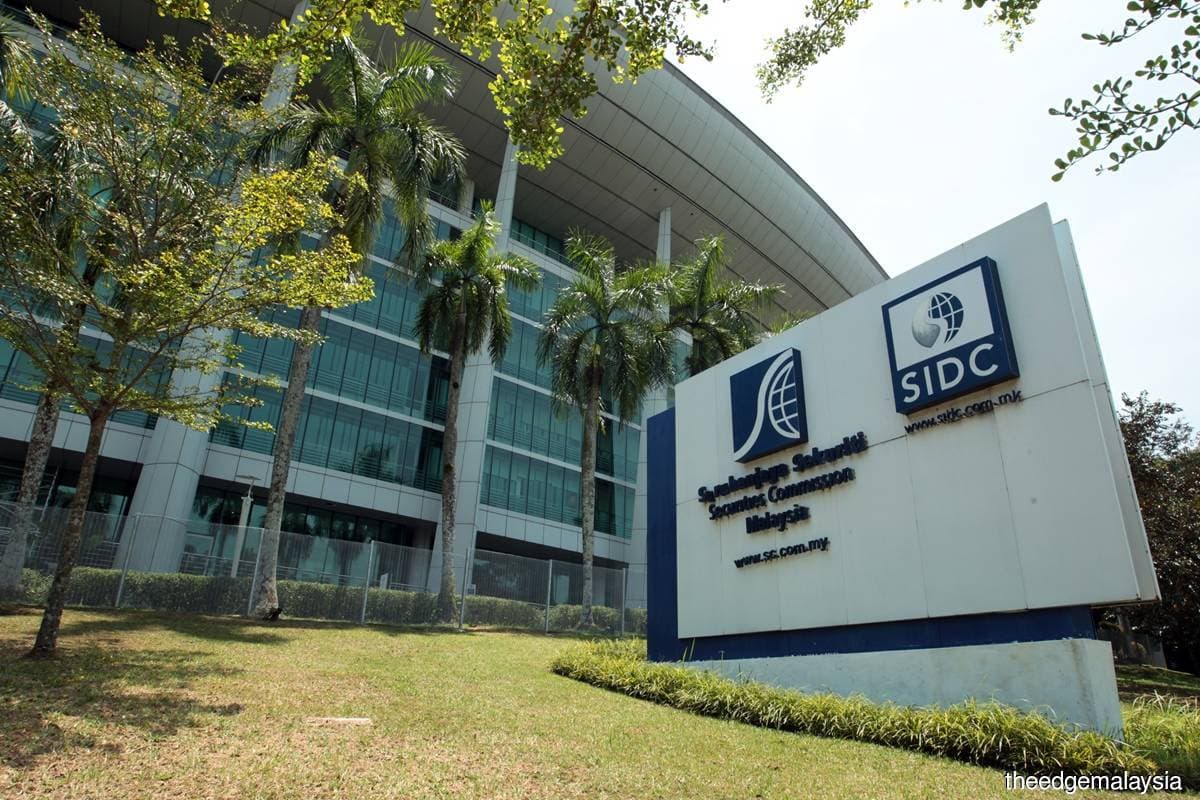
KUALA LUMPUR (June 4): The Securities Commission Malaysia (SC) has clamped down on investment-style trust companies engaged in the capital market, now requiring these companies to be licensed for their activities.
The capital market regulator drew a distinction between a conventional trust business — whose primary business is estate administration and private trust for succession or legacy planning — and trust structures that effectively operate as investment products, in a new Practice Note issued on May 22 and effective on the same date.
Under the guidance, the SC said trust companies may continue to provide investment-related services without a capital markets services licence (CMSL) if such activities are “solely incidental” to a conventional trust business.
If their involvement in capital market products is not “solely incidental” to a conventional trust business, they are required to obtain a licence, it noted.
Illustrating the distinction, the SC said a trust company managing a family’s education trust or estate trust is still allowed to engage in regulated activities of providing financial planning, investment advice and fund management without a licence for the purpose of preserving the trust’s value.
On the other hand, a trust company that promises projected annual returns from investment for the benefit of an individual’s beneficiary and mainly invests in capital market products is required to be licensed by the SC as a CMSL holder.
That said, the SC noted that if the investment-style trust company only invests in non-capital market products, such as fixed deposits, real estate, investment-linked insurance and gold, it does not fall under securities laws and is hence not under the regulator’s purview.
“In light of the above, all trust companies are encouraged to engage the SC as to whether their trust business will require a licence from the SC,” it added.
The change comes under Paragraph 1 of Schedule 3 of the Capital Markets Securities Act, which empowers the SC to determine “specified persons” exempt from the requirement of being licensed or registered with the SC.
Since Jan 1, the SC has been given more power to decide which trust companies and trust activities can operate without needing a capital markets licence, following changes to the Capital Markets and Services Act 2007.
Before this, cash trust schemes were handled by trust companies registered with the Companies Commission of Malaysia (SSM) under the Trust Companies Act 1949, and they were also governed by the Trustee Act 1949.
The SC’s move comes as the government plans stronger regulation for trust companies in Malaysia. Deputy Domestic Trade and Cost of Living Minister Datuk Dr Fuziah Salleh in February said the government plans to table a new Trust Companies Bill this year structured around four main areas of regulation. First, it defines what trust companies are allowed to do and requires them to be formally registered. Second, it introduces rules for disclosing the true owners behind trust businesses. Third, it strengthens governance and administrative requirements for trust companies. Finally, it sets out the procedures for closing, winding up or dissolving trust companies.