

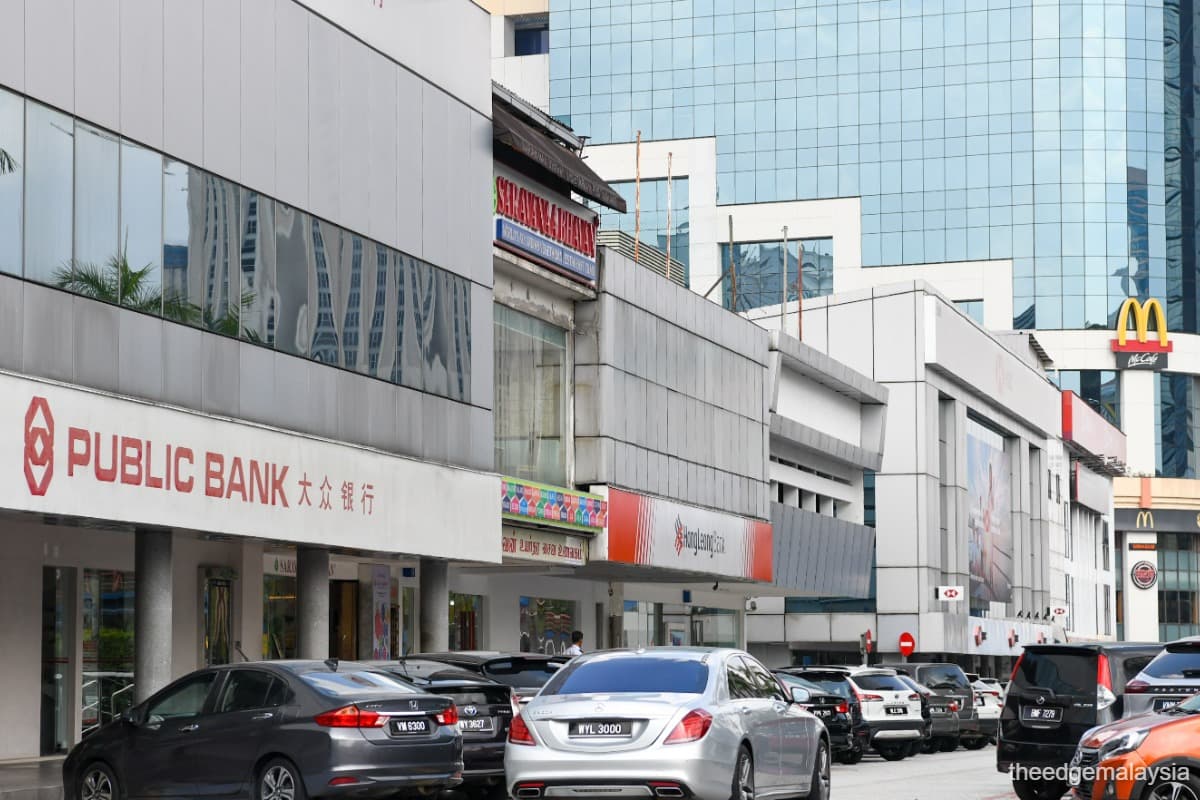
KUALA LUMPUR (June 4): Leading indicators suggest looming credit tightening, but moderation is only expected in the second half of this year as elevated fuel prices and inflationary pressures potentially weigh on economic activity, analysts said.
"While industry GIL (gross impaired loans) remains healthy at 1.40%, most banks refrained from proactively increasing provisions over the recent 1QCY2026 (first quarter of calendar year 2026) reporting season, citing that it remains too early to fully assess the impact of elevated fuel prices on repayment behaviour..." Kenanga Research said in a note on Thursday.
The house further noted that system loan growth accelerated to 5.6% year-on-year (y-o-y) in April, though on a monthly basis, growth moderated to 0.2% as business loans contracted slightly following the festive season.
Loan applications grew 10% y-o-y but declined 3% month-on-month (m-o-m), with approval rates falling to 48.9% from 55.1% in March, suggesting banks are adopting a more cautious lending stance.
Despite geopolitical tensions, asset quality defended its turf, with the GIL ratio holding steady at 1.40% in April.
Kenanga said only two banks had topped up on their provisions, that being Malayan Banking Bhd (KL:MAYBANK) and Alliance Bank Malaysia Bhd (KL:ABMB), by five basis points (bps), while AMMB Holdings Bhd (KL:AMBANK) had written back on its pre-emptive buffers.


However, Kenanga warned that the coming months will be crucial points of assessment for the banking sector's health, particularly with regard to GIL ratios.
The house said any deterioration could only possibly be more apparent in the second quarter of this year.
Separately, Hong Leong Investment Bank (HLIB) Research observed that "the corporate segment exhibited signs of slowdown" as application growth flattened at 28.2% y-o-y, while approvals decelerated significantly to 14.9% y-o-y.
"The aggregate approval rate's drop flags a potential credit tightening on the horizon," said HLIB.

Deposit growth remained uninspiring at 3.4% y-o-y, with the industry current and savings accounts (CASA) ratio easing to 29.4% as funds rotated into fixed-income instruments. HLIB noted that "system deposit growth decelerated to 3.4% y-o-y, dragged down by a decline in CASA growth to 7.4% y-o-y".
HLIB noted that Bank Negara Malaysia's RM5 billion SME Stabilisation Relief Facility, backed by up to 80% guarantees, "should insulate asset quality and prevent a spike in GILs".
In April, net interest margin (NIM) expansion finally materialised as industry interest spreads widened by 2bps m-o-m to 2.39%, driven by a 5bps drop in the cost of funds to 2.14%.
HLIB stated that "this trend confirms that high-cost fixed deposits have successfully been re-priced following last July's OPR (overnight policy rate) cut, paving the way for NIM normalisation".
MBSB Research described 1QCY2026 as "a decent quarter, though there were clear sources of downside pressure", with core drivers being NIM expansion and solid cost control offset by weaker non-interest income.
The dividend outlook remains extremely bright, particularly among the larger- to mid-sized banks, with several banks having already announced special dividends, according to MBSB.
Kenanga's top picks include Public Bank Bhd (KL:PBBANK) for its compelling over 6% dividend yield alongside industry-leading asset quality, CIMB Group Holdings Bhd (KL:CIMB) for offering the sector's highest dividend return potential and AMMB for earnings resilience and growth.
Meanwhile, HLIB favours CIMB and AMMB for their undemanding valuations and defensive dividend yields amidst near-term macro headwinds.
MBSB said reduced industry valuations present a buying opportunity, as the recent share price correction is overly severe.
All three research houses maintained an "overweight", or positive, stance on the Malaysian banking sector.