

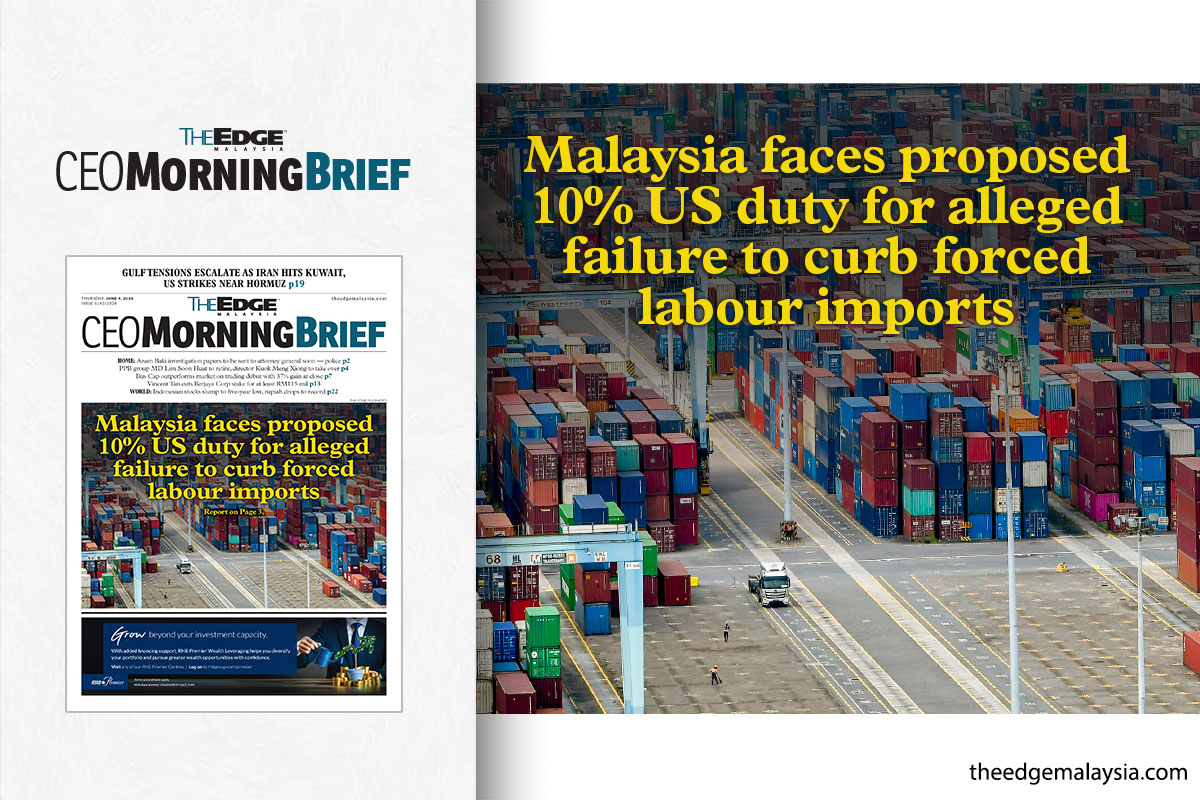
KUALA LUMPUR (June 3): The US has proposed an additional 10% duty on imports from Malaysia after determining that the country has failed to impose and effectively enforce a prohibition on imports made with forced labour.
The finding by the Office of the US Trade Representative (USTR) concluded that the failure to curb imports of goods produced with forced labour is unreasonable, burdens or restricts US commerce, and is therefore actionable under Section 301 of the Trade Act.
Products listed in the provision of the Harmonized Tariff Schedule of the United States are exempted from the tariff.
Malaysia is among 54 economies found to have failed to impose and effectively enforce a ban on the importation of goods produced wholly or partly with forced labour. The list also includes China, India, Japan, Singapore, South Korea, Thailand, Vietnam and the UK, according to the USTR's statement.
A further six economies — Canada, Ecuador, the European Union, Indonesia, Mexico and Pakistan — were found to have failed to effectively enforce existing prohibitions on imports made with forced labour.

The finding comes as Malaysia is still being investigated by the US over claims of excess production capacity in its electronics, machinery, and steel industries. The investigation is being conducted under the same US trade law, Section 301, that allows authorities to examine and respond to foreign practices considered unfair to US trade.
The move comes ahead of the July 24 expiry of a temporary 10% tariff imposed by the Trump administration following a US Supreme Court ruling that struck down tariffs in February this year imposed under the International Emergency Economic Powers Act.
US Trade Representative Jamieson Greer said the failure of trading partners to address forced labour imports is unacceptable, as it leaves American workers competing on an uneven global playing field.
“We will no longer tolerate this disparity. Some trading partners have taken initial steps to prevent the importation of forced labour goods, including through United States-Mexico-Canada Agreement (USMCA) and commitments in Agreements on Reciprocal Trade. However, each of our trading partners must do more to ensure that trade does not perversely encourage and entrench forced labour globally,” he added.
For all other economies, the USTR proposes 12.5% as the rate of additional duty. It is also proposing a textile mechanism that would allow a specified volume of apparel and textile imports from certain economies to enter the US at a reduced Section 301 tariff rate.
The proposal is subject to public consultation, with written comments due by July 6 and hearings scheduled for July 7.