

This article first appeared in Capital, The Edge Malaysia Weekly on June 1, 2026 - June 7, 2026
FROM Sunway Healthcare Holdings Bhd (KL:SUNMED) to SkyeChip Bhd (KL:SKYE), there is no shortage of companies with sound business models and strong management debuting on Bursa Malaysia this year. Another notable initial public offering (IPO) lined up for 2026 is KK Mart Retail Bhd, which is reported to be targeting an October listing, at a valuation of nearly RM3 billion.
On a RM3 billion valuation, KK Mart is valued at a price-earnings ratio (PER) of about 31 times based on a net profit of RM97 million for its latest full financial year ended June 30, 2025 (FY2025).
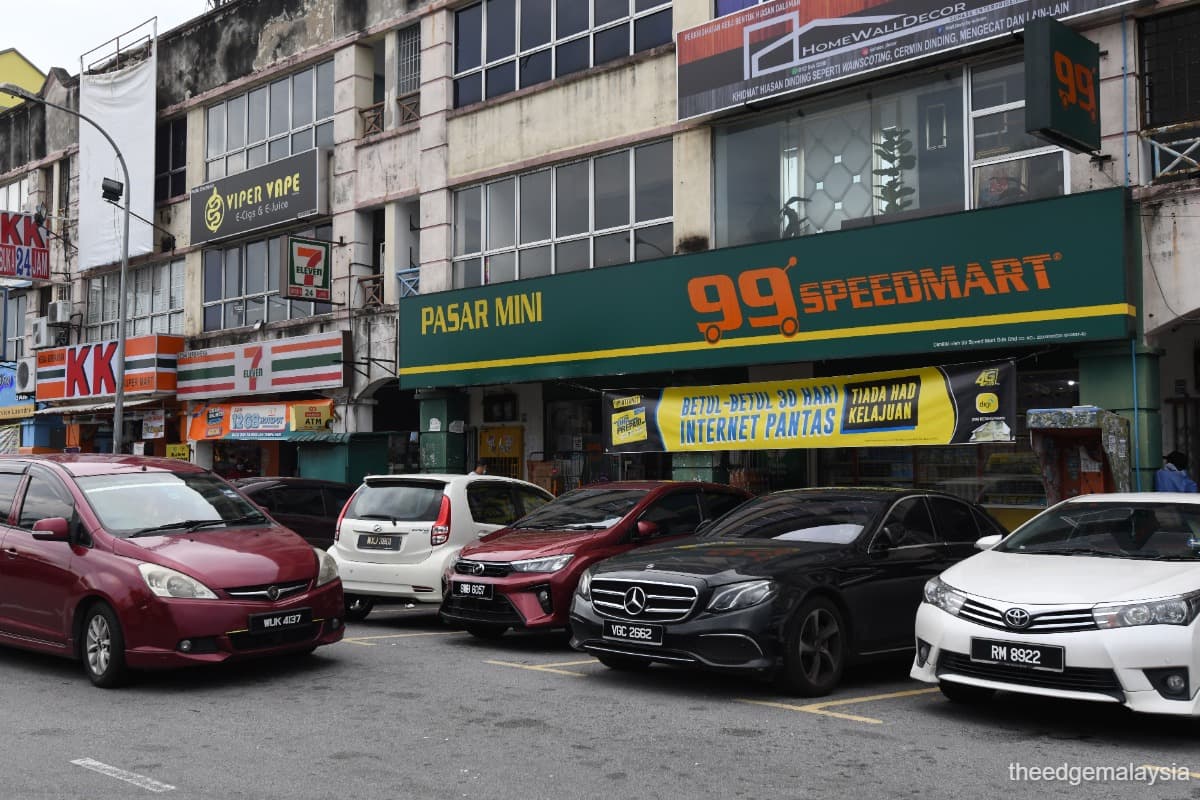
At a PER of 31 times, KK Mart is valued at slightly below competitor 99 Speed Mart Retail Holdings Bhd’s (KL:99SMART) 35 times when it listed in 2024.
The discount is not surprising given KK Mart’s smaller network of branches, 1,000 as at March this year, compared with 99 Speed Mart’s 3,000-odd currently and 2,651 when it listed.
Since its listing at an issue price of RM1.65 per share on Sept 9, 2024, 99 Speed Mart’s counter has doubled, closing last Thursday at RM3.30, and valuing the convenience store operator at RM27.72 billion — significantly more than auto and industrial equipment distributor Sime Darby Bhd’s (KL:SIME) market capitalisation of RM14.24 billion.
At RM3.30 per share, 99 Speed Mart is trading at a trailing 12-month and forward PER of 42.5 times and 37.93 times, respectively, according to Bloomberg.
Could KK Mart hope to follow in 99 Speed Mart’s footsteps in terms of share price performance? With no shortage of companies making their debut on the local bourse and competing for investors’ attention and funds, how will it fare?
“Similar to 99 Speed Mart, KK Mart should be able to garner investor attention as it is in the retail sector that is known for their strong cash flow,” opines William Ng, chief investment officer of research firm LeInves PLT.
In fact, market observers say controversies that KK Mart found itself embroiled in during 2024 and in early 2025, arising from the socks issue and the mislabelling of sandwiches, are well behind the convenience store operator and unlikely to affect investor sentiment.
“In my view, the convenience store segment is the jewel of the consumer sector as the other segments — namely, manufacturing — are finding it challenging due to competition from foreign players,” says private investor and former investment banker Ian Yoong.
He sees convenience stores as a “conduit” between manufacturers and consumers where they can source goods from local and foreign manufacturers. “This segment is an oligopoly where there are a number of large chains, namely 99 Speed Mart, NSK, Family Mart and KK Mart.”
How do KK Mart’s operations compare with that of 99 Speed Mart or other listed convenience store operators?

KK Mart’s draft prospectus, exposed on April 20, offers an insight into its operations.
From its first KK Super Mart in Selangor in 2004, the franchise has grown into a chain of 1,000 stores in March 2026, mostly in Peninsular Malaysia. The majority of its stores operate 24 hours a day and seven days a week.
This is a key difference between KK Mart and 99 Speed Mart, as the latter’s stores only operate from 9am to 10pm.
In the draft prospectus, it is stated that the 24-7 concept enables KK Mart to capture foot traffic between 10pm and 10am when “approximately 50.6% of our sales for FY2025 were generated”.
This puts KK Mart in direct competition with 7-Eleven Malaysia Holdings Bhd (KL:SEM) — the pioneer of the 24-hour convenience store format in Malaysia. However, the difference between their stores are the type and number of products offered.
According to its latest annual report, 7-Eleven stores carry more than 2,500 stock keeping units (SKUs), including popular items such as Slurpee frozen beverages and soft-serve treats.
KK Mart carries a total of 6,852 SKUs with a focus on daily essentials and “on-the-go” convenience products as well as value-added consumer services. The daily essentials fall into the following categories: food and beverage; household; personal and baby care products, apart from toys; stationery; pet food; home electric hardware and information technology accessories.
According to 99 Speed Mart’s latest annual report, it has more than 3,000 SKUs across 50 product categories.
Apart from the goods offered for sale, KK Mart offers services such as prepaid top-ups for mobile service providers and Touch ’n Go, sale of gaming vouchers for online games, and ATM and cash deposit machine services.
Notably, the group has its own in-house brand of generic items targeted at price-conscious shoppers.
KK Mart also has an online version of its physical stores known as KK e-Mart, as well as a presence on aggregator platforms such as ShopeeFood and Foodpanda.
The discount in KK Mart’s valuation when compared with 99 Speed Mart is also justified by the latter’s superior revenue and net profit that translates into higher revenue and net profit per store, based on data from the latest full financial year (see table).
In terms of gross profit margin — a measure of a business’ ability to sell and manage its supply chain, including procuring its merchandise — 99 Speed Mart loses the crown to KK Mart and 7-Eleven. As for overheads control, financing choices and tax strategies, as reflected by the net profit margin, 99 Speed Mart is second to KK Mart while 7-Eleven lags behind both its competitors.
But 99 Speed Mart is the leader in terms of same-store sales growth (SSSG), average value per transaction and average inventory turnover days.
In terms of expansion plans, 99 Speed Mart founder and CEO Lee Thiam Wah has said that the group will focus on its target of adding 250 stores annually while KK Mart is aiming for 1,500 stores by June 2028.
Save by subscribing to us for your print and/or digital copy.
P/S: The Edge is also available on Apple's App Store and Android's Google Play.