


This article first appeared in Capital, The Edge Malaysia Weekly on June 1, 2026 - June 7, 2026
IPOH-BASED bus builder Bus Cap Bhd is steering towards its ACE Market debut with a deliberately modest valuation, betting that sustained earnings growth and strong order visibility will eventually drive a market rerating.
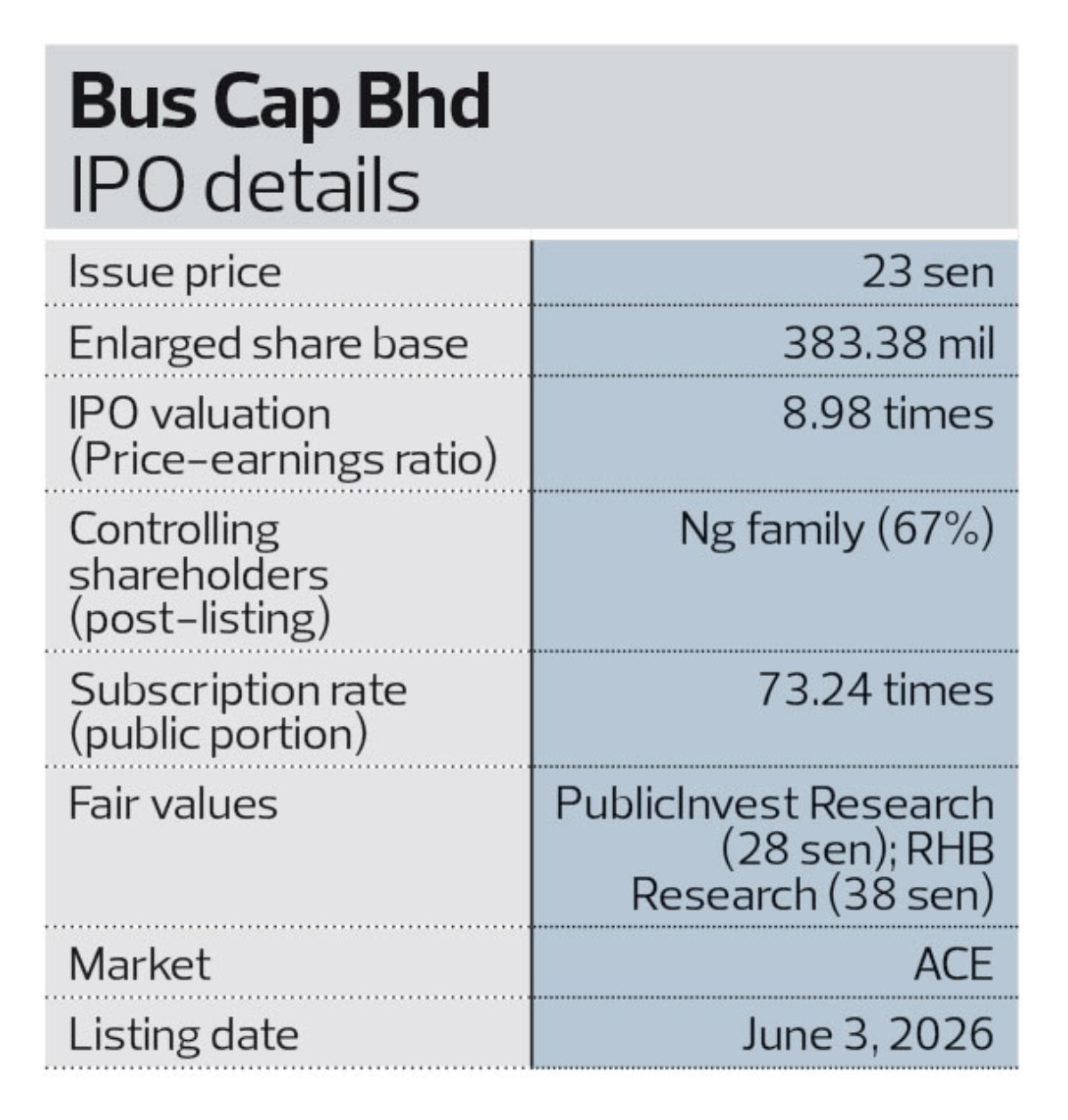
At 23 sen per share, the initial public offering (IPO) values the company at 8.98 times earnings for the financial year ended Dec 31, 2025 (FY2025) — a level the management openly concedes does not fully capture its growth prospects.
Executive director Bernard Ng Chong Yan says the conservative pricing is intentional.
“If you look at our earnings performance, our IPO valuation of about nine times may not fully reflect our value. But we made a conscious decision to price it this way,” he tells The Edge in an interview.
“We are only raising fresh capital of about RM25 million. To be honest, it’s not a large-scale IPO.”
Ng, the grandson of late Bus Cap founder Ng Boon Lan and son of managing director Ng Chai Sing, says the listing is less about maximising value than positioning the company for its next phase of expansion.
“We intend to price the IPO at a reasonable level, so there is room for growth and rerating after listing. For us, the exercise is about expanding production capacity, strengthening our corporate brand, increasing market awareness and improving access to capital for future growth,” he adds.
Ng notes that many recent IPOs in other sectors have debuted at far richer multiples.
“We are coming in at a much lower level. We believe this will attract investors. Our focus is to deliver results first. Once we show consistent growth, the valuation will follow,” he says.
“We are not here to cash out. We are here for the market and the public to grow together with us. We have plans for the next phase, and some of these will require a bigger capital base. Listing now gives us that platform.”
Founded in 1968, Bus Cap started out by producing wooden-bodied buses before turning to metal fabrication in the late 1970s. Today, the group manufactures a range of single-deck, semi-high deck, high deck and double-deck buses, including closed-top double-deck models for the Singapore market. It currently operates four production lines and offers six bus models.
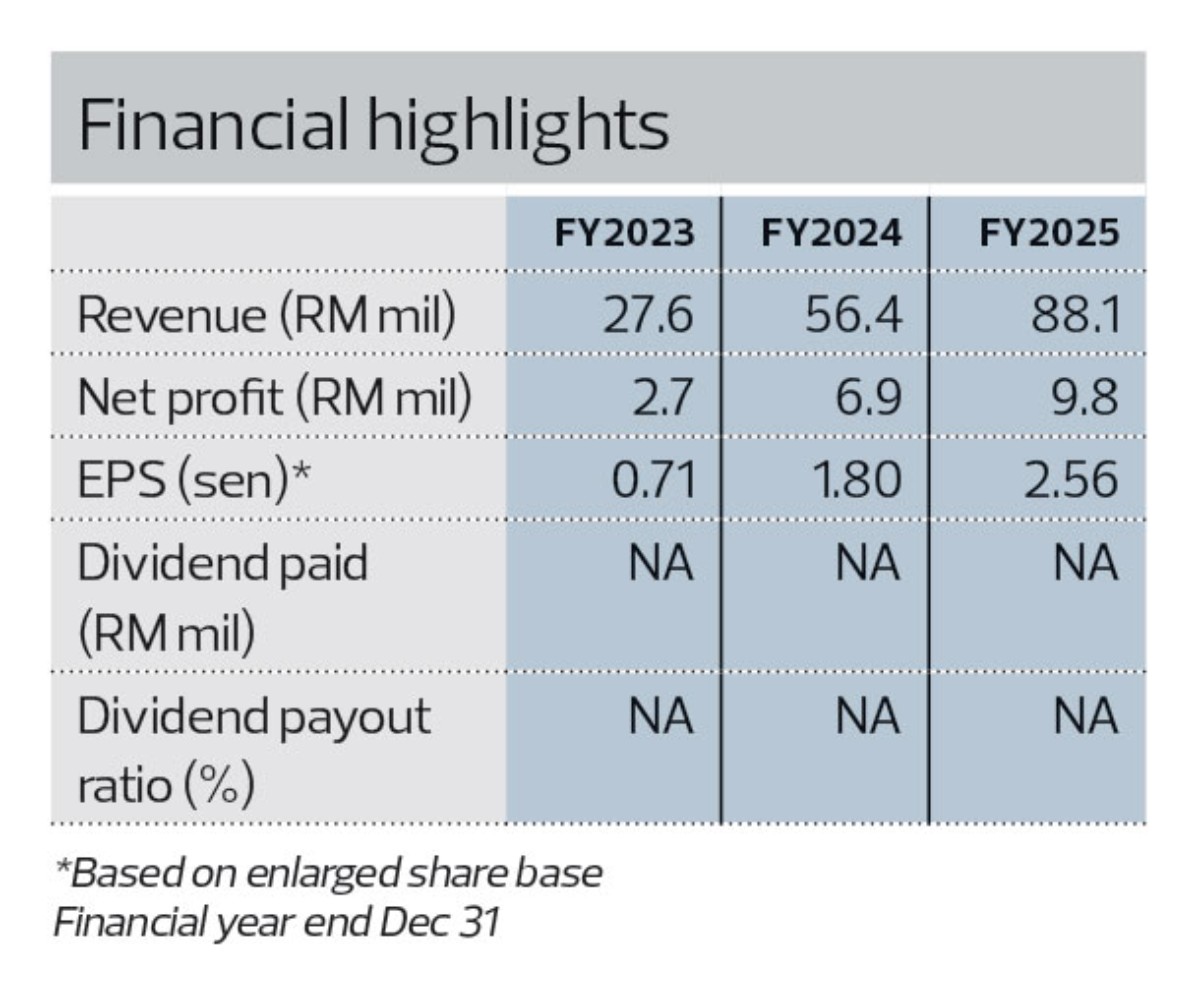
The company’s financial performance has accelerated sharply in recent years. Revenue more than tripled to RM88.1 million in FY2025 from RM27.6 million in FY2023, while net profit rose to RM9.8 million from RM2.7 million.
Based on its enlarged share capital of 383.38 million shares, Bus Cap will debut on Bursa Malaysia with a market capitalisation of RM88.18 million on June 3. Post-listing, NCS Consolidated Holding Sdn Bhd — the Ng family’s investment vehicle — will retain a 67% stake in the company.
For perspective, Bus Cap commands about 10% of Malaysia’s bus-building market, having delivered roughly 130 buses last year in an industry that sees an annual demand of around 1,300 units, says Ng.
“Our local market share is around 10%, making us one of the top bus builders in the country. In terms of ongoing orders, we can say the next one to two years are already secured,” he adds.
“The earnings visibility is there. The key for us now is execution — improving efficiency, shortening cycle time and increasing output.”
The company’s current annual production capacity stands at 168 buses. A new factory and semi-automated fabrication line to be funded by the IPO are expected to raise capacity by about 15% to 194 units a year.
Ng points out that the sector remains relatively defensive despite broader economic uncertainty.
“Unless something extreme like a pandemic happens, demand will always be there. People still need to travel, students still need transport and tourism continues,” he says.
He adds that higher fuel prices could even support demand for buses as consumers shift towards more affordable modes of transport.
There is also a natural replacement cycle.
“Buses have a lifespan, and bus operators cannot keep using old vehicles forever. Even if the economy is slower, they will still need to replace their buses over time. For express operators especially, they need to maintain quality and comfort, so replacement happens regularly,” Ng observes.
Financing risk remains
Still, Ng acknowledges that financing constraints among operators remain one of the sector’s key risks.
“As bus prices increase, buyers need stronger financial capability to secure loans. But historically, this sector has very low default rates, so banks are still willing to lend, especially to established operators,” he says.
At the same time, Bus Cap focuses on larger, financially stronger operators to mitigate credit risk.
For the company, the next chapter is about scaling up. The IPO proceeds will mainly fund a new factory and semi-automated fabrication line, as well as for working capital.
“We have decided to pursue an IPO exercise because the next phase of growth requires a stronger capital base. Bus demand has recovered strongly since the pandemic, with a stronger appetite for higher-capacity models, especially the semi-high deck. This IPO is not about repairing the balance sheet. It is about funding growth,” says Ng.
The offering comprises 126.52 million shares — including 107.35 million new shares, representing 28% of the enlarged share base — which will raise RM24.69 million. Another 19.17 million existing shares have been put up for sale by NCS Consolidated, which will generate RM4.41 million for the investment vehicle.
Post-listing, Bus Cap expects to hold RM26.76 million in cash and bank balances. “We view this as growth capital, not surplus cash,” says Ng.
The company has reduced its customer concentration risk in recent years. The number of customers served expanded to 64 in FY2025 from 13 in FY2022, while its cumulative customer database now exceeds 300.
Revenue contribution from its single largest customer fell to 9.6% in FY2025 from 25.3% in FY2022, while the combined contribution of its top five customers declined to 28.9% from 67.4%.
“Malaysia remains our core market, and we have built a presence in Singapore. We will continue to evaluate regional opportunities in a disciplined way,” says Ng.
TA Securities is acting as principal adviser, sponsor, underwriter and placement agent for the listing. The IPO’s public tranche was oversubscribed by 72.24 times.
In a May 15 report, RHB Research analyst Queenie Tan assigned Bus Cap a fair value of 38 sen per share, implying an upside potential of 66% from the IPO price. According to the research house, the company stands to benefit from rising bus demand driven by tourism recovery, stronger intercity and cross-border travel, and recurring fleet replacement demand tied to the 10-year lifespan rule for express buses.
Malaysia’s new bus registrations rebounded to 1,355 units in 2025 from 276 units during the pandemic, surpassing pre-Covid-19 levels, according to the report.
Save by subscribing to us for your print and/or digital copy.
P/S: The Edge is also available on Apple's App Store and Android's Google Play.