

This article first appeared in The Edge Malaysia Weekly on May 25, 2026 - May 31, 2026
TALK of a snap election has intensified of late, especially since Prime Minister Datuk Seri Anwar Ibrahim did not discount the possibility at the Pakatan Harapan Convention 2026 last week, given the escalating tensions between parties in the coalition government.
The current term of Anwar’s administration is due to end in December 2027, and a general election is required to be held by February 2028.
Economists agree that an upcoming general election would mean tinkering with fuel subsidies — never mind removing it — would be a difficult move for the government.
Surging global oil prices have prompted a renewed debate on whether fuel subsidies should be removed for the top 20% of income earners in the country. Recently, Anwar was reported as saying that the government is in the midst of examining the best mechanism for the proposed revision of the RON95 petrol subsidy for high-income earners.
UOB Malaysia senior economist Julia Goh opines that if the intent is to reduce or conserve fuel consumption in view of the global energy crisis, policies need to be aligned with conservation goals.
“Fragmented or targeted subsidy rollbacks would not suppress demand enough to protect national reserves. If the true intent is resource preservation, a universal price adjustment is the only mechanism broad enough to alter consumption patterns on a meaningful scale,” she says, adding that trying to define “fairness” through targeted rollbacks will only lead to highly subjective debates that polarise communities.
Nevertheless, a universal rollback of subsidies can be a costly move for any prime minister as Malaysian history shows, given how entrenched fuel subsidies are in our society.
In 2008, then prime minister the late Tun Abdullah Ahmad Badawi bravely removed fuel subsidies three months after the March 2008 general election, even though his Umno-led Barisan Nasional coalition had lost its two-third majority in parliament for the first time in history.
The removal of the fuel subsidies caused inflation to spike to 8.5% in July 2008 from 2.3% in January that year as the price of RON95 petrol was increased to RM2.70 per litre from RM1.92. Although the government tried to ease the pain with rebates and cash handouts, the public could not be assuaged.
Eventually, Abdullah was forced out as Umno president and prime minister, with the higher cost of living being the main reason. No other prime minister since has dared to propose a blanket removal of fuel subsidies.
Lee Heng Guie, executive director of the Associated Chinese Chambers of Commerce and Industry of Malaysia’s Socio-Economic Research Centre, calls the removal of fuel subsidies a highly sensitive issue because of its direct impact on the cost of living and its ability to trigger major public discontent, thus impacting electoral consequences if altered abruptly. He does not think the government will make any politically difficult cuts with the next general election looming.
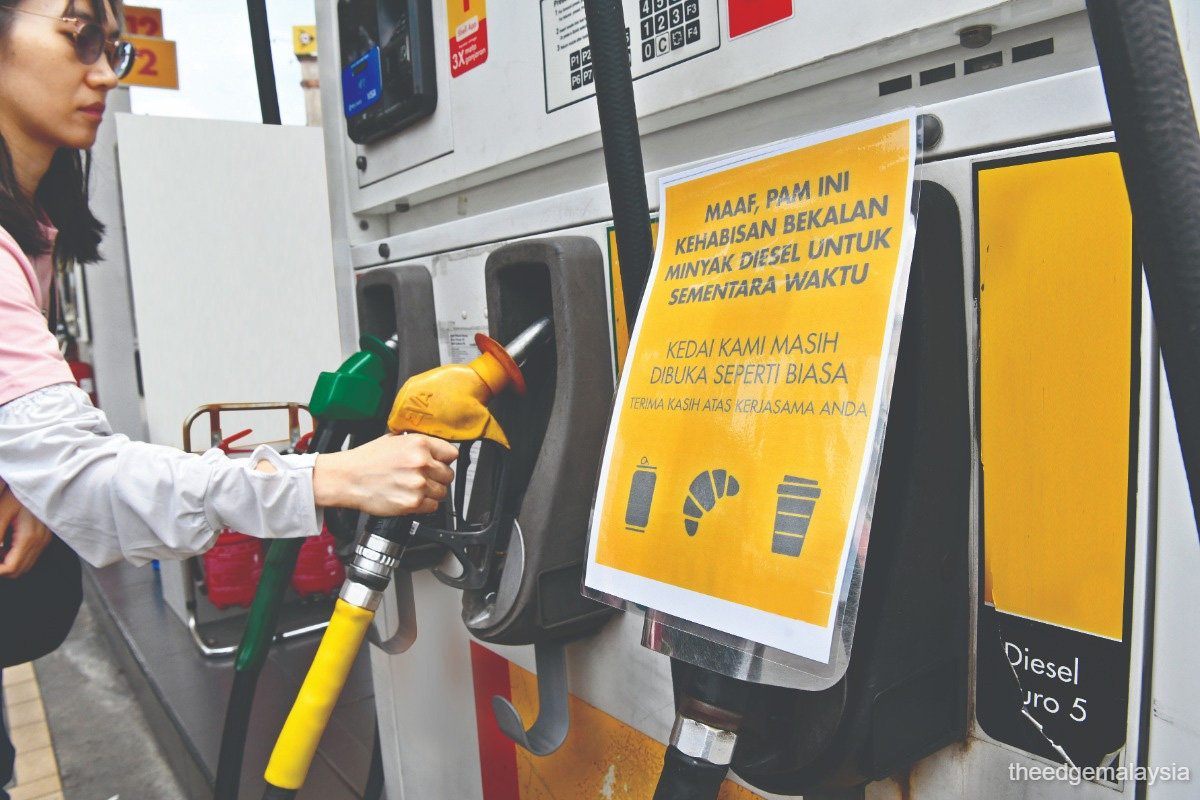
For consumers, this is good news, especially now that global oil prices have surged above US$100 per barrel. However, it is a different story when it comes to the government’s fiscal position. The administration has said it is spending about RM7 billion a month on fuel subsidies, but the amount fluctuates, depending on the market price.
Will this put the government’s target fiscal deficit ratio at risk?
OCBC senior Asean economist Lavanya Venkateswaran expects some fiscal slippage of up to 0.1% of GDP in 2026, with the fiscal deficit at 3.6% of GDP versus 3.7% in 2024. The government’s target fiscal deficit ratio for 2026 is 3.5% of GDP. “The risk is a further widening of the fiscal deficit, especially if global oil prices remain elevated,” she warns.
CGS International Securities economist Ahmad Nazmi Idrus has a slightly different view, as he thinks what matters most is the country’s ability to maintain its GDP growth.
“A stable GDP growth ensures stable tax collection, as the fiscal deficit is calculated as a percentage of GDP. So, maintaining a good GDP growth is key to keeping the fiscal deficit sustained,” he explains.
He also points out that the Federal Constitution mandates that operating expenditure — under which subsidies fall — cannot be larger than the country’s revenue. Since it is unlikely that the government can raise revenue immediately, the easiest path is to cut expenditure, he adds, noting recent news reports that the government was proposing to reduce the healthcare and education budgets.
“If these expenditure reductions are materially affecting GDP growth, then there could be a chance that the fiscal deficit target will be affected. So far, there has not been any signs of large cuts that could drag GDP. So, I’m not ready to revise the fiscal estimates yet,” says Nazmi.
He also points out that during the high oil price years of 2011 to 2014, when the commodity averaged at US$100 to US$120 per barrel, the fiscal deficit had continued to improve. “If we play our cards well, we can still come out on top,” he opines.
As to when the war in the Middle East will come to an end and the Strait of Hormuz — a vital transport channel for oil — is fully reopened, no one knows.
If a peaceful resolution takes place in the near term, it could spare the government from making an unpopular decision on fuel subsidies and allow the incumbent to head into the polls without widespread public discontent.
Should Anwar’s coalition return to power in the next general election, the government will have another term to tackle the fiscal position and hefty subsidy bill. But if the voters decide otherwise, the persistent problems will fall on the next administration.
Save by subscribing to us for your print and/or digital copy.
P/S: The Edge is also available on Apple's App Store and Android's Google Play.