

[To read Part 1, click here]
If the mill is beginning to think, the estate must not remain trapped in yesterday’s notebook.
For many years, the plantation estate has remained the most romantic and stubbornly practical end of the palm oil supply chain. It is where sunrise still matters, rain still interrupts good intentions, roads still decide efficiency, and fresh fruit bunches still have to be cut, collected and evacuated before anyone in the head office can admire a dashboard.
Now comes another promise from the age of smart everything: the digital plantation.
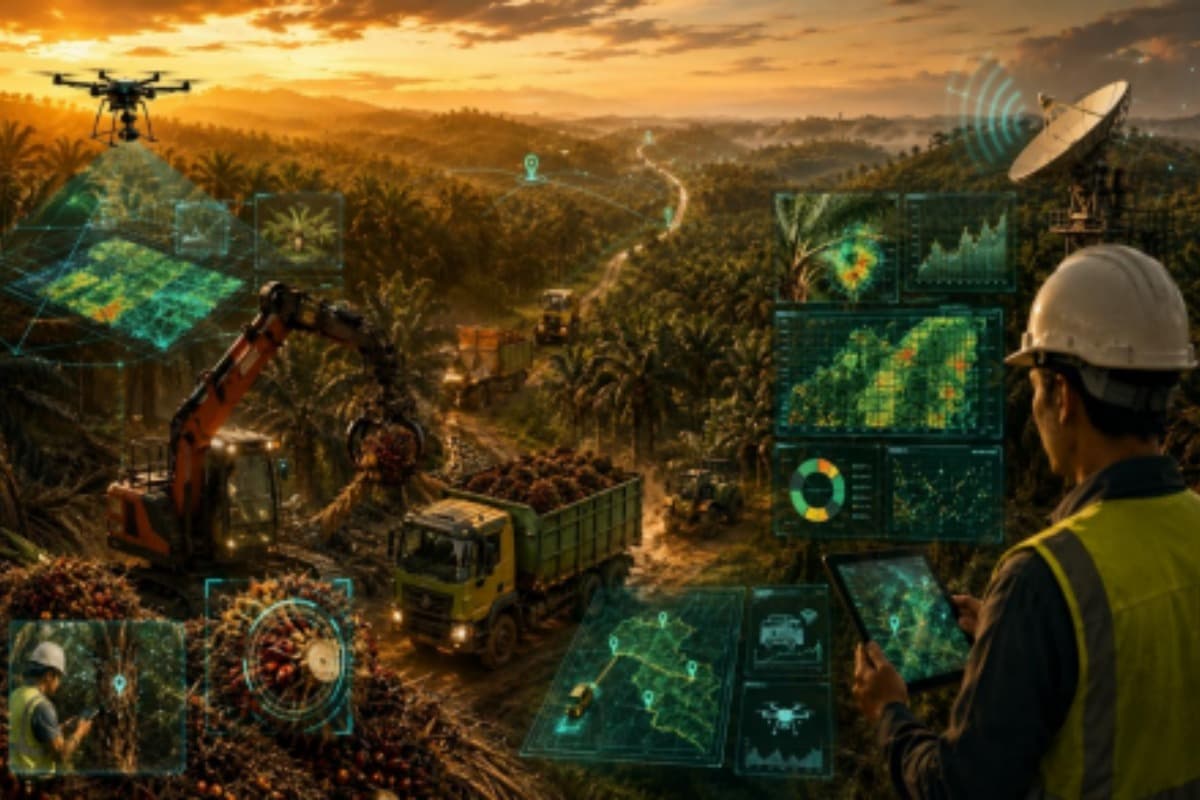
There are plantation digital platforms presenting themselves as end-to-end management systems designed to optimise productivity, control costs and support sustainability by integrating operations, finance, analytics and compliance into one intelligent platform. These systems use artificial intelligence (AI), business intelligence, cloud computing and Internet of Things (IoT), infused with agronomics and plantation management best practices.
The estate gets its digital boots
A plantation estate is not short of data. It has always produced data: harvesting records, manuring records, spraying rounds, weeding progress, pruning, road repairs, vehicle movements, crop evacuation, labour attendance, field inspections, rainfall, fresh fruit bunch (FFB) production, cost statements, budget variances and audit records.
The problem is not that estates lack information. The problem is that too much of it arrives late, sits in silos, depends on manual entry, or becomes useful only after the mistake has already gone for its weekend holiday.
These platforms propose modules covering finance and accounting, labour and resource management, vehicle and equipment tracking, transportation, productivity monitoring, budget planning, work planning through calendars, Gantt charts and alerts, planting monitoring, field inspection and advisory. In plain estate language, they try to bring the loose pages of plantation management into one living system.
That matters because estate management is ultimately a business game of discipline repeated daily. The harvest must be on round. The crop must be evacuated. The fertiliser must reach the palm, not merely the store ledger. The sprayer must cover the correct field. The road must be passable. The tractor must be where it claims to be. The supervisor must know, not guess.
Digital tools will not replace supervision. But they can make supervision less blind.
The map is no longer just a map
One of the most useful aspects of estate digitalisation is the map-based view. A plantation is geography before it is finance. Blocks, terraces, roads, drains, rivers, collection points, steep slopes, replants, poor patches and access constraints all shape productivity.
A good map is therefore not decoration. It is management. Map-based plantation views, IoT-enabled data collection, vehicle tracking, mobile field applications, geolocation, image capture and time-stamped proof of work can help managers monitor estate activity more clearly. They can also support FFB identification, counting and activity monitoring anytime, anywhere.
When a field inspection comes with a photograph, timestamp and location, the old phrase “sudah buat, boss” becomes easier to verify. When a vehicle route is tracked, transport efficiency is no longer dependent on memory, charm or the driver’s storytelling ability. When harvesting output is linked to blocks and dates, crop patterns become clearer. When field work is visible on a map, leakages become harder to hide.
Of course, technology will not abolish human creativity in avoiding responsibility. Plantation people are resourceful. Some are resourceful in the wrong direction. But digital proof raises the cost of casual excuses. That alone is progress.
AI can count fruit, but discipline must count too
Plantation digital platforms also promote automated fruit count and grading using AI tools for better quality and productivity monitoring, including palm fruit detection and dashboard style image analysis.
This is promising. Crop estimation has long been part science, part art, part experience and occasionally part hope. If AI-assisted image recognition can improve FFB counting, bunch grading, crop estimation and harvest monitoring, it can support better planning. Labour allocation, transport scheduling, mill intake coordination and revenue forecasting may all improve.
There is also ongoing work to develop fruit identification for harvesting alerts, where the system can eventually alert the harvester or supervisor when bunches are ready, especially when linked with hardware integration. This is where digitalisation moves from passive reporting into active operational nudging. The estate no longer merely records what has happened. It begins to suggest what should happen next.
But AI can count only what it sees. Poor lighting, variable bunch positions, tall palms, difficult terrain, camera quality, network gaps and inconsistent image capture can all affect accuracy. AI also needs training data that reflects real plantation diversity, not merely neat demonstration conditions.
In other words, AI can assist crop intelligence. It should not become crop superstition with a logo.
Beyond crop: ESG, wildlife and tree health
The next layer of digital estate management will not stop at harvesting, vehicles and productivity. Additional functionality is being incorporated or developed, including an ESG calculator, environmental and wildlife monitoring and tree health assessment.
This is important because the estate of the future will not only be judged by tonnes per hectare or cost per tonne. It will also be judged by how well it records, manages and proves its environmental and social responsibilities. For larger planters, sustainability reporting is no longer an annual decorative chapter in a glossy report. It is becoming operational, auditable and increasingly linked to market access.
Tree health is another important frontier. Yield is not created at the weighing bridge. It begins much earlier, in palm vigour, nutrition, drainage, disease pressure, water stress, terrain and field condition. If mapping data and tree-health observations can be incorporated into the platform, the estate can move closer to predictive management rather than historical explanation.
In selective pilots, data from mapping and tree health are being brought into the platform. Vehicle tracking is already being tested, while human tracking, fruit identification and harvesting alerts are in the works with hardware integration. This is how such technology should mature: not as a dramatic magic show, but as a careful layering of practical functions tested against real plantation conditions.
Connectivity: The quiet game changer
For years, one of the biggest excuses against estate digitalisation was connectivity. Many estates, especially in remote areas, struggled with weak signals, patchy internet and the familiar ritual of walking around with a phone held up like a divining rod, searching for one bar of mercy.
That is changing. With better WiFi options, improving rural connectivity and satellite internet services such as Starlink becoming more available and increasingly affordable, connectivity is becoming less of a wall and more of a bridge. This could be a genuine game changer for plantations.
Once connectivity improves, mobile field apps, geo-tagged inspections, vehicle tracking, real-time reporting, cloud dashboards and remote management become far more practical. The estate manager can see more. Headquarters can respond faster. Technical teams can support remotely. Audits can be better prepared. Younger staff, who grew up in a connected world, may find plantation life less like exile and more like a modern profession with trees.
This does not mean every estate will become a remote-control plantation. Boots are still needed. Field presence still matters. But better connectivity allows the boots to be supported by bandwidth.

Robots can wait; integration cannot
There is excitement around LIDAR, drones, robotics and below-canopy technologies. They will come, especially as labour shortage becomes more serious. But for many estates, broad practical adoption is still some years ahead.
That is fine. The first frontier is not to fill the plantation with robots. The first frontier is to connect the existing operation intelligently: good maps, reliable crop data, vehicle tracking, work verification, fruit identification, harvesting alerts, tree-health monitoring, mill process data, oil-loss monitoring, boiler control, finance integration and ESG proof.
Do this properly, and the industry will have built the platform on which future robotics can stand. Otherwise, we may one day have a drone flying above an estate that still cannot explain why the crop was late. That would be very modern, and very silly.
Smart estates and mills
For years, the palm oil industry has spoken of integration. Field to mill. Mill to refinery. Plantation to market. Farm to fork. Soil to shelf, if one wishes to make it sound suitably poetic after lunch.
But much of this integration has remained more organisational than operational. The estate produces the crop. The lorry carries it. The weighbridge records it. The mill processes it. The accounts department later tries to explain the numbers. By then, the fruit has become oil, the oil has entered the tank, the report has become history, and the argument has begun.
Now, digitalisation and AI offer something more ambitious: not merely a smart estate, and not merely a smart mill, but an integrated AI estate-mill operation.
That, to me, is where the real frontier lies. A smart estate tells us what is coming. A smart mill tells us what is happening to it. But an integrated AI estate-mill system begins to tell us why performance is improving or slipping — and where intervention is needed before the losses become month-end explanations.
As more operating outcomes and performance results emerge, the investment case is becoming harder to ignore. Improvements in extraction, loss control, labour productivity, downtime reduction and process stability are no longer merely attractive talking points for technology brochures.
They are beginning to translate into numbers that owners, planters, millers, engineers and accountants can all recognise. In that sense, the return on investment is becoming increasingly compelling for the plantation sector to study seriously — not as a fashionable leap into AI, but as a phased and practical step towards a more efficient, accountable and future-ready industry.
Traditionally, plantation management has too often worked backwards. At month-end, the crop statement appears. The oil extraction rate (OER) is reviewed. Cost per tonne is discussed. Labour productivity is examined. Transport cost is questioned. The estate may blame weather, terrain, labour, roads or crop pattern. The mill may blame fruit quality, bunch condition, poor crop flow or sterilisation challenges. Finance may blame everyone, but with tables. This ritual is familiar. It is also costly.
An integrated AI estate-mill operation should help move the industry from hindsight to foresight — from explaining yesterday’s losses to anticipating tomorrow’s problems before they become today’s excuses.
When tree health, crop forecasting, harvesting alerts, vehicle tracking and FFB evacuation data are connected to weighbridge intake, steriliser performance, oil losses, boiler efficiency and OER, managers — or those entrusted with watching the pulse of the operation — can begin to see relationships much earlier and more clearly.
Late harvesting may no longer appear merely as a field issue. It may show up as a milling performance issue. Poor evacuation may quietly affect fruit quality. Erratic crop supply may disturb steriliser planning. Weak road conditions may slow transport turnaround. Bunch quality at the ramp can be traced back to the block, the harvester, the harvesting interval, the field condition — and, where the numbers begin to misbehave, even raise early suspicion of theft or pilferage.
Suddenly, “field to mill” is no longer a pleasant slogan for conference slides. It becomes a live operating system — one where the estate speaks to the mill, the mill answers with data, and management has fewer places to hide behind the old phrase: “We only knew after the month-end report.”
The new workforce will ask new questions
This matters even more because the next generation will not enter the industry with the same assumptions as their seniors. Gen Z is already asking different questions, and Gen Alpha will ask them even more boldly.
Can I work from home? Are weekends protected? Is there decent internet? Can Starlink reach the estate? Is the mill connected, or must I still chase information by walking from station to station with a clipboard and a prayer?
Some older hands may smile, sigh or grumble into their coffee. Yet these questions are not entirely unreasonable. A modern industry that wants modern talent must offer modern tools.
Smart estates, smart mills, digital dashboards, remote monitoring, IoT and AI will not make plantation and milling work soft. Nor will they remove the discipline required on the ground. But they can make the workplace more attractive, more professional and more aligned with the expectations of younger engineers, technicians and executives.
If palm oil wants the next generation to come in, it cannot invite them into the future using only yesterday’s wiring.
The frontier is integration
The real promise of AI in palm oil is not isolated smartness. A smart estate alone is useful. A smart mill alone is useful. But an integrated AI estate-mill operation is potentially transformational.
It closes the gap between crop and extraction. It links field discipline to mill performance. It allows management to see causes, not just outcomes. It strengthens compliance and traceability. It supports better labour planning. It makes maintenance and operations more predictive. It gives finance better context. It gives younger talent a more modern workplace. It gives leadership a clearer view of what is truly happening.
The palm oil industry has often been accused of being old-fashioned. Sometimes unfairly. Sometimes with uncomfortable accuracy. But this may be one of the moments where the industry can show that it is not merely defending the past. It is wiring the past into the future.
The old planter had boots, instinct and a notebook. The old miller had steam, sound and experience. The new AI estate-mill operation will still need all of that. But it will add maps, sensors, cameras, IoT, dashboards, algorithms, real-time intelligence and controlrooms. That is not the end of human judgement. It is the upgrading of it.
And if done properly, the future of palm oil may not be found only in higher-yielding planting materials, better refineries or new downstream products. It may also be found in the invisible conversation between the palm in the field and the press in the mill — where data travels faster than excuses, where discipline becomes visible, and where the industry learns, at last, to manage itself as one connected chain.
In the end, AI should not make palm oil less human. It should make human judgement better informed, better timed and, one hopes, less dependent on heroic guesswork after the damage is done.
The old plantation walked. The old mill steamed. The new frontier will still walk, still steam, still smell of fruit, oil, mud and machinery. But now, perhaps, it will also think — or at least help us think earlier, clearer and a little less expensively.
I shall therefore look forward, God willing, to living long enough — and being invited kindly enough — to see a truly integrated and transformative AI estate–mill operation in action, learning, improving and proving its worth. After all, at this age, one must choose one’s excitement carefully. Watching a mill think may be as good as any.
In that sense, the International Palm Oil Millers Conference 2026 was not the end of a milling conversation, but the opening bell for a wider plantation one. It reminded us that AI and digitalisation are no longer decorative words for brochures; they are becoming tools for efficiency, traceability, talent renewal and survival.
The coming International Planters Conference 2026 (IPC26) scheduled for July 13–14, 2026 in Kuala Lumpur, should now carry that conversation from the mill floor to the estate road, the boardroom, the laboratory and the policy table. The industry must move forward, but not through slogan and salesmanship alone. It needs honest, engaging and sometimes uncomfortable conversations — about technology, people, productivity, sustainability and leadership. After all, the future will not wait politely at the guardhouse while palm oil finishes its meeting.
Joseph Tek Choon Yee is a former president of the Malaysian Estate Owners’ Association and past chief executive of the Malaysian Palm Oil Association.