

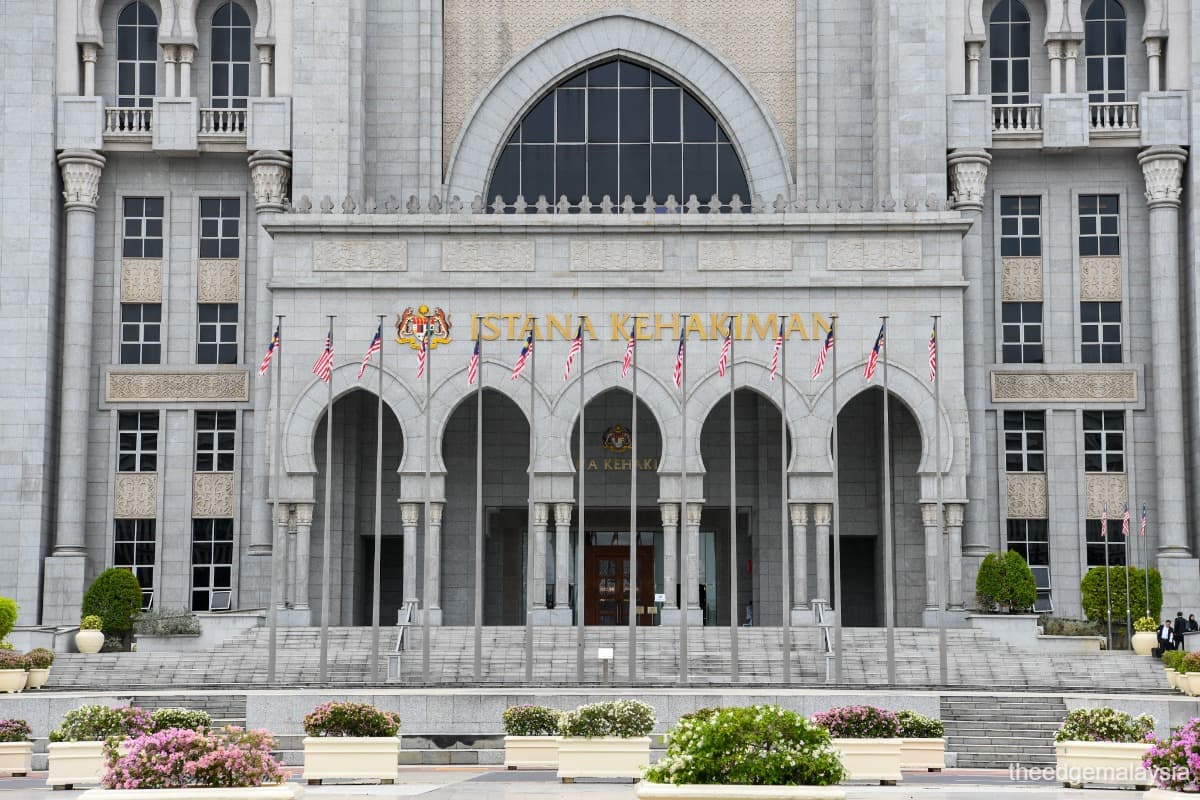
KUALA LUMPUR (May 20): The appellate court has ruled that a section of the Covid-era law passed extending the delivery of vacant possession or completion of common facilities is constitutional, as it does not violate a person's right to property.
In a unanimous decision, a three-member panel lead by now Federal Court judge Datuk Ravinthran Paramaguru, who sat with Court of Appeal (COA) judges Datuk Azizul Azmi Adnan and Datuk Ahmad Fairuz Zainol Abidin, said that rights under the Federal Constitution are permanent, while the Covid-19 Acts passed were a temporary measure, limited to a specific purpose and time.
"What is temporary by definition cannot constitute a permanent intrusion upon constitutional rights," Ahmad Fairuz said in reading the judgement.
The panel delivered the decision last Friday in an appeal filed by homeowners against Sime Darby Brunsfield Resort Sdn Bhd, the minister of housing and local government and then director general of the National Housing Department, Datuk N Jayaselan.
The decision by the panel is also applicable to 10 other separate appeals which were heard together, as they concerned a similar issue.
The nub of the appeals concerned Section 38C of the Temporary Measures For Reducing The Impact of Coronavirus Disease 2019 (Covid-19) (Amendment) Act 2022 ("Act A1641").
In particular, Section 38C(3) states that the minister "shall not consider" an application if it is made "after the expiry of the time for delivery of vacant possession or the completion of common facilities specified under the agreement".
Law was not intended to provide a windfall for developers
The court affirmed that the law was only applicable to projects which were active in construction, not projects that were already behind schedule, abandoned or "sick" projects for reasons unrelated to the pandemic.
According to the broad grounds released later and obtained by The Edge, the court said, "Section 38C was never intended to provide a windfall to developers who had pre-pandemic delays and pre-pandemic defaults.
"Its purpose was targeted and precise — to protect developers whose projects were genuinely on track but were disrupted by the pandemic measures imposed in 2021."
"Subsection (3) exists to exclude the undeserving. Not to bar those whose delays are squarely attributable to the pandemic," the grounds read.
A breach in contract does not translate to violation of right to property
The panel said that the appellants' contention that Section 38C violates Article 13(2) because it affects a compulsory acquisition or use of their liquidated ascertained damages (LAD) rights without adequate compensation, cannot stand.
"Section 38C does not transfer any property, from the Appellants to anyone else. It does not vest any asset, interest or choice in action in the developer or in the state. The developer does not acquire the appellants' LAD rights. Those rights are not extinguished absolutely, they are suspended for a defined period. There is no transfer of ownership, possession or control," Ahmad Fairuz said.
"Section 38C is a general legislative modification of statutory contract rights in response to a force majeure event, not a taking of property for any public or private purpose," he added.
The judge said that this is akin to force majeure clauses in any contract, which "excuse performance for defined periods".
He added that the LAD is mainly a contractual remedy within the sales and purchase agreement (SPA) and a breach does not translate into violation of right to property.
Prior exemptions shift original construction period
Ahmad Fairuz said that the homeowners had accepted and did not challenge the two other exemptions totalling 289 days from March 18, 2020 to Aug 31, 2020, and Sept 1 2020 to Dec 31, 2020, which were granted under a previous Covid-era law.
These exemptions, he said, changes the contractual timeline and the original construction period under the SPA no longer stands.
"The contractual vacant possession date was effectively pushed forward by the accumulated effect of the statutory exclusions," he said.
"More fundamentally," he added, "the appellants cannot simultaneously accept that the first and second exemptions were validly granted, thereby acknowledging that the pandemic impacted construction progress during 2020, while contending that any similar impact during 2021 (when the MCOs and recovery phases continued with equal or greater severity) should attract no relief at all. That is an internally inconsistent position which the law does not permit".
The court affirmed that the third exemption was legitimately granted as the developer applied for it on Feb 16, 2022, when vacant possession had yet to be delivered.
The court also noted that in its application for the exemption, the developer had produced evidence consisting of "detailed chronological table, mapping the various MCO phases and recovery phases throughout 2021, together with technical reports from the project architect and letters from contractors confirming the disruptions encountered".
Vacant possession, he said, was eventually delivered in December, which showed that construction was "genuinely and substantially impacted by the pandemic measures in 2021".
The court also added that although Act A1641 only came into force on Jan 14, 2022, it covers the period of 2021 as explicitly stated in the law.
Court says Section 38C is proportionate to its objective
The court also found that Section 38C was not arbitrary or unjust as it was a carefully drafted law in response to a public health emergency.
"The construction industry suffered RM42 billion in losses due to MCOs between 2020 and 2021. Parliament had clear empirical justification for the measure.
"Section 38C is also proportionate as the objective was to prevent the collapse of the Malaysian housing construction industry during an unprecedented global pandemic, thereby protecting not only developers but ultimately purchasers from the catastrophic consequence of mass abandoned housing projects," Ahmad Fairuz said.