

This article first appeared in The Edge Malaysia Weekly on May 18, 2026 - May 24, 2026

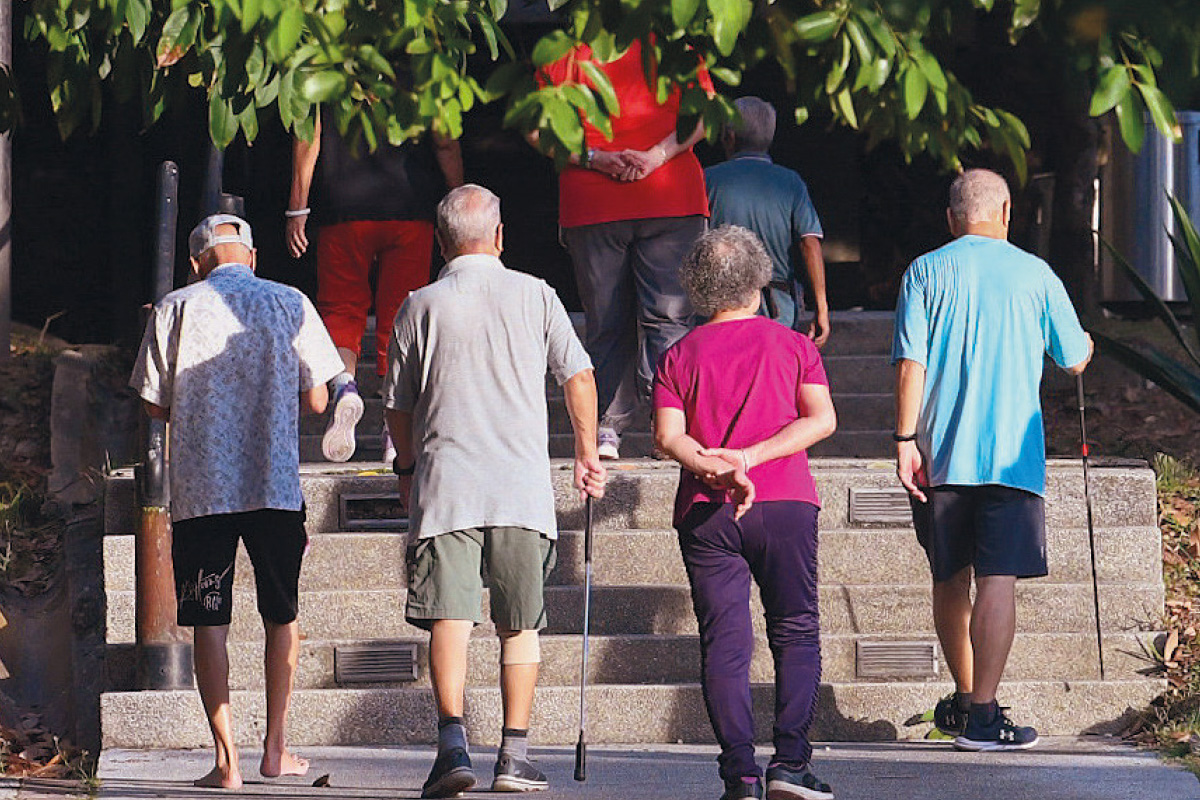
Malaysia’s transition to an ageing nation is no longer a distant projection but an unfolding demographic reality. Data from the Department of Statistics Malaysia (DOSM) reveals that those aged 65 and above reached 8% of the population in 2021, officially placing the country in the “ageing” category. This figure is expected to reach 14% by 2045.
Meanwhile, fertility rates continue to decline and are expected to drop to 1.6 children per woman by 2035, well below the replacement level of 2.1. As the average household size continues to shrink, this shift reflects a longer life expectancy and evolving social structures.
Across Southeast Asia, similar demographic headwinds are evident, although the pace of transition varies. Thailand and Singapore has already attained “aged nation” status and Indonesia is progressing rapidly along a similar path.
In contrast, advanced economies like Japan and South Korea underwent this transition over several decades, supported by higher income levels and mature social safety nets.
However, Socio-Economic Research Centre (SERC) executive director Lee Heng Guie says Malaysia is approaching aged nation status at a significantly faster pace compared with many developed countries, raising urgent questions about how quickly its economic and housing ecosystems can recalibrate.
Nawawi Tie Leung executive director and regional head of research and consulting Saleha Yusoff frames this transition as a structural shift with profound implications for labour dynamics and long-term productivity. “Between 2026 and 2030, about 498,000 people will shift from the 15 to 64 age group into the 65 and above segment,” she says.
The implications are clear: ageing is an impending force that will redefine Malaysia’s economic and consumption landscape, with a significant impact on the evolving needs of the housing market. Yet, beneath the macro data lies a more immediate tension — whether the Malaysian housing system, which is currently geared towards first-time homebuyers and young families, can accommodate an ageing population whose needs are increasingly specialised.
While the market has seen a recent uptick in purpose-built senior housing and assisted living developments, experts suggest the reality is that the vast majority of Malaysians will choose to age in place. The challenge lies in the fact that much of the current housing stock is unsuitable for integrated, age-friendly living. The question is no longer if the market needs to change but whether it can adapt in time to avoid a supply-demand mismatch.
A structural shift reshaping housing demand
This shift calls for more integrated housing options. With smaller households and longer lifespans becoming the norm, the market must reconfigure itself to meet the growing demand for specialised age-friendly living.
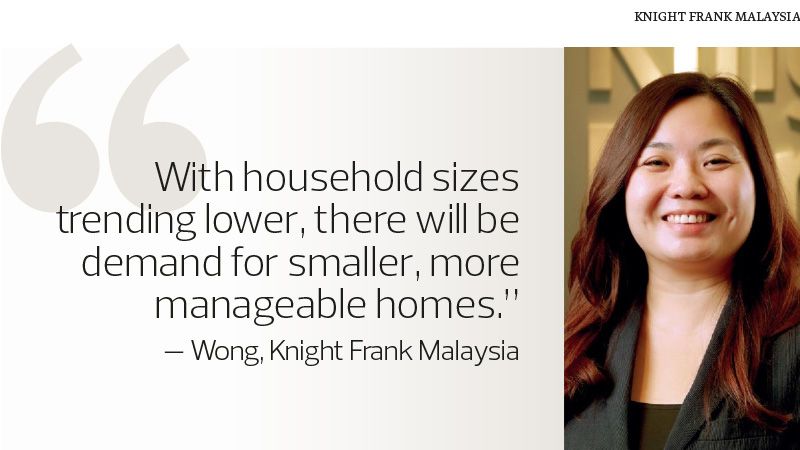
Knight Frank Malaysia executive director of research Amy Wong identifies household formation as the central force in this transition.
“With household sizes trending lower, there will be demand for smaller, more manageable homes. This is not just about ageing but about broader demographic changes that are already taking place,” she says.
This trend suggests a move towards compact layouts and higher-density formats.
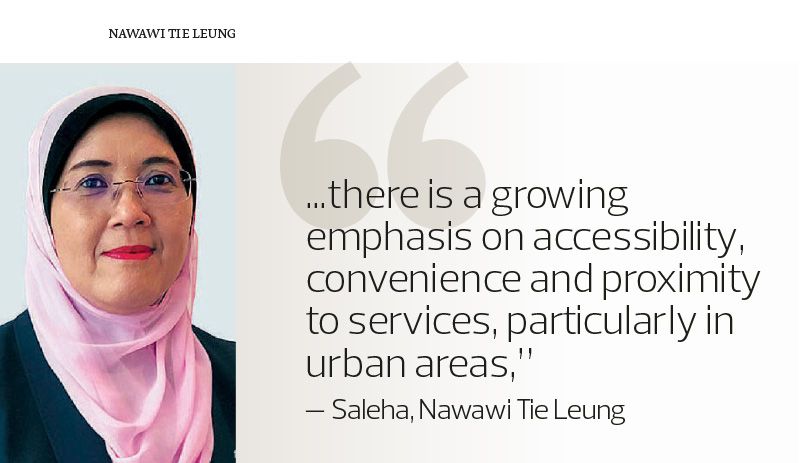
Saleha characterises the shift as structural rather than cyclical. “Demand is increasingly tilting towards smaller, more manageable homes. At the same time, there is a growing emphasis on accessibility, convenience and proximity to services, particularly in urban areas,” she says.
As a result, the traditional model of large, multigenerational households occupying sprawling landed homes is slowly yielding to more stratified living arrangements.
CBRE | WTW Malaysia adviser Foo Gee Jen believes this transition will reshape demand across all segments, with a particular focus on land efficiency. “I believe, because of the scarcity of land [in major cities], that moving forward, this has to be done in a high-rise situation,” he says.
This points to a migration of interest away from landed properties and towards strata and mixed-use developments in established townships, where integrated facilities and flexible floor plans can be more effectively delivered.
Ageing in place as the dominant model
Despite the rise of modern retirement villages, the dominant preference in Malaysia remains ageing in place — a trend shaped by cultural values, financial realities and the desire for social continuity.
Saleha observes that most seniors prefer the “known” over the “new”. “Most older Malaysians in both urban and rural areas prefer to age in place, remaining in familiar surroundings. Rather than relocating, many opt to modify their existing homes,” she says.
This preference is supported by a shift to proximity-based living rather than traditional co-residence. Families may no longer live under one roof but they want to live within the same radius.
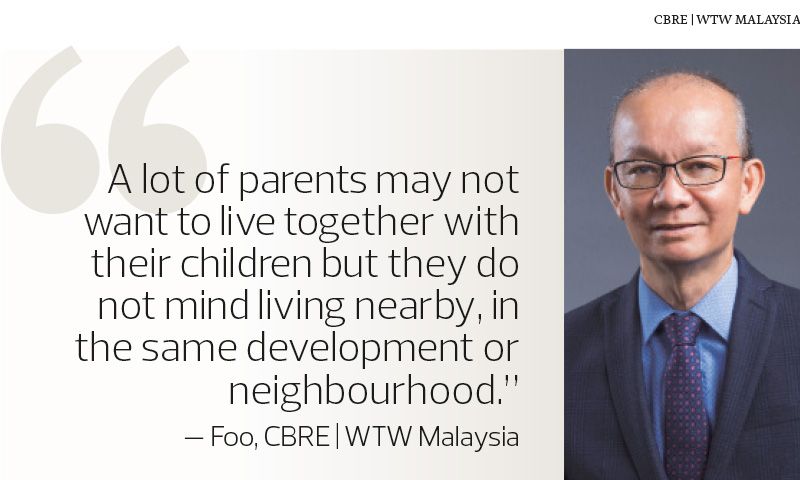
Foo describes this as a recalibration of family dynamics. “A lot of parents may not want to live together with their children but they do not mind living nearby, in the same development or neighbourhood.”
Wong echoes this sentiment, framing the concept as one of psychological security.
“Ageing in place doesn’t necessarily mean living in the same house. It means remaining in the environment you are used to, where your networks, routines and support systems already exist,” she says.
“Because as you grow older, you tend to rely more on familiarity. You know the roads, the area, the people. You try not to do things out of the ordinary.”
However, the decision to stay put is as much about economics as it is about emotions. For a significant portion of the population, alternative housing models remain financially out of reach.
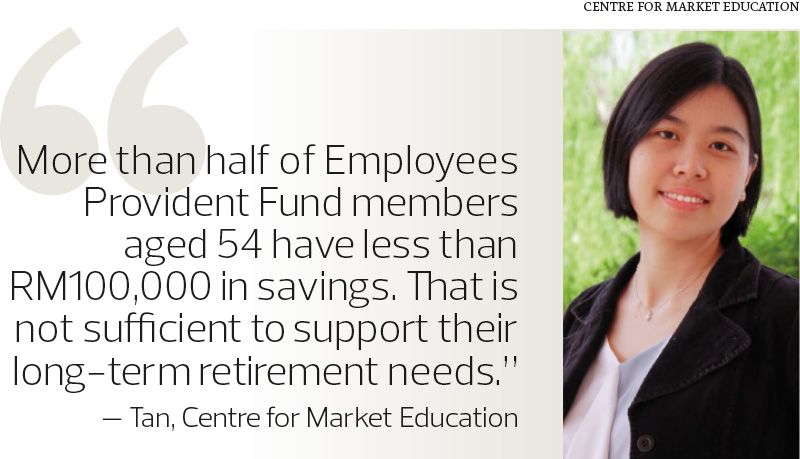
Consilz Tan, a fellow at the Centre for Market Education and a senior lecturer at Xiamen University Malaysia, highlights a retirement savings gap.
“More than half of Employees Provident Fund members aged 54 have less than RM100,000 in savings. That is not sufficient to support their long-term retirement needs, particularly if alternative housing options involve ongoing costs,” she points out.
Many Malaysian retirees find themselves in a predicament — being asset-rich but income-constrained, holding valuable property but lacking the liquidity to fund service-intensive senior living.
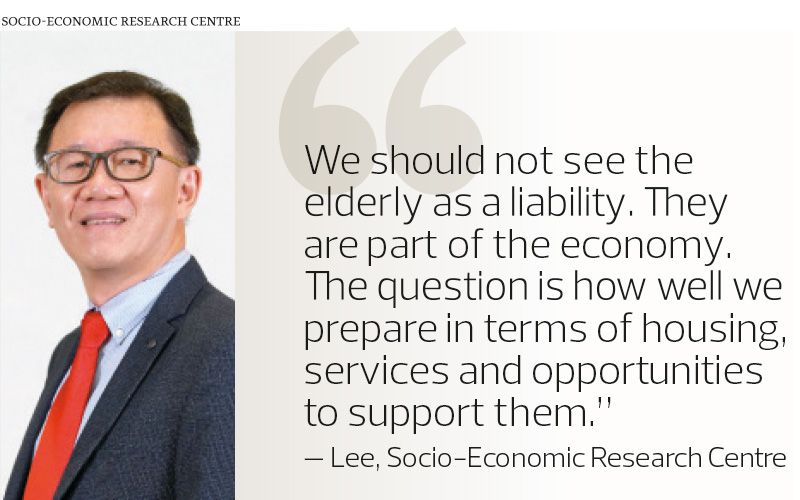
Lee notes that for this group, the priority in retirement is not luxury. It is affordability, accessibility and having basic services such as healthcare, mobility and community support.
“As people age, they want to live with dignity and maintain independence. Many would prefer smaller, more manageable homes that are easier to maintain and more affordable over time,” he explains.
If ageing in place remains the primary model, the focus for the industry must shift towards ensuring the broader housing stock is adaptable. Wong says age-friendly design should no longer be viewed as a specialised niche.
“Developers should not treat ageing as a niche segment. It is something that affects everyone. You have to design your properties [with senior-friendly features in mind] so that people can age in place.”
Senior living potential constrained by structure
While purpose-built senior housing models are being developed rapidly, their role in the broader housing ecosystem is limited by high entry costs and investment ambiguity.
Saleha points to the recurring costs as a primary hurdle for the mass market. “Purpose-built senior living developments typically involve recurring service charges for healthcare support and maintenance, which are beyond the reach of a large portion of the ageing population.”
Beyond costs, the legal and tenure structures of these projects remain a deterrent for some while being an attractive model for the high-income group.
In Malaysia, retirement villages typically operate on leasehold or right-to-use models rather than outright ownership, with leases of at least 10 years, according to Foo.
“The structure of retirement villages is different from conventional housing because many of them are based on leasing arrangements rather than ownership. That raises questions about tenure and long-term security, especially if a resident outlives the lease period,” he says.
He suggests that the sector needs a firmer regulatory foundation to guide both developers and buyers in helping grow the industry over the long term.
“There should also be incentives to support the development of senior living. Without policy support, it will be difficult for developers to bring costs down to a level that is accessible to a broader segment of the population,” Foo adds.
Tan stresses the need for legislative clarity. “In Malaysia, the establishment of a Retirement Villages Act is crucial to maintaining a balance between the rights of the residents and the operators. The legislation should ensure transparency and fairness in the financial terms presented.”
Without such frameworks, senior living may remain a boutique offering for the affluent rather than a scalable solution.
Older housing stock under strain
If the majority of Malaysians continue to live in conventional homes, the suitability of the country’s existing housing stock becomes a pressing concern. Much of the country’s residential inventory, particularly in the affordable and older segments, was built without considering the needs of elderly occupants.
Saleha highlights the physical barriers inherent in older designs. “A large portion of the existing housing stock, particularly older affordable apartments, was not designed for ageing residents. This will increasingly constrain liveability as mobility declines,” she says.
The challenges are practical and pervasive: the absence of lifts in five-storey walk-up apartments, narrow doorways that cannot accommodate wheelchairs and bathrooms that lack safety features.
Wong notes that these issues are particularly acute in urban suburbs. “We still have a lot of walk-up apartments across Malaysia. Without lifts, these become very difficult for elderly residents.”

Upgrading this legacy stock will require a massive undertaking of retrofitting and urban redevelopment. However, given the fragmented ownership of older strata properties, such changes are likely to be slow, potentially leaving a generation of seniors “trapped” in homes that no longer suit their physical capabilities.
Lee advocates that ageing housing be upgraded with safety features, smart technology and community-focused infrastructure, citing Singapore’s Age-Well Neighbourhoods initiative — a community-based strategy to help seniors age in place within their existing housing — as an example.
Reconfiguring housing through integration
Recognising the barriers to dedicated senior facilities, many developers are now choosing to weave age-friendly features into the fabric of mainstream projects. This strategy acknowledges that a building should be able to serve residents from their first home purchase until their retirement.
“For developers and investors, the priority will be less about creating entirely new asset classes and more about embedding age-ready features into mainstream developments, positioning themselves ahead of a demographic shift that will become far more pronounced beyond the next decade,” says Saleha.
This shift also places a premium on location and connectivity. For an ageing resident, the value of a home is increasingly tied to its proximity to healthcare facilities, grocery stores and public transport.
Foo highlights the role of mobility in maintaining autonomy. “Public transport is critical. It reduces dependence on driving and allows older residents to maintain independence.”
This evolution suggests a future where property value is determined by its integration into a wider service ecosystem.
A necessary market adjustment
Malaysia’s ageing transition is no longer a “grey sky” forecast but an active market force.
Over the coming decade, these pressures will likely drive a significant market correction. Homes that lack accessibility or are situated far from essential services may see their value stagnate while adaptable, well-connected properties will likely command a premium.
Lee frames the challenge as one of preparation. “We should not see the elderly as a liability. They are part of the economy. The question is how well we prepare in terms of housing, services and opportunities to support them.”
Current policy efforts to encourage this transition have seen limited success thus far.
Tan notes that existing incentives for retirement villages have yet to achieve the scale needed to impact the mass market.
“The government should consider providing incentives such as tax breaks or grants to encourage the development of affordable housing options for retirees. At the same time, implementing regulations that guarantee the quality and affordability of retirement villages is essential, including setting minimum standards for living conditions and services,” she says.
Tan and Wong echo the need to move beyond an “ownership only” market mindset. “To address affordability and provide more practical solutions, policymakers and developers should explore alternatives such as rental models, assisted living, leaseback arrangements or even reverse mortgage structures,” says Tan.
Wong sees this as a transition far beyond the next 10 years as ownership remains a nationwide cultural preference.
Ultimately, the goal is the creation of a “living ecosystem”. As Tan puts it, “The development of an integrated living ecosystem will be the utmost priority so that older households can access transport, healthcare and community services within a single environment.”
For the property sector, the message is clear: ageing is a structural transformation that will dictate the next cycle of urban development.
Saleha notes that the segment is already gathering significant momentum. “Estimates suggest that Malaysia’s senior living segment could reach RM1 billion to RM1.3 billion in value by 2030, with annual growth rates ranging from 8% to 18%, supported by demographic ageing, urbanisation and rising expectations for quality care and lifestyle-oriented living.”
Ultimately, the alignment between policy and property development will be key to ensuring Malaysia transitions to a sustainable housing ecosystem.
Save by subscribing to us for your print and/or digital copy.
P/S: The Edge is also available on Apple's App Store and Android's Google Play.