

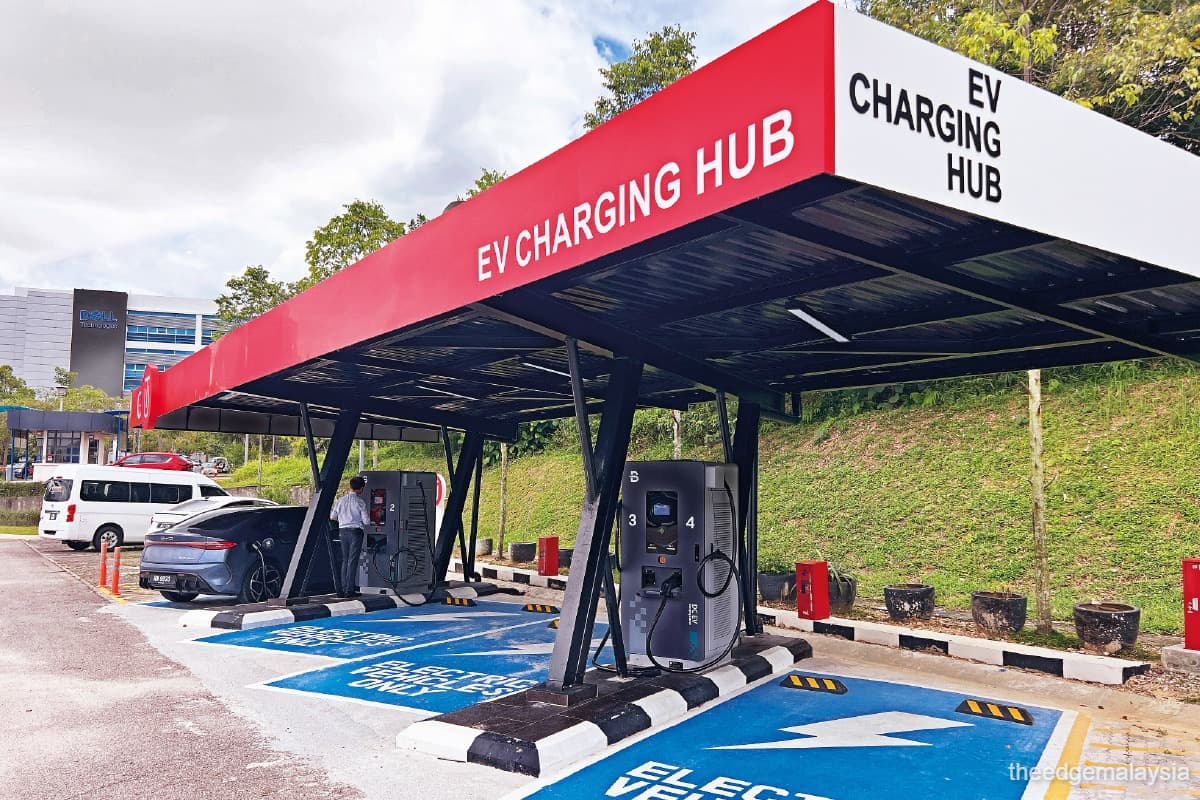
This article first appeared in The Edge Malaysia Weekly on May 18, 2026 - May 24, 2026
In 2021, former minister of environment and water Tuan Ibrahim Tuan Man announced that as part of the larger Low Carbon Mobility Blueprint, Malaysia would have 10,000 charging stations by the end of 2025 to enhance electric vehicle (EV) charging infrastructure and reduce carbon emissions in the transport sector.
Fast forward to 2026 and Malaysia has fallen short of this goal. According to the Malaysia Automotive Robotics and IoT Institute (MARii), as at Dec 31, 2025, there were a total of 5,624 charging stations nationwide, which is 56.24% of the goal.
When asked, MARii chief operating officer Nizmar Mohd Nazar says the target needs to be viewed in the larger context of accelerating the EV rollout rather than a strict, standalone key performance indicator for having more EV chargers.
“In hindsight, the ambition itself was appropriate and necessary. What has evolved is a clearer understanding that charging infrastructure deployment is inherently multi-variable and non-linear, influenced by grid readiness, site economics, regulatory processes and demand maturity,” says Nizmar.

Today, for MARii and the charging point operators (CPOs), the focus has shifted from the number of charging stations deployed to the types of charging stations installed, especially for AC (alternating current) and DC (direct current) types of chargers.
AC chargers are more affordable but slower, supplying from 3kW to 22kW, and could take hours to fully charge an EV. By contrast, DC chargers provide, on average, 350kW and can fully charge an EV within minutes to an hour.
Nizmar adds that, as of Mar 31, the number of public chargers deployed has increased to 5,839. Of these, 3,868 are AC chargers and 1,971 are DC chargers, with a charger-to-vehicle ratio of around 1:16.
Lee Yuen How, managing director of CPO EV Connection Sdn Bhd, which operates chargers under the brand JomCharge, says in the context of DC chargers, Malaysia has met its target.
“Even though we didn’t meet the [overall] target, we met the targets for DC chargers. The government targeted 1,500.”
Lee says this reflects a deliberate evolution and shift in the country’s charging plans and policy road map. He adds that this is a shift from quantity to quality. DC chargers, which enable faster charging, are seen as a medium to accelerate EV adoption, especially in the early stages.

Install right type of chargers at right locations
This shift from installing a fixed number of chargers to the right type of chargers is a lesson learnt by the policymakers and industry players alike.
Lee recalls how, in 2021, 50kW AC charging units were considered fast chargers and were expensive to install. CPOs raced to deploy as many as they could afford. But today, those same chargers are outdated and have been far surpassed by DC chargers.
He adds that this shift to DC charging, beyond enabling faster charging, is also meant to meet new demand. Newer EV models coming into the market require more electricity than before and this shift to faster, more demanding charging is reflective of that.
However, despite the obsolescence of the earlier hardware, he does not regret those early investments. The 50kW chargers did their part in promoting EV adoption to justify continued investment, Lee says.
“When we started with a 50kW charger, we could use the existing supply from the building to support it. But now we see this trend of moving towards bigger-capacity chargers and I don’t think the grid alone is enough to support it in the long term. We need technologies like battery energy storage systems to support the grid to meet this new demand,” he adds.
Kelvin Soon, managing director of ChargEV and DrivEV, subsidiaries of Yinson GreenTech, agrees. He says ChargEV’s “focus is not just on having more chargers but more of the right chargers in the right places, especially higher-capacity fast charging at key travel corridors where demand spikes”.
ChargEV currently operates close to 400 charging stations and aims to double its network by the end of the year.
This does not mean that AC chargers are now obsolete. Soon notes that ChargEV today installs AC chargers primarily in areas where EV users would spend a lot of time. This includes office buildings, hotels and residential areas.
Both JomCharge and ChargEV identified highway fast-charging corridors as their top expansion priority. During festive seasons, queues at highway chargers have become a visible pain point.
This is part of a larger plan to expand EV charging stations to more key locations so that EVs are not concentrated in big cities like the Klang Valley, Johor Bahru and Penang. Having more stations on highways allows cross-state travel via EVs to become more viable, especially as declining EV prices make them more affordable.
“Last time, our concentration was always in big cities. But we can see the adoption of EVs has spread to other cities in Malaysia as well because of the affordability of EVs,” says Lee.
Nizmar agrees, noting that in terms of infrastructure, the focus has shifted towards ensuring speedy deployment of chargers in high-impact areas. This includes expanding DC fast-charging networks along highways and key intercity routes.

Grid readiness, power availability and bureaucracy are key hurdles
On the key factors that prevented CPOs and MARii from hitting that 10,000 target, Soon identifies three constraints.
The first is land access and site readiness. He notes that charging stations require locations that are commercially viable, strategically positioned and able to support appropriate grid capacity, especially in light of the recent push for DC charging.
This leads directly to the second constraint: grid readiness and power availability. Some locations may see strong traffic but lack the electrical capacity to support high-powered EV chargers.
The third is multi-agency coordination. Rolling out charging stations involves multiple parties and processes. From infrastructure planning to local council approvals and various government agencies, all these approvals move sequentially rather than in parallel, stretching timelines considerably.
“In Malaysia, we have roughly 151 local town councils. Each has a different application [process]. We hope the applications for the local town councils can be synchronised so that we can actually quicken the pace of deployment,” says Lee.
He does note, however, that approval times from the Energy Commission have improved significantly, shrinking from 60 days to 30 days, with some cases resolved in as little as two weeks.

Urban living arrangements pose yet another obstacle. A high proportion of Malaysians live in high-rise condominiums, where retrofitting chargers is not always straightforward. JomCharge is exploring options to install more chargers at these buildings, whether as personal chargers or in visitor parking bays.
“In the meantime, we are also trying to put more chargers in street parking,” says Lee.
Additionally, Soon notes that ChargEV is collaborating extensively with local grid distribution planners to secure reliable power connections for future sites.
Despite missing the 10,000-charger target, Nizmar says Malaysia’s EV momentum remains intact. According to the Road Transport Department, the country has achieved a 5.56% EV share of total industry volume as at September 2025, against the National Automotive Policy 2020 target of 20% by 2030.
EV registrations more than doubled in 1Q2026 with 4,717 vehicles registered in March 2026 alone. This is a 58.5% year-on-year increase from 2,976 units in March 2025, notes Soon.
Additionally, macroeconomic headwinds are also nudging consumers towards electrification. Oil price volatility linked to geopolitical conflicts in the Middle East continues to make EVs and their more predictable energy costs an appealing transport alternative, according to the interviewees.
Save by subscribing to us for your print and/or digital copy.
P/S: The Edge is also available on Apple's App Store and Android's Google Play.