

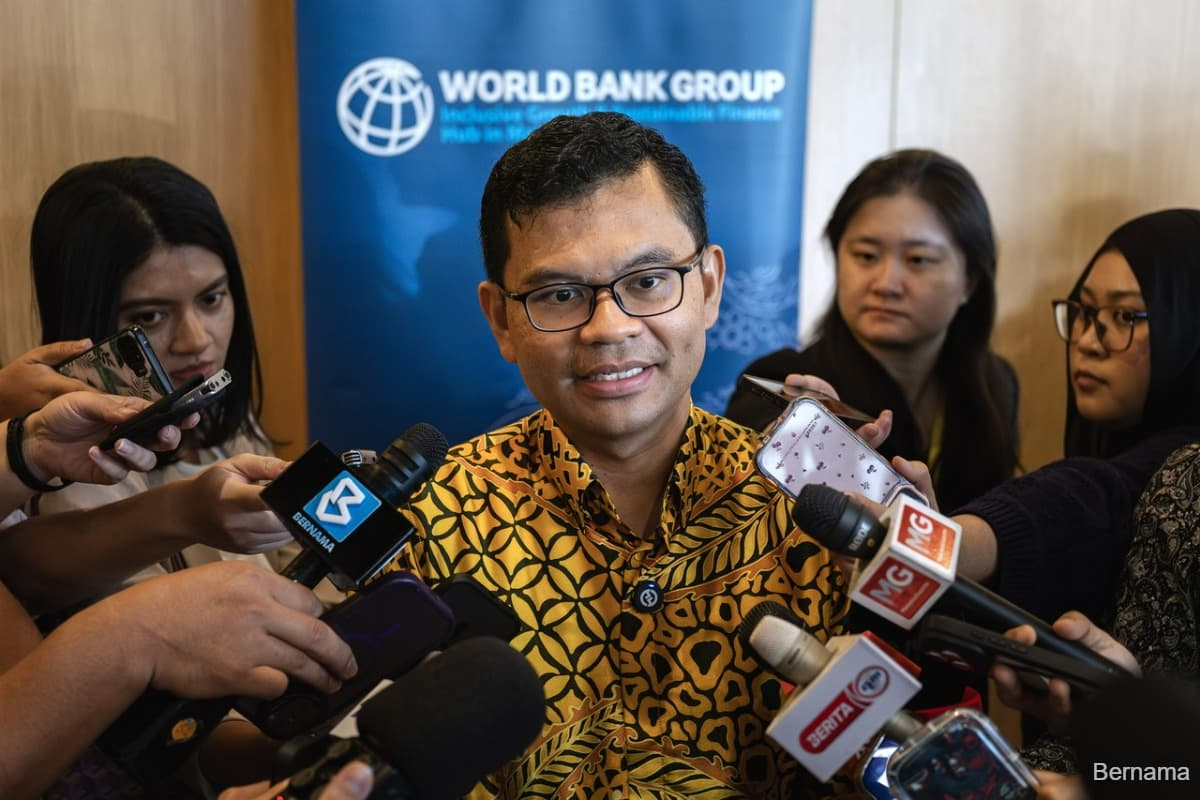
KUALA LUMPUR (May 14): Malaysia’s economic growth in the first quarter may come in better than initially estimated, although the government acknowledged that the prolonged global energy supply crisis is increasingly straining its fiscal capacity to sustain fuel subsidies, Economy Minister Akmal Nasrullah Mohd Nasir said.
He said the initial estimate by the Department of Statistics Malaysia (DOSM) had been "quite conservative", given uncertainties surrounding the ongoing geopolitical and energy crisis.
“Our earlier estimate was already quite conservative, and at the same time, I personally tried to tone down the growth outlook, taking into account the context of the ongoing crisis, but I expect first-quarter growth to be not far from what we projected and possibly better than the earlier estimate,” Akmal told reporters on Thursday.
Last month, advance estimates released by the DOSM showed the country's gross domestic product (GDP) grew 5.3% in the January-to-March period, slowing from 6.3% in the fourth quarter of 2025 and missing the 5.5% median forecast in a Bloomberg survey.
Bank Negara Malaysia is scheduled to announce Malaysia’s official first-quarter GDP figures on Friday.
Meanwhile, Akmal said the government is closely monitoring the impact of the crisis on fuel supply, inflation and fiscal sustainability, while continuing to absorb part of the burden to avoid passing higher costs on to consumers.
“As far as the available fiscal space is concerned, we have to acknowledge that the longer the crisis continues, the narrower that space becomes,” he told reporters on Thursday when asked whether maintaining the subsidised RON95 petrol price at RM1.99 per litre remained fiscally sustainable under the government’s 3.5% fiscal deficit target.
According to the Ministry of Finance, Malaysia’s monthly fuel subsidy bill has surged about 10 times to RM7 billion as of April from about RM700 million before the outbreak of the war, adding fiscal pressure to the government.
Akmal said the government must balance the need to ensure fuel supply security and contain inflationary pressures against the fiscal cost of maintaining subsidies during a prolonged crisis.
“While we assess the scale and duration of the crisis, there also needs to be a balance to ensure that the majority of the rakyat remain protected,” he said.
The minister said the government is currently focused on improving the subsidy management mechanism for diesel, including aligning it with the Budi95 targeted subsidy framework, following Cabinet discussions on the matter.
“As announced yesterday following the Cabinet’s decision, we will also align the diesel mechanism with the Budi95 approach,” he said.
He added that the move is aimed at reducing leakages and smuggling activities arising from the widening gap between subsidised and market fuel prices.
“When there is a significant gap between market prices and subsidised prices, activities such as smuggling and leakages become more pronounced,” he said.
Akmal also clarified that no final decision has been made at the National Economic Action Council or Cabinet level on raising the subsidised RON95 retail price or reducing the monthly individual Budi95 quota further.
“At this stage, there have been no discussions that have led to any final decisions because our current focus is on the rollout of the diesel subsidy mechanism,” he said when asked whether the government had discussed reducing the Budi95 quota or raising the subsidised RON95 retail price. “When a decision is made, we will announce it clearly,” he said.
On Wednesday, Communications Minister Datuk Fahmi Fadzil confirmed that the government was studying the implementation of a diesel subsidy mechanism aligned with the Budi Madani system used for RON95 petrol subsidies.
Fahmi also said the Cabinet had not discussed reducing the Budi95 quota during its latest meeting, reiterating that the government’s current priority was aligning diesel subsidy distribution with the Budi95 mechanism.
The subsidised RON95 quota under Budi95 was temporarily reduced to 200 litres per month from 300 litres, effective April 1, following the escalation of the war in West Asia.