

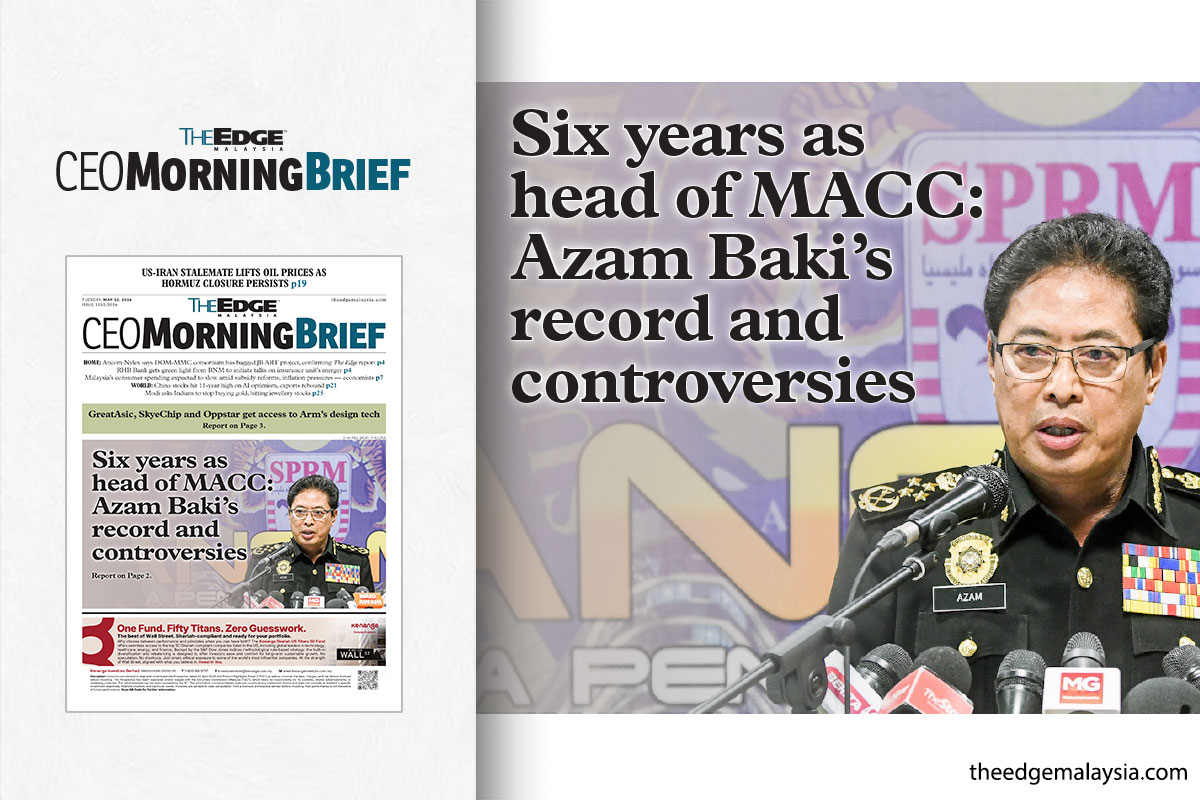
KUALA LUMPUR (May 11): After more than six years at the helm of Malaysia’s anti-graft agency, Tan Sri Azam Baki is set to leave office on May 12 following the government’s decision not to extend his contract.
Born in 1963 in Negeri Sembilan, Azam began his career with the Anti-Corruption Agency (ACA) in 1984, which was later rebranded as the Malaysian Anti-Corruption Commission (MACC).
Over the course of his career, he served in various roles within the agency, including as an investigation officer, intelligence officer and prosecuting officer.
He later rose through the ranks to hold several senior positions, including director of the intelligence division, director of the investigation division and deputy chief commissioner (operations), before being appointed MACC chief commissioner on March 9, 2020.

He succeeded Latheefa Koya, who stepped down after less than a year in office during a period of political uncertainty following the “Sheraton Move”.
Notably, Azam served under three prime ministers — Tan Sri Muhyiddin Yassin, Datuk Seri Ismail Sabri Yaakob and Datuk Seri Anwar Ibrahim — and had his contract renewed in 2023, 2024 and 2025.
During his tenure, the MACC pursued a series of high-profile corruption investigations involving politicians, senior government officials and corporate figures.
However, his leadership was also shadowed by controversy, including questions surrounding alleged abuse of power, institutional independence and governance.
These developments contributed to a divided public perception of his tenure — with supporters pointing to a more assertive enforcement approach, while critics raised concerns over transparency and perceptions of selective prosecution in politically sensitive cases, making him one of the most scrutinised figures to have led the MACC.
High-profile cases
Throughout his more than 40-year career, Azam has been involved in several high-profile corruption investigations involving political figures such as former finance minister Tun Daim Zainuddin and former prime ministers.

One of the most notable was the 1Malaysia Development Bhd (1MDB) scandal, where he served as investigation director. At the height of the controversy a decade ago, the MACC stated that the RM2.6 billion deposited into former prime minister Datuk Seri Najib Abdul Razak’s account was a “donation” from an Arab source.
Azam even told the media in December 2015 that investigators had met the purported donor — a claim later dismissed by the High Court in 2025, which ruled that the explanation lacked merit while upholding Najib’s conviction.
Najib was first charged by the MACC on July 4, 2018 over the SRC International case, while Azam was serving as deputy chief commissioner (operations) at the time.
Another former prime minister, Tan Sri Muhyiddin Yassin, was also charged during Azam’s tenure as chief commissioner in relation to alleged abuse of power and money laundering linked to the Jana Wibawa project. The case remains ongoing.
The MACC’s latest high-profile investigation involves the government’s RM1.1 billion deal with UK-based chip design company Arm Holdings, linked to former economy minister Datuk Seri Rafizi Ramli.
Azam’s pursuit of high-profile corruption cases drew praise from Prime Minister Datuk Seri Anwar Ibrahim, who described him as courageous in taking action against powerful individuals.
Anwar also defended extensions to Azam’s tenure despite criticism from several quarters, citing the MACC’s recovery of substantial sums linked to corruption and financial leakages.
According to the MACC, a total of RM16.3 billion in assets were seized, frozen and recovered under the Anti-Money Laundering, Anti-Terrorism Financing and Proceeds of Unlawful Activities Act 2001 and the MACC Act 2009 during Azam Baki’s stint between 2021 and end-2025.
The commission also recorded 6,643 arrests, charged 2,843 individuals in court and secured 1,459 convictions between 2020 and March 11, 2026.
Controversies
Azam’s tenure was also marked by controversies that drew criticism from lawmakers, civil society groups and governance advocates.
In April 2025, businesswoman and mother Pamela Ling was grabbed from a taxi by men in hoods outside the MACC headquarters after she finished giving her statement in relation to an investigation. Till today, her whereabouts remain unknown. Ling, a Malaysian from Sarawak, had been living in Singapore with her children but was extradited to Malaysia at the request of the MACC. Questions were raised as to how the kidnappers were aware that she was at MACC that day.
Most notably, Azam faced allegations linked to his ownership of shares in listed companies on two separate occasions.
He first came under intense scrutiny in 2021 after reports surfaced that he owned 1.9 million shares in Gets Global Bhd as at end-April 2015, which was later reduced to 1.03 million shares the following year. The company is now known as One Glove Group Bhd (KL:ONEGLOVE).
Azam was also reported to have held 2.16 million warrants in Excel Force MSC Bhd (KL:EFORCE) as at end-March 2016.
He denied any wrongdoing, saying the shares were purchased by his brother using his trading account. The Securities Commission Malaysia (SC), which conducted an inquiry into the matter in 2022, later said it was unable to establish any breach under Bursa Malaysia Depository rules.
However, Azam’s explanation and the SC’s clarification failed to quell criticism from opposition politicians and governance groups, who argued that the episode risked undermining public confidence in the anti-graft agency.
Interestingly, Anwar — then opposition leader — issued a joint statement with Pakatan Harapan leaders calling for Azam to be suspended to allow an independent investigation.
Fast forward to 2026, Azam Baki again found himself embroiled in controversy after Bloomberg reported that he held outsized shareholdings in Velocity Capital Partner Bhd (KL:VELOCITY), allegedly exceeding limits imposed on civil servants.
Azam acknowledged purchasing the shares in early 2025 and said they were sold by July the same year without generating any profit. He maintained that all transactions had been declared in accordance with the law.
In contrast, Anwar has consistently defended the MACC chief and rejected repeated calls for his removal or suspension.
The Cabinet ordered a special investigation led by Attorney General Mohd Dusuki Mokhtar to determine whether the purchases violated public service rules. However, the findings have not been released despite growing calls for transparency.
Adding to mounting scrutiny, Bloomberg published a follow-up exposé alleging the existence of a “corporate mafia” network involving MACC officers and businessmen purportedly working together to target companies for takeovers.
Both Azam and the MACC strongly denied the allegations, with Azam issuing a letter of demand to Bloomberg, describing the report as defamatory and misleading.
The twin exposés further intensified pressure on Anwar — who holds the authority to advise on the appointment of the MACC chief commissioner — not to extend Azam Baki’s contract for a fourth term.
On the day of the April 25 Tangkap Azam Baki rally, the appointment of former High Court judge Datuk Seri Abdul Halim Aman as the new MACC chief commissioner was announced.
To receive CEO Morning Brief please click here.