

This article first appeared in Forum, The Edge Malaysia Weekly on May 11, 2026 - May 17, 2026
"It’s the economy, stupid.” James Carville’s famous line cut through the noise of the 1992 US presidential campaign because it named the thing that mattered. Thirty years on, Southeast Asia’s policymakers need a similar moment of absolute clarity: it’s climate change, stupid.
The stakes are highest in one underreported area: the protection gap. Across Southeast Asia, the gulf between economic losses that climate disasters inflict and the fraction that insurance actually covers is widening at alarming speed. Bridging that gap is not merely a financial problem. It is a question of whether cities and their most vulnerable residents can survive what is coming.
Asean is among the world’s most disaster-prone regions and climate change is making it more so. Typhoons are intensifying. Floods are reaching places that never flooded before. Droughts, peat fires and lethal heatwaves are becoming routine rather than exceptional. The region is not simply unlucky; it is on the front line of a crisis driven overwhelmingly by emissions it did relatively little to produce historically, but where it is now a major contributor to the carbon crisis the planet faces.
Cities concentrate the risk. The very features that made our coastal cities prosperous; their low-lying coastal locations ideal for trade, now leave them acutely exposed. Rising sea levels and coastal erosion threaten their foundations. Heavy rainfall overwhelms infrastructure built for a different climate. And the density of that infrastructure, combined with human activity that defines urban life, traps heat in ways that can turn a heatwave into a public health emergency.
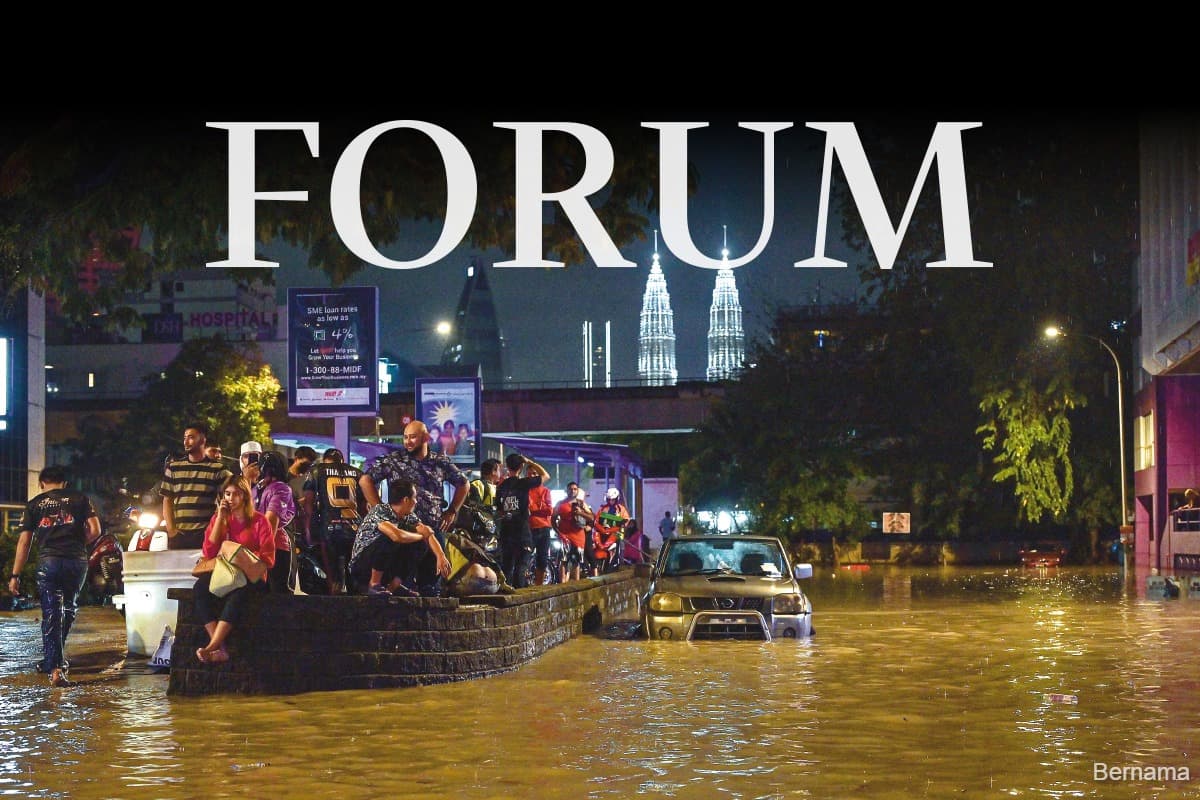
From the sprawling heat islands of Jakarta, Indonesia, to the flood-prone streets of Manila, the Philippines, and Kuala Lumpur, Southeast Asian cities are already living with the consequences. And the systematic vulnerabilities that define them, such as ageing infrastructure, vast informal settlements, low-income housing built in low-lying areas, mean that when the next shock comes, the insurance gap will determine who recovers ... and who does not.
We are no longer reading projections; we are living them. The numbers are unambiguous. So-called natural disasters already drain over US$10 billion (RM39 billion) from the Asean region annually. Over the last 32 years, floods, storms, droughts, wildfires, landslides and extreme heat have claimed more than 200,000 lives across Asean. In Asia-Pacific more broadly, disaster losses just last year amounted to US$73 billion, of which only US$9 billion was insured. That 88% protection gap is not “market inefficiency”. It is a slow-motion crisis, and it is accelerating year on year.
And when the floods or typhoons come, as inevitably they do, it is not the balance sheets of corporations that suffer most. It is the precarious lives of the low-income urban households, the small business owners who prop up the economy, and the marginalised communities who lose everything. Of course, we cannot stop the storms, but we can determine whether, when they hit, cities bend or break. The answer lies in reimagining insurance not as a payout mechanism but as a tool for resilience and adaptation, built on four interlocking pillars.
The first requirement is adaptation. If a city remains high risk, insurance premiums become unaffordable and the market withdraws. Governments across the region should issue green bonds or green sukuk to fund nature-based coastal defences, such as Jakarta’s coastal sea walls or Bangkok’s underground water storage parks in Thailand. By reducing physical risks, they invite insurers back into the market at premiums that ordinary households and small and medium enterprises can afford.
Alongside adaptation must come mitigation. Urban areas account for 70% of global emissions, and a region that fails to reduce its own carbon footprint is simply deferring the problem. Tax incentives and insurance premium subsidies for buildings and businesses that achieve net zero certification would create a virtuous cycle where “low carbon” equals “low risk”, incentivising the private sector to fund the transition.
When a disaster does strike, Asean should formalise a regional “catastrophe shield”, similar to the Caribbean Catastrophe Risk Insurance Facility, which pays member governments within days of a major event, based on objective data such as wind speed or flood depth, rather than waiting months for damage assessments. That kind of immediate capital is needed to repair critical infrastructure such as power grids and water systems while the longer recovery process gets underway.
But the most important pillar is also the most neglected. Conventional insurance fixes the bridge and forgets the person who sells fruit on it. A mobile-platform-based micro-insurance scheme for the urban poor could automatically transfer small cash payments to registered low-income workers when a heatwave exceeds a set threshold or floodwater reaches a specific district. This would prevent the need to resort to negative coping strategies, such as pulling children out of school or selling productive assets, ensuring that a climate shock does not become a generational poverty trap.
These four pillars only work if they are combined as a system. Adaptation without insurance leaves communities exposed when defences fail. Insurance without adaptation prices the poor out of the market entirely. And neither means anything without the political will to treat climate finance as the central obligation of government rather than a problem to be deferred. For the policymaker who still sees this as a peripheral concern, the arithmetic of the protection gap is a direct indictment of that choice.
Insurance is the invisible infrastructure of a stable society. When a city is insured, we are not merely hedging against property damage; we are making a decision about whose losses matter and whose do not. The climate crisis will not wait for the region to resolve that question gradually. The storms are already here. The protection gap is, if we are honest about it, a political choice; and one that can and must be unmade.
After all, it’s climate change, stupid.
Prof Tan Sri Dr Jemilah Mahmood, a physician and experienced crisis leader, is executive director of the Sunway Centre for Planetary Health at Sunway University, Malaysia. She is the founder of Mercy Malaysia and has served in leadership roles internationally with the UN and Red Cross for the last decade. She also sits on several corporate and non-profit boards globally and nationally. In 2019, she was the first Malaysian recipient of the Asean Prize.
Save by subscribing to us for your print and/or digital copy.
P/S: The Edge is also available on Apple's App Store and Android's Google Play.