


This article first appeared in City & Country, The Edge Malaysia Weekly on May 11, 2026 - May 17, 2026
JLL Malaysia’s 2Q2026 report, presented on April 28 at a press conference, highlights a growing tension within the country — while Malaysia sees increasing global investment traction, its physical infrastructure is under increasing strain.
As Malaysia continues to attract significant cross-border interest driven by the “China Plus X” shift and spillover effects from Singapore, JLL warns that the rapid proliferation of data centres is testing the national power grid, while office and industrial stock struggle to meet an accelerated flight-to-quality trend.
Data centres: Grid power strain concerns
Malaysia is on track to becoming one of the largest data centre hubs in Asia-Pacific (Apac). National capacity is set to more than double in 2026 from last year, with Johor leading regional growth at a compound annual growth rate (CAGR) of 17%.
Since 2020, Johor’s co-location market has recorded a 5,262% growth — the highest in Apac, which recorded average CAGR of 70%, according to JLL.
JLL expects nationwide operational capacity to reach 2,055MW by end-2026, with an additional 3,500MW planned beyond 2027. Johor sits at the centre of this expansion, with 850MW operational, 1,800MW under construction and 2,700MW in the pipeline.

Nusajaya in Iskandar Puteri, Johor, remains Malaysia’s premier data centre destination due to its proximity to Singapore via the Tuas Second Link, offering optimal latency for Singapore-dependent workloads.
“With AI (artificial intelligence) transforming from generative AI to agentic AI, this calls for a massive amount of computing power,” JLL director of capital markets and data centres Keith Eng said at the press conference, noting that the emergence of 5G in Indonesia also signifies potential regional competition for cross-border connectivity as mobile data usage accelerates.
However, the concentration of data centres, especially in Johor, has placed unprecedented pressure on local utilities. This poses delays for grid connection — with the period between requesting capacity and receiving it being stretched.
Eng said challenges lie in the wait time for grid connection, with connectivity time at about 24 months for emerging markets and up to eight years in certain core markets.
“Malaysia is in the core market category. In terms of electricity, we are not facing as much of a challenge as other [global] core markets, but local authorities remain selective on types of data centres to supply power to.”

To overcome these limitations, operators are seeking alternative locations across Johor — namely Tebrau, Ulu Tiram and Pasir Gudang — to distribute capacity. JLL identifies solar energy as the likely predominant renewable option for the region.
“We foresee [operators] adopting solar energy for renewable solutions,” Eng added.
JLL Malaysia chief growth officer Christophe Vicic concurred: “Power remains a challenge, and green power remains an even bigger challenge that needs to be addressed at the volume that will allow data centres and other industries to thrive in Malaysia.”
Office: Flight to quality drives market divergence
In the office sector, flight to quality remains a primary driver of market divergence. JLL’s data illustrates a significant pricing gap, where green-certified premium Grade A offices command a 17% rental premium at RM10.47 psf, compared with RM6.77 psf for non-certified Grade A buildings.

Occupancy rates mirror this performance, with green buildings maintaining a 12.4% vacancy rate while non-certified stock struggles at 20.1%.
JLL Malaysia head of leasing advisory Quiny Lee attributed this to a fundamental shift in occupier expectations. “Tenants are prioritising seamless environments and superior amenities, such as concierge services and landlord-managed properties.” She added that owners of legacy assets are now turning to asset enhancement initiatives to retrofit buildings and modern environmental, social and governance (ESG) standards to avoid obsolescence.
“Flight to quality is the key driver here — dated offices are upgrading because occupiers know a better environment is essential for talent acquisition.”
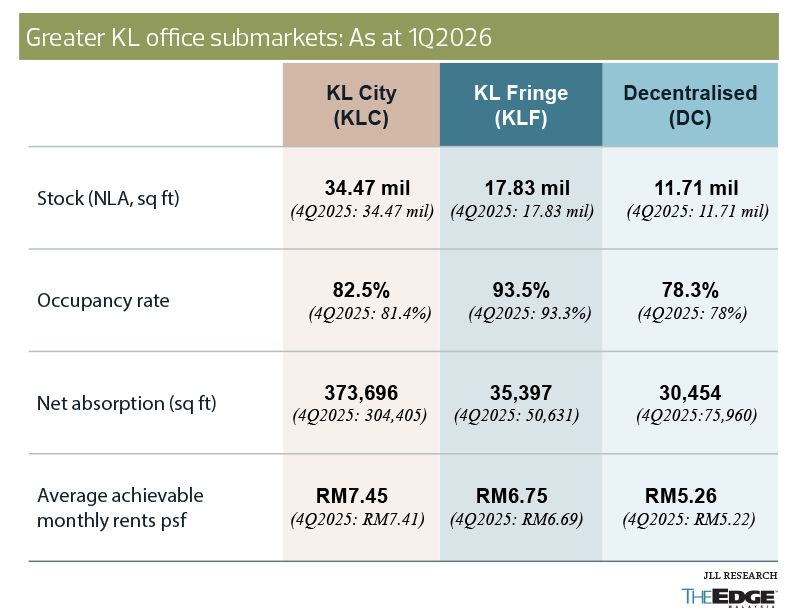
In Greater Kuala Lumpur, the KL fringe remains the standout performer with a 93.5% occupancy rate, far outpacing the 78.3% seen in decentralised zones. While KL city rents average at RM7.45 psf, decentralised nodes offer a more competitive RM5.26 psf.
Penang faces a unique structural challenge with growth hampered by heritage conservation constraints. On the island, rents range from RM3 to RM6 psf while mainland remains a preferred location for multinational corporation (MNC) regional offices and research and development centres, with rents at RM2 to RM3 psf.

In Johor Bahru, demand is increasingly catalysed by the Rapid Transit System Link and the Johor-Singapore Special Economic Zone. Prime rents range from RM3 to RM5 psf, with Medini serving as a purpose-planned commercial hub for tech-focused MNCs.
“Many occupiers are looking to relocate from Singapore to Johor Bahru to tap an integrated ecosystem. They don’t just look at one sector; they seek office space within logistics and industrial hubs and data centres,” Lee explained.
Industrial: Quality factory scarce in key hotspots
The industrial sector tells a similar story: while warehouse supply is increasing, and subsequently granting tenants greater negotiating power, there remains a lack of high-quality factory space in Johor, Greater Kuala Lumpur and Penang, according to JLL Malaysia head of logistics and industrial Derek Yap.
He predicted vacancy rates to remain low for 2026 across all locations, with capital values rising, driven by strong occupier demand. While supply projects remain on schedule, he expects competitive market pressures to delay some completions into late 2026.
Overall, demand is underpinned by the “China Plus X” strategy, with industries such as electrical and electronics (E&E), medical devices and automotive supply chains seeking premium facilities.
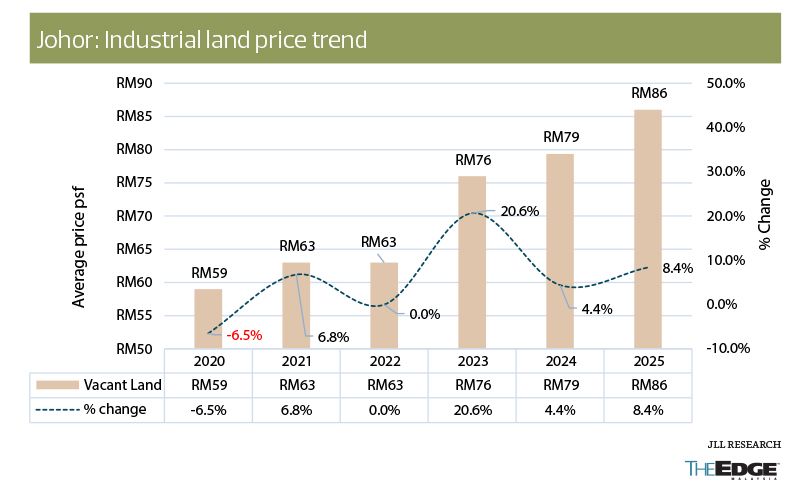
In Johor, strategic corridors like Iskandar Puteri and the Port of Tanjung Pelepas command up to RM150 psf, despite a seasonal 6.6% vacancy uptick.
Yap added, “Strong momentum from logistics operators seeking cross-border logistic opportunities will subsequently increase warehouse demand in Johor.”
In Greater Kuala Lumpur, Shah Alam leads at RM248 psf — nearly doubling in value since 2019 due to key highway connectivity — while Bukit Raja (RM139 psf) and Port Klang (RM102 psf) offer cost-effective alternatives.
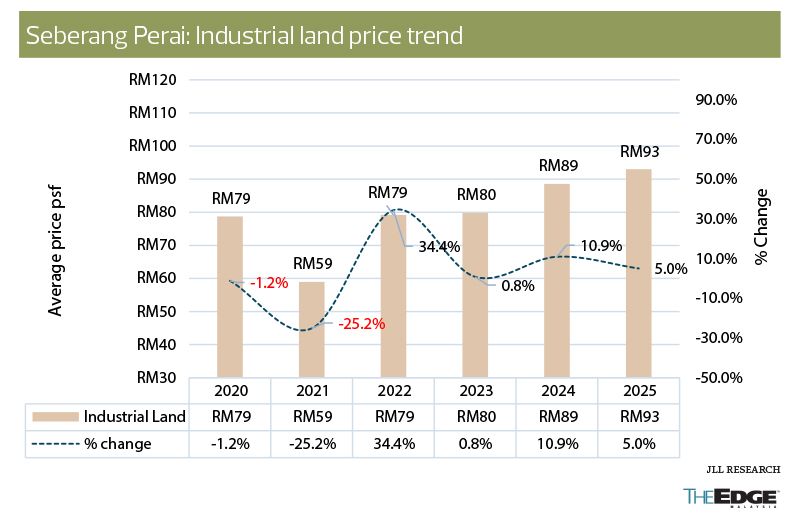
Penang remains equally resilient, with a low 5% vacancy rate and steady demand from the semiconductor and medical manufacturing sectors. Average rents for high-spec logistics properties range from RM2.85 to RM3.50 psf. On the mainland, industrial land in Seberang Perai reached RM93 psf in 2025 — a 5% y-o-y climb.
Residential: Transaction value resilient amid cooling volumes
The residential sector remains Malaysia’s primary economic engine, accounting for 62% of all property transactions.
JLL’s 2025-2026 data reveals a market characterised by healthy liquidity despite a slight 1.5% y-o-y decline in transaction value. Transaction value, however, has increased progressively each quarter since 2021.
The market closed 2025 on a high note, with Kuala Lumpur recording its strongest quarterly performance in five years at RM30.4 billion in 4Q2025.
In the Klang Valley, Mukim Batu continues to lead in the double-storey terraced house and apartment sectors. The region’s serviced apartment sector is seeing a price slowdown, signalling a period of market consolidation.
Meanwhile, Johor’s residential market is entering a natural cooling-off phase after years of rapid growth, while remaining the nation’s price leader. Average serviced apartment prices in Johor Bahru hit RM738 psf, outpacing Penang (RM695 psf) and the Klang Valley (RM608 psf).
Looking at housing demand, JLL Malaysia managing director Jamie Tan identified a growing shift in younger households pivoting towards renting over homeownership — a trend driven by tightening bank financing and he rising cost of living.
“Younger households are choosing to rent while monitoring the market. Low-income earners continue to be wary of future employment, company downsizing, a recession and an escalated cost of living,” he said.
However, Tan foresees little to no impact on the residential market price outlook for the short to medium term.

Macro headwinds: Geopolitical caution
Volatility in global energy prices is filtering into local construction costs with the rise in diesel prices. While JLL does not expect a blanket surge across the board, the price of industrial diesel is impacting transport and manufacturing costs.
Tan warned that the current stability in pricing may be temporary. “Presently, most developers are still utilising their existing inventory of building materials, but once that runs out, we may expect an increase in the overall construction costs. The cost of transporting and manufacturing building materials will inevitably escalate as the energy crisis continues,” he said.
“Uncertainty very well leads to a wait-and-see attitude, manifesting in delayed project launches as developers wait for more favourable conditions.”
JLL CEO of Southeast Asia Michael Glancy added that these cost pressures are compounded by a global cautionary environment. “Certain areas will be impacted in terms of energy prices and in supply chains, which will potentially slow down decision-making.”
Save by subscribing to us for your print and/or digital copy.
P/S: The Edge is also available on Apple's App Store and Android's Google Play.