

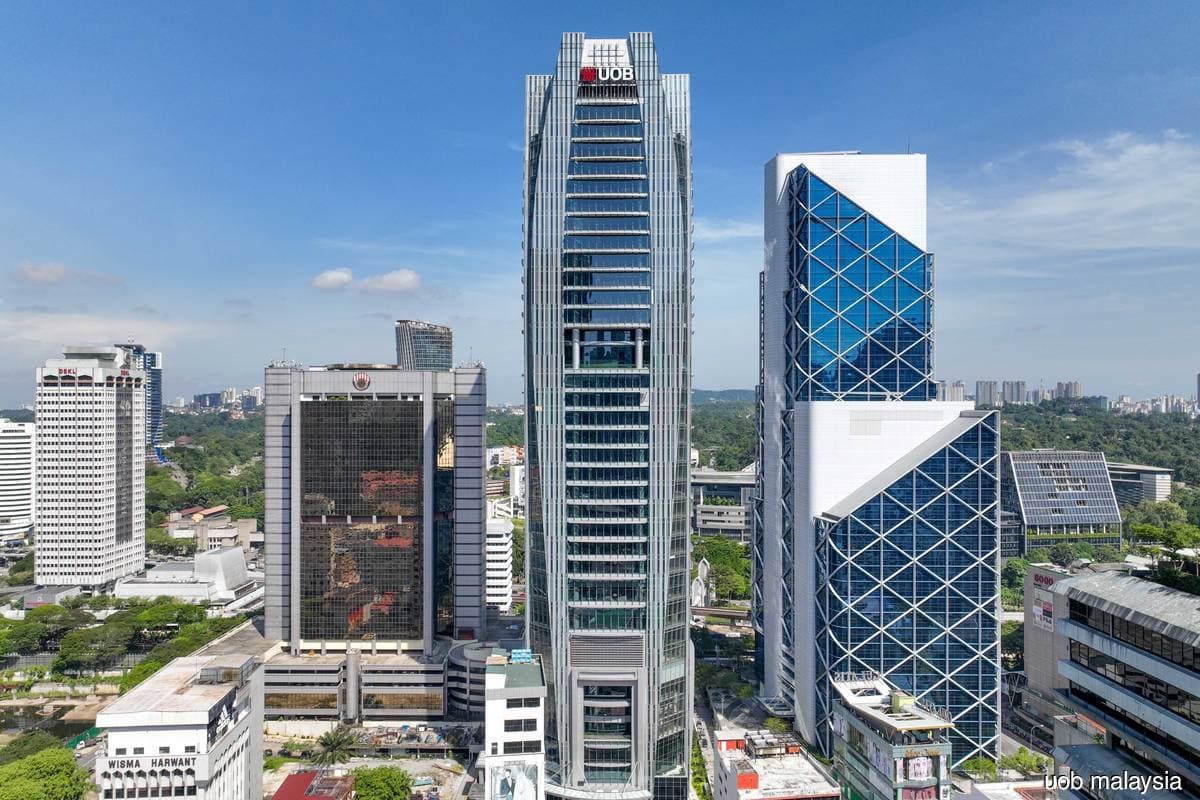
KUALA LUMPUR (May 6): United Overseas Bank (Malaysia) Bhd posted a record-high profit before tax (PBT) for the financial year ended Dec 31, 2025 (FY2025), with earnings rising more than 15% on steady income growth, lower credit costs and disciplined cost management.
The bank’s PBT rose to RM2.5 billion in FY2025, compared with RM2.2 billion a year earlier, according to a statement on Wednesday.
The improvement was supported by a 9.5% growth in operating profit and a sharp decline in credit losses, which fell nearly 70% due to write-backs from non-impaired assets.
Operating income increased 4.5% year-on-year to RM4.9 billion from RM4.7 billion, underpinned by stronger net interest income from an optimised balance sheet, higher non-interest income and improved contributions from its Islamic banking business.
UOB Malaysia also reported better cost efficiency, with its cost-to-income ratio narrowing by more than two percentage points.
On the balance sheet, gross loans, advances and financing grew 2.8% to RM112.6 billion from RM109.5 billion, supported by both the wholesale and retail segments.
Non-bank deposits rose 5.8% to RM121.3 billion, with the bank maintaining a focus on quality deposits. This led to an improved funding mix and a higher current account savings account (Casa) ratio.
Capital buffers remained strong, with a common equity Tier 1 (CET1) ratio of 14.7% and a total capital ratio of 17.9%, well above regulatory requirements.
In the statement on Wednesday, UOB Malaysia chief executive officer Ng Wei Wei said the performance reflected the resilience of the franchise and prudent risk management.

"This strong performance reflects the resilience of our franchise, prudent risk management and our continued focus on building a sustainable, well-balanced business to support our customers and Malaysia’s long-term growth,” she said.
As it marks its 75th anniversary, UOB Malaysia said it will also deepen regional connectivity and expand cross-border capabilities, supported by Malaysia’s resilient domestic demand, stable labour market and ongoing structural economic reforms.