

This article first appeared in Forum, The Edge Malaysia Weekly on April 27, 2026 - May 3, 2026
The unfolding crisis in West Asia has once again exposed the fragility of global governance, the limits of international institutions and the enduring consequences of political failure. While the geography may be distant from Malaysia, the underlying issues — conflict, injustice, leadership and accountability — are not unfamiliar. They echo questions we have long grappled with at home: What defines responsible leadership? How should power be exercised in times of crisis? And what does moral courage look like when the stakes are high?
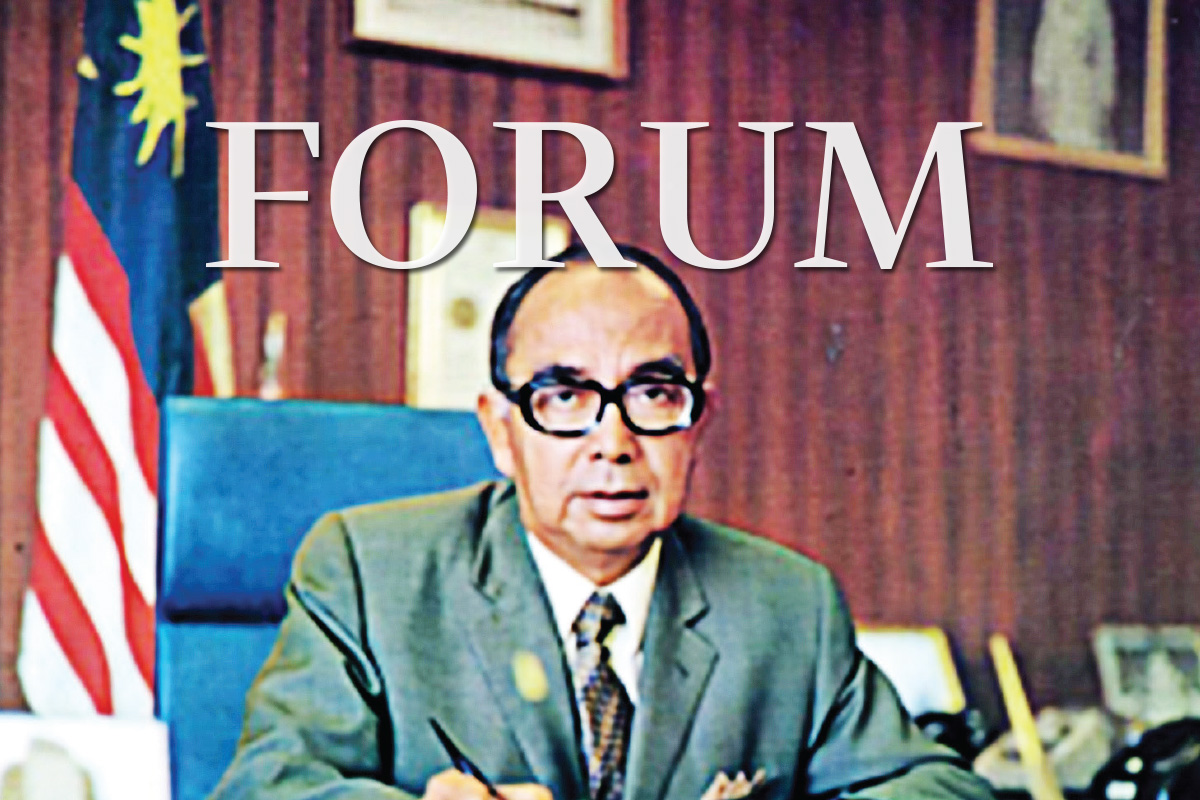
To reflect on these questions, it is instructive to revisit the leadership philosophy of Tun Abdul Razak Hussein, the nation’s second prime minister. His approach to governance, particularly in moments of national upheaval, offers a framework that is both grounded and strikingly relevant to today’s global disorder.
Razak governed Malaysia at a time of profound instability. The aftermath of the May 13, 1969 riots was not merely a domestic crisis; it was an existential one. Communal tensions had erupted into violence, trust in institutions had eroded and the future of the nation was uncertain. Yet, in navigating that crisis, Razak demonstrated three defining principles: decisiveness; institutional integrity; and a commitment to long-term stability over short-term expediency.
In commemoration of the 50th anniversary of his passing, a forum organised by Universiti Malaya’s Asia-Europe Institute last week, at which I was a panellist, provided a platform for reiterating the principles that Razak demonstrated in his service to the nation.
Applied to the current West Asia crisis, these principles suggest a markedly different approach from what we are witnessing globally today.
First, decisiveness anchored in justice. Razak did not equivocate when confronting corruption or threats to national unity. He acted swiftly, even when it meant removing senior officials or taking unpopular positions. In the context of West Asia, this raises an uncomfortable but necessary question: where is the moral clarity in global leadership? Too often, responses to the crisis have been shaped by strategic interests rather than consistent principles. Razak would reject selective outrage. He would insist that the protection of civilian lives, adherence to international law and accountability for wrongdoing are non-negotiable — regardless of who the actors are.
Second, the primacy of institutions over personalities. One of Razak’s most remarkable decisions was to relinquish extraordinary powers once stability returned, restoring parliamentary democracy and strengthening institutional frameworks. He understood that sustainable peace cannot rest on individuals; it must be embedded in systems that outlast them.
In West Asia, the persistent failure has been precisely this: the absence of credible, trusted institutions capable of mediating conflict and enforcing agreements. Ceasefires collapse, negotiations stall and cycles of violence repeat because institutional legitimacy is weak or contested. Razak would likely argue that any durable resolution must prioritise rebuilding institutional trust — whether through multilateral frameworks, regional cooperation, or renewed commitment to international bodies that can act impartially.
Third, addressing root causes rather than symptoms. The New Economic Policy (NEP), often debated in economic terms, was fundamentally a peace-building instrument. Razak recognised that inequality and marginalisation, if left unaddressed, would continue to fuel resentment and instability. His policies sought to recalibrate socioeconomic imbalances as a pathway to national unity.
The lesson for West Asia is clear. Humanitarian aid and temporary ceasefires, while necessary, are insufficient. The deeper structural issues — displacement, statelessness, economic deprivation and political disenfranchisement — must be confronted. Without addressing these underlying grievances, any peace will remain fragile, if not illusory.
Equally important is Razak’s emphasis on inclusivity. Through the National Consultative Council, he brought together diverse voices — political, religious and social — to shape the nation’s recovery. This was not merely a political exercise; it was an acknowledgment that legitimacy comes from participation. In contrast, many diplomatic efforts in West Asia have been criticised for excluding key stakeholders or failing to reflect the realities on the ground. A more inclusive process, though complex, is essential for any agreement to hold.
There is also a lesson in humility. Razak did not seek power for its own sake. His leadership was marked by a willingness to act decisively and then step back, allowing institutions to function. In today’s global arena, where geopolitical competition often overshadows humanitarian considerations, such restraint is rare. Yet it is precisely this restraint that is needed to de-escalate tensions and create space for genuine dialogue.
Of course, it would be naïve to suggest that the complexities of West Asia can be resolved through analogies to Malaysia’s past. The historical, political and geopolitical contexts are vastly different. However, the principles of good governance are not bound by geography. They are universal: accountability; transparency; inclusivity; and the courage to act in the public interest.
The tragedy of the current crisis is not only the scale of human suffering but also the apparent erosion of these principles at the global level. When rules are applied inconsistently, when institutions are weakened by politics, and when leadership lacks moral clarity, the consequences are measured not just in instability but in lives lost.
Razak’s legacy reminds us that leadership in times of crisis is ultimately a test of values. It is about making difficult decisions, upholding principles even when inconvenient, and building systems that endure beyond one’s tenure. These are not abstract ideals; they are practical necessities for peace and stability.
As Malaysia continues its own journey in strengthening governance and integrity, there is value in looking outward and recognising that the same challenges — of power, accountability and justice — play out on a global stage. The question is whether we, collectively, are willing to apply the lessons we already know.
Razak did not have the luxury of easy choices, and neither do today’s leaders. But he demonstrated that even in the most turbulent times, it is possible to act with clarity, purpose, and integrity. In a world searching for direction, that example remains as relevant as ever.
Datuk Dr Anis Yusal Yusoff is principal fellow at The Institute of Ethnic Studies (KITA), Universiti Kebangsaan Malaysia. He is a former president and CEO of the Malaysian Institute of Integrity.
Save by subscribing to us for your print and/or digital copy.
P/S: The Edge is also available on Apple's App Store and Android's Google Play.