

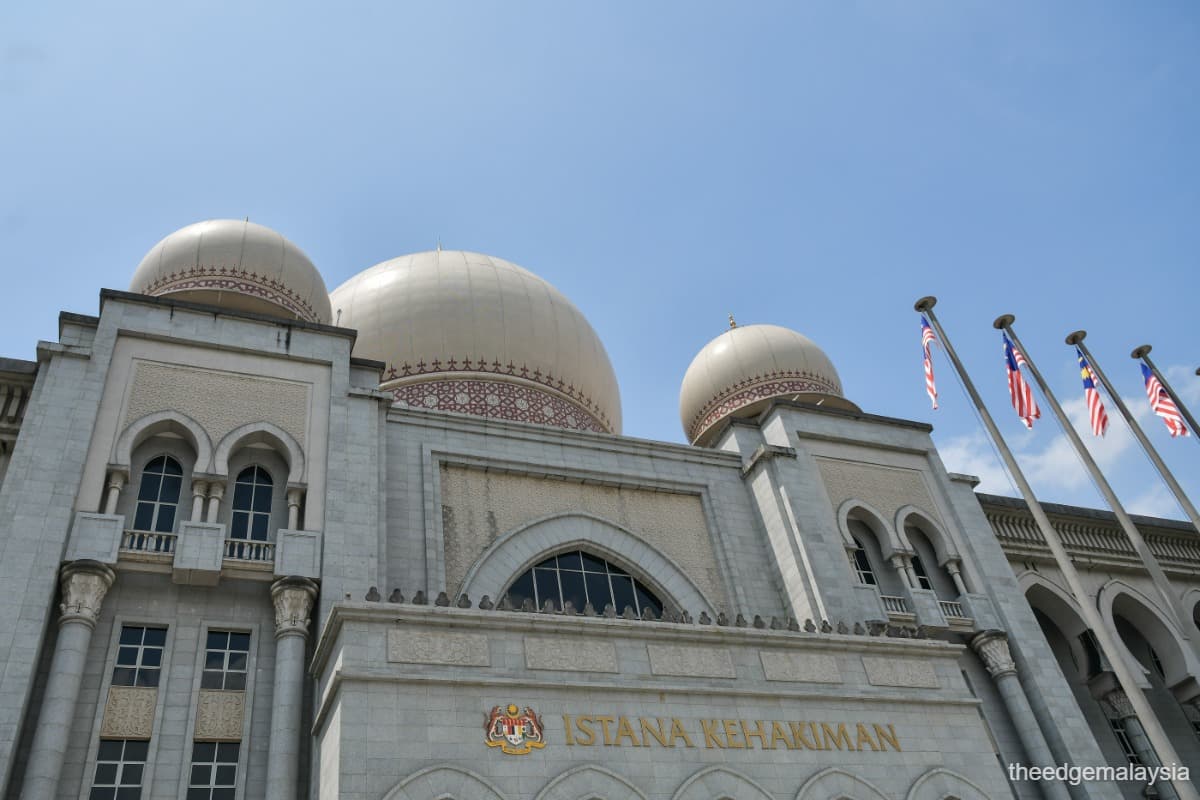
PUTRAJAYA (April 24): The Court of Appeal maintained that Kepala Batas Member of Parliament Siti Mastura Mohamad had defamed three senior DAP politicians by linking them to communist leader Chin Peng.
Leading a three-member bench, judge Datuk Ahmad Kamal Md Shahid upheld an earlier Penang High Court decision to reject Siti Mastura’s defence of fair comment, justification and qualified privilege. He also kept the damages awarded to Tan Sri Lim Kit Siang, Lim Guan Eng and Teresa Kok.
The judge disagreed with the defence’s argument that the sum awarded to Kit Siang is manifestly excessive even as he had retired. Ahmad Kamal pointed out that Kit Siang’s retirement does not affect the reputation that he has garnered after dedicating his life to public service.
Similarly, the claim that Kok is cousin to Guan Eng’s wife and linking her to subscribe to the communist agenda “has caused much harm which is substantial”, Ahmad Kamal said. Siti Mastura’s defiance, in not apologising and retracting the claim, are simple aggravating factors, he noted.
“Hence, what is said must also serve to vindicate the plaintiffs as the legal line cannot be crossed,” he said in reading out broad grounds of judgement for 55 minutes in an online proceeding.
Ahmad Kamal sat with judges Datuk Evrol Mariette Peters and Datuk Seri Latifah Mohd Tahar in the unanimous decision and upheld the RM300,000 damages to Kit Siang, another RM250,000 to Guan Eng and RM200,000 to Kok.
BN’s book
Ahmad Kamal agreed with the lower court that Siti Mastura’s reliance on a book published by Barisan Nasional (BN) was not justified as the book has no author and she failed to call any witnesses from the coalition to support her claim.
Siti Mastura should have verified the contents of the book and also asked her fellow parliamentarians Guan Eng and Kok whether such claims are true for the defence's qualified privilege to apply, Ahmad Kamal noted.
While she claimed that she had tried to call Datuk Seri Dr Zambry Abdul Kadir and Datuk Seri Dr Shamsul Anuar Nasarah from BN to testify, the court noticed undue delay that the subpoena was only issued two weeks before the trial when it had been fixed months earlier.
“This shows the defendant's lack of due diligence to secure these witnesses,” the judge said. “The fact remains the creator and maker of the book is unknown to this day and hence, she has failed to discharge the evidentiary burden to verify its authenticity.”
The High Court, the appellate judge said, was correct in not admitting the book as evidence in the trial as the defendant cannot assume that Zambry or Shamsul Anuar will own up to the book even if they were called to testify.
Ahmad Kamal pointed out that the defence of qualified privilege can only be invoked if she had taken reasonable steps to verify the statements. Siti Mastura, being an academician with a PhD qualification, should have verified the information in the book before making such statements.
“We find that the defendant did not take appropriate steps to get the plaintiff's side of information and had not acted diligently, and this nullifies the defence of qualified privilege in this actionable action,” Ahmad Kamal said.
Closed door
The bench also disagreed with Siti Mastura’s contention that she could not be held responsible for the spread of the speech made at a closed-door briefing as evidence showed that the speech in question was uploaded on her own social media before it was removed.
Furthermore, the appellate court also took note that the video containing the speech and uploaded to a TikTok account was shot steadily on a proper camera and tripod and its publication demonstrated the intention to disseminate.
In rejecting her defence of fair comment, the Court of Appeal also agreed with the High Court that the words in the natural and impugned meaning do refer to the plaintiff’s purported familial ties with Chin Peng.
“To label a person affiliated with the outlawed Communist Party of Malaysia and posed a threat to national security is undeniably defamatory” and brings questions to their loyalty and integrity, Ahmad Kamal said. “These statements were not fair comment and manifestly false.”
While she claimed DAP had never lodged a report over the BN communications book, the court took note that not a single witness was called to verify her sole source, the name of the author, and publisher. “One cannot make a claim built on a false stratum,” Ahmad Kamal remarked.
Foreign law
The bench also disagreed with Siti Mastura lawyers’ claim of a gap in Malaysia’s defamation law when it comes to “innocent dissemination” as provided in the laws of Australia and the UK.
“Parties are bound by their pleadings,” Ahmad Kamal said. “They cannot be outside the four corners or beyond the boundaries and the High Court was correct in rejecting the defence of innocent dissemination.”
While Siti Mastura claimed that she was not the author and relied on information from the book, the fact remains she gave a narrative and a political spin to her statements, he stressed.
Malaysia also has its own well-established law with the Defamation Act dating back to 1957 and having a section that deals with “unintentional” defamation, the judge said.
Section 7 of the Act allows a person who published defamatory words innocently to make an “offer of amends” — including a correction, apology, and notification to others — to avoid or mitigate legal proceedings. However, Siti Mastura had refused to do.
“There is no lacuna in this jurisprudential development,” the judge added.
Case background
Siti Mastura, who is from Parti Islam Se-Malaysia (PAS), was appealing her loss at the Penang High Court in December 2024 in a defamation suit over her statements made in a speech in the run-up to the 2023 Kemaman by-elections.
The statements were made in a closed-door address to members of the party election machinery that was later published on TikTok and picked up by the press.
Kit Siang and Guan Eng, who is now DAP party adviser, sued the PAS politician over the comments that the father and son were blood relatives of the controversial Communist Party of Malaya figure. She also alleged that the duo were related to the late Lee Kuan Yew, the long-time prime minister of Singapore.
In her statements, however, she had referred to the ex-city-state leader as "Lim Kuan Yew" instead of his actual name, a mistake she admitted to in the course of the trial.
All three politicians have emphatically dismissed the allegations during the case's trial.
Siti Mastura was ordered by the High Court to pay RM300,000 to Kit Siang, RM250,000 to Guan Eng and RM200,000 to Kok. Additionally, the court ordered RM25,000 in costs to be paid to each of the plaintiffs on Dec 4 last year.
She paid the sums in January ahead of the appeal while the trio cross-appealed the sums.
Siti Mastura was represented by Yusfarizal Yussoff and Mohd Faizi Che Abu of Messrs Yusfarizal Aziz and Zaid. The three DAP leaders were represented by Datuk Sankara Nair and Wong Guo Jin of Messrs SN Nair and Partners.