

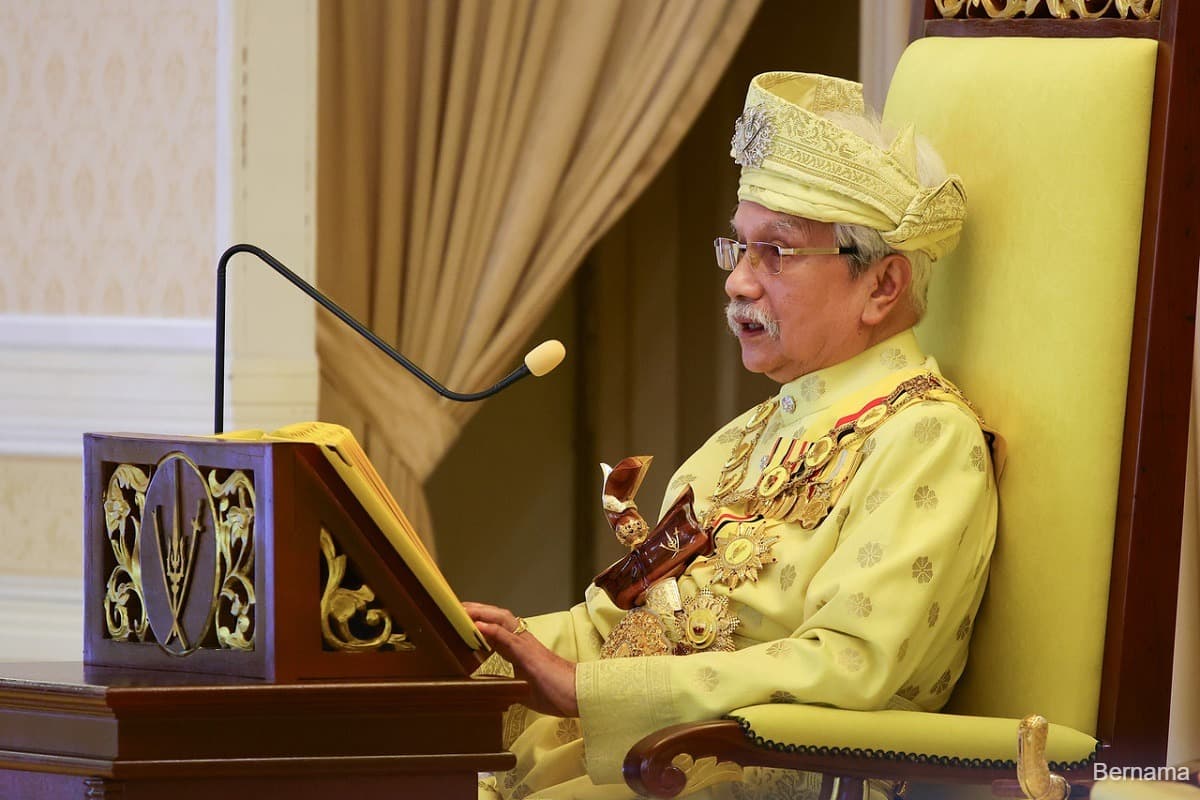
As a former judge, I am deeply troubled by the constitutional crisis that is now happening in my state, that is, Negeri Sembilan. This is added to the fact that I am also an anak Negeri Sembilan. I belong to the Suku Biduanda. My late great-great grandfather, Datuk Johan Lela Perkasa Setiawan, Datuk Wan Saeto, was the Undang of Johol. He ruled Johol for more than 60 years, being one of the longest reigning Undangs of Johol.
Having discerned the facts and the legal issues, my opinion is as follows:
Was the removal of Datuk Mubarak Thahak of Sungai Ujong valid?
At the adat level, I am not able to offer an opinion since I am not privy to the facts; nor am I an expert on adat law.
However, according to media report, Datuk Mubarak had been lawfully removed from his post by the adat authority in accordance with adat law as the Undang of Sungai Ujong effective May 13 last year for contravening 33 customary laws. And his removal was subsequently affirmed by the state’s Dewan Keadilan dan Undang (‘Dewan Keadilan’) last Friday (April 17).
The Dewan Keadilan is empowered by Article XVI of the state constitution of Negeri Sembilan (‘state constitution’) to advice on any question relating to the election or succession to or removal from any office of the Ruling Chiefs (Undangs).
The Dewan Keadilan did have a meeting recently on April 17 to consider and to advice on the legality on the removal of Mubarak by the relevant adat authority in accordance with adat law at the luak level. The Dewan Keadilan, in the exercise of its powers under Article XVI, did make a decision to advice that the removal was in accordance with adat law at the luak level.
The decision and advice of the Dewan Keadilan is now disputed by three Undangs, namely, the Undang of Jelebu, the Undang of Johol, and the Undang of Rembau; and also, by Mubarak (ex-Undang of Sungai Ujong). However, Article XVI of the State Constitution states that the decision and advice of the Dewan Keadilan ‘shall be final and shall not be challenged or called in question in any court on any ground.’
Was the proclamation to remove the DYMM Yang di-Pertuan Besar valid?
On the evening of April 19, Mubarak and three other Undangs met and issued a proclamation calling for the abdication of DYMM Tuanku Muhriz as the Yang di-Pertuan Besar of Negeri Sembilan. The three Undangs were the Undang of Jelebu, the Undang of Johol and the Undang of Rembau.
The power to call for such abdication is provided for by Article X, Clause (1), of the state constitution that states that such a power may be exercised ‘if it is considered and determined that His Highness has done any overt act detrimental to the sanctity, honour and dignity of a Yang di-Pertuan Besar or has deliberately disregarded the provisions of this Constitution.’
However, Article X, Clause (1) also provides that such determination could only be made by the Undangs after due process, that is to say, ‘after full and complete enquiry by the Undangs’ that His Highness was guilty of the matters mentioned above. Thus, the question arises as to whether the Undangs, collectively, had conducted a full and complete enquiry.
I am not privy as to the nature of the allegations against His Highness; nor am I privy as to whether there has been a full and complete enquiry including giving the Yang di-Pertuan Besar the right to be heard in accordance with the rules of natural justice. On the assumption that there had been no due process carried out in the call for abdication, then the proclamation purportedly issued by the three Undangs and Mubarak is not valid.
There is another reason why the proclamation by the Undangs is not valid. The former Undang of Sungai Ujung, Mubarak, who had two days ago been removed by the Dewan Keadilan, had participated in the decision-making process that led to the proclamation. In fact, it was he who read out the proclamation. It is, however, true that Mubarak disputes the validity of the decision and advice of the Dewan Keadilan. But this fact makes him a bias participant. He should not have been a party to the proclamation.
I am, of course, mindful of Article XXIX of the state constitution that states that the Undangs’ decisions are deemed to have ‘been duly exercised or performed if such powers were exercised or such duties were performed by at least three Undangs or by as many of them as may be living at the time of the exercise of such powers or the performance of such duties.’ However, with the participation of the former Undang of Sungai Ujong, Mubarak, the validity of the proclamation becomes questionable, notwithstanding the provision of this Article.
There is yet another reason why the proclamation is not valid. The proclamation as it is now is only issued unilaterally by the three Undangs. It is, in my opinion, legally unenforceable unless and until there is a Proclamation issued jointly but the Undangs and the Menteri Besar as prescribed by the proviso to Clause (2) of Article X. The menteri besar, however, is not a party to the proclamation. In fact, he is reportedly to have said that he does not recognise the proclamation.
I pray for an amicable settlement to this crisis.
Datuk Seri Mohd Hishamudin Yunus is a former Court of Appeal judge.