

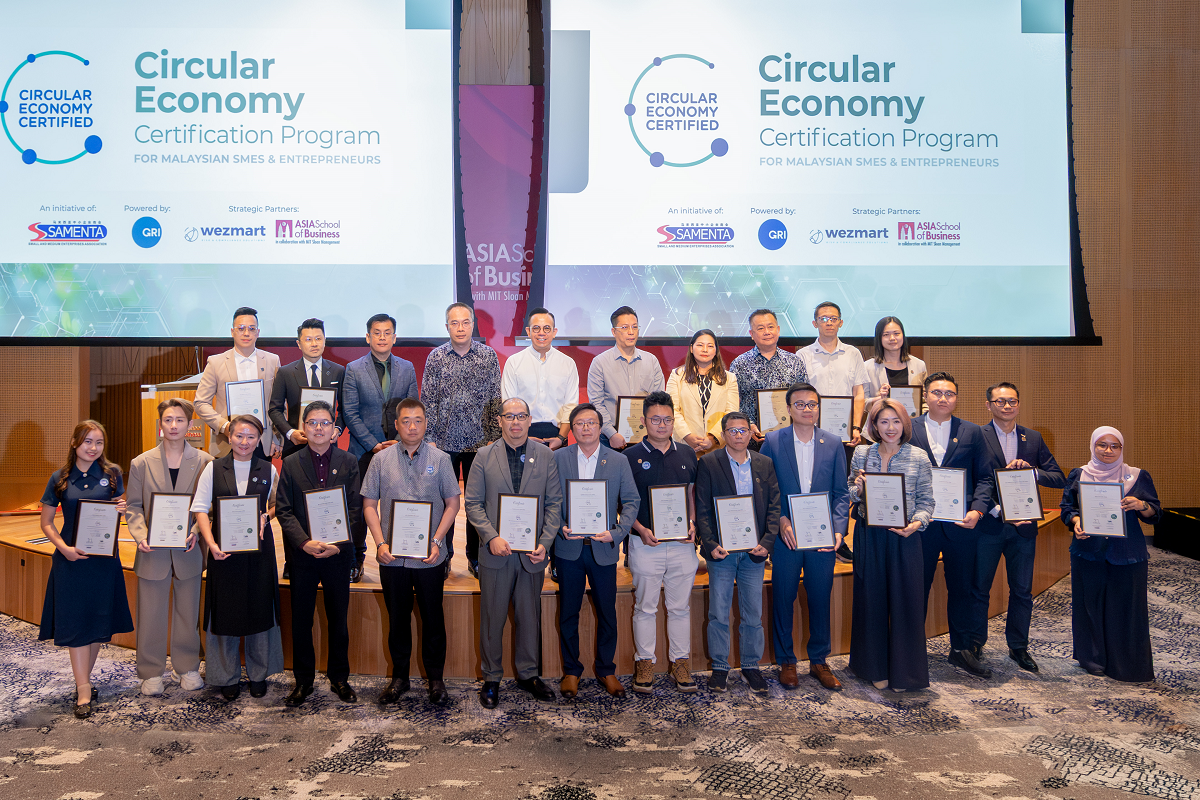
KUALA LUMPUR (April 22): The Small and Medium Enterprises Association of Malaysia (Samenta) launched the Circular Economy Certification (CEC) for small and medium enterprises (SME) on Tuesday, which it says is the first in the region.
The CEC is supported by the Global Reporting Initiative, which is a global provider of sustainability reporting standards. Following the launch in Malaysia, the CEC will be rolled out to the region via the Asean SME Caucus.
Datuk William Ng, national president of Samenta, said the CEC is a tool for SMEs to navigate Malaysia’s upcoming Extended Producer Responsibility, which would hold producers responsible for the entire lifecycle of their products, including the end-of-life management.
“We are now in a global energy crisis that is driving up costs. Traditionally, our take-make-waste linear model was enough. But today, circularity is a strategic economic imperative,” said Ng.
The circular economy, which advocates for waste to be turned into useful raw materials again via methods like recycling and refurbishing, could unlock economic opportunities for businesses. He added that the importance of the circular economy was evident in a recent trade mission that he led to Hong Kong recently.
“In Hong Kong and China, you can see very clearly the importance of the circular economy as a key economic generator in the years to come,” he said.
The recent floods in Malaysia also reflect the need to reduce waste, which benefits the society, environment and businesses. “For SMEs, this is a path to resilience. By decoupling growth from finite resource consumption, we reduce our energy intensity and protect our businesses from volatile commodity prices,” said Ng.
At the event, a memorandum of understanding was also exchanged with MIDF and the Credit Guarantee Corporation Malaysia Bhd to facilitate green financing for certified SMEs.
Minister of Entrepreneur Development and Cooperatives (Kuskop) Steven Sim added during his opening speech that the ministry supports Samenta’s efforts and hopes that the financing agencies under Kuskop can collaborate with the association as well.
“We are more than happy to work with Samenta to support this initiative and support SMEs that are going to come in,” said Sim.
The CEC has four levels. Companies can get started via a self-assessment questionnaire to become “CEC Ready”, before embarking on the silver, gold and platinum certifications. The latter three certifications are valid for three years, with annual surveillance audits, while the CEC Ready recognition is valid for a year.
The CEC has five pillars. Pillar one is resource efficiency and waste reduction; pillars two and three are on product or service life extension and repairability, and recycling and recovery practices.
Pillar four is on circular business models, such as reuse or refill, leasing, subscription or product-as-a-service, reverse logistics, industrial symbiosis and circular procurement. Pillar five is on governance, disclosure and data tracking.
The different levels have varying requirements. Under pillar five, for instance, silver certification requires policy and basic records, while platinum certification requires a key performance indicator dashboard and verified improvements.
An independent reviewer will make the final certification decision. At the event, 20 companies received their CEC ready recognition certificates.