

This article first appeared in The Edge Malaysia Weekly on April 20, 2026 - April 26, 2026
DESPITE the sluggish initial rollout of the Perodua QV-E — Malaysia’s first homegrown electric vehicle (EV) — MCE Holdings Bhd (KL:MCEHLDG) views its participation in the project as a pivotal turning point. More than immediate volume, the project represents a strategic leap into the high-tier frontier of automotive electronics as it improves the company’s technological capabilities.
This is possible because MCE co-developed the parts — specifically the in-vehicle infotainment or IVI system, and the advanced driver-assistance system (Adas) — closely with automaker Perusahaan Otomobil Kedua Sdn Bhd (Perodua). The collaboration allowed MCE to gain experience in producing cutting-edge electronics and mechatronics.
“We had a wonderful experience working with the customer [Perodua] at the design exchange and development [stages]. In turn, we also taught our customer a lot of electronic knowledge. We’ve done this for the last 1½ to two years,” says MCE group managing director Dr Goh Kar Chun.
But the QV-E isn’t selling well, Goh acknowledges, though he is confident things will “definitely” pick up. “They [Perodua] have plans to boost sales,” he tells The Edge during an interview at the group’s new MCE Auto Hub in Serendah, Rawang, Selangor.
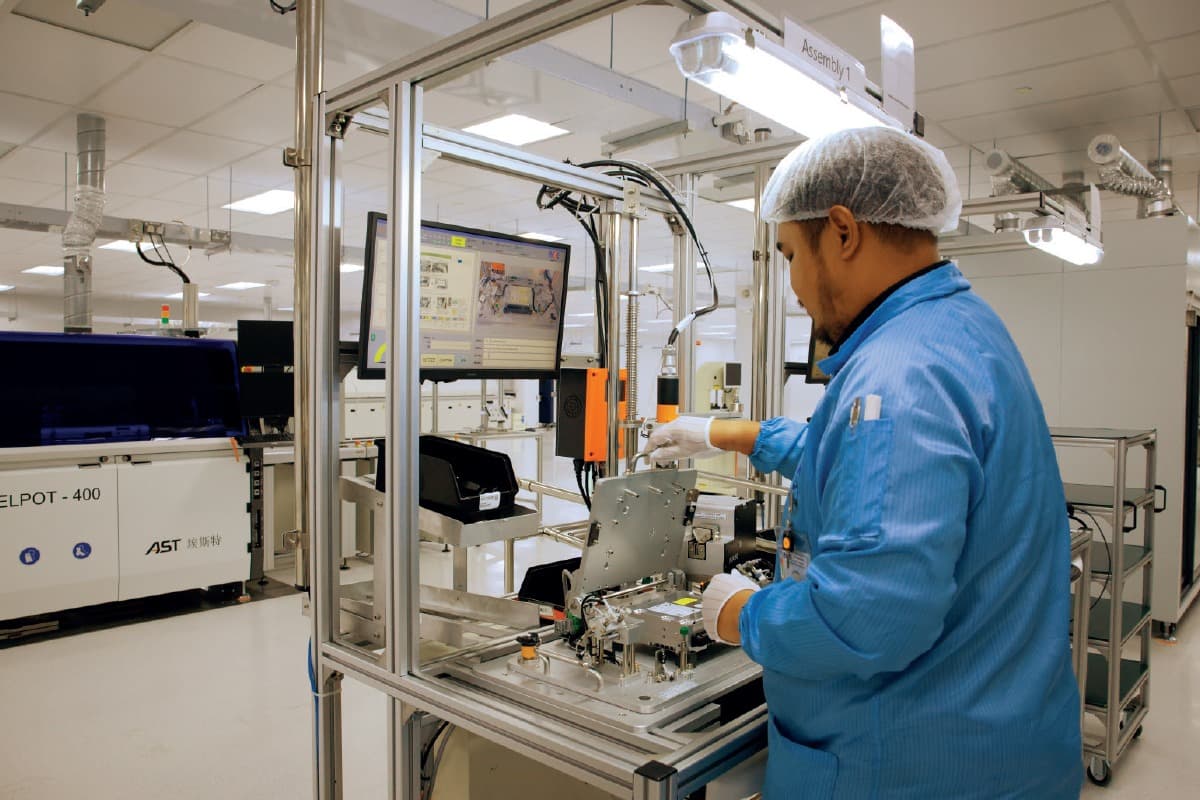
MCE has invested RM50 million in the first phase of this Serendah facility, which houses the surface mount technology and IVI assembly lines, providing the company the capability to assemble its own printed circuit boards.
In total, the group plans to invest between RM150 million and RM200 million into the eight-acre site located near Perodua’s headquarters and manufacturing hub. MCE intends to gradually scale up production floor space and set up a research and development centre, as well as a training centre for automotive electronics.

While the plant is not exclusively for the QV-E project, it was instrumental in developing the electronic components for the project, in which MCE invested about RM19 million, says Goh.
In April last year, MCE said its subsidiary, Multi-Code Electronics Industries (M) Bhd, had received new orders from Perodua valued at about RM41.33 million to supply parts for the automaker’s electric and internal combustion engine (ICE) models.
The supply contract for electric — the QV-E — started in November 2025 for three years, while the ICE job is to run for six years from August 2026.
With the new Serendah plant, MCE is aiming to double its revenue by 2030 — from last year’s RM152.6 million — and for its top line to reach RM700 million by 2035.
MCE has another facility in Klang, Selangor and a third one in Johor Bahru, Johor.
Founded in 1990, the company started with manufacturing switch products, followed by electronic parts such as sensors and cameras. “We have now successfully developed IVI and Adas — they are on the road now. So, we hope that given more opportunities, we can also supply to other national or even non-national cars like BYD,” says Goh.
Breaking the foreign vendor monopoly
Following the end of a four-year excise duty holiday for imported EVs last year, the Malaysian government has been pushing automakers to produce their models locally.
National carmaker Proton Holdings Bhd is leading the charge by producing EV models — e.MAS 5 and e.MAS 7, which are based on Geely Auto Group’s models — in Tanjong Malim, Perak. Meanwhile, foreign players like Chery Automobile Co Ltd and SAIC Motor have secured local assembly partners, while BYD Auto is finalising its own plans for a local production hub.
But this push for localisation of EV production has sparked a heated debate, fuelled by claims that many completely knocked-down (CKD) operations remain “shallow” as they use little local content. Critics argue that many foreign brands — particularly those from China and Japan — are simply assembling parts imported from their native countries rather than sourcing them locally. This raises the question of whether the Malaysian automotive ecosystem actually benefits from the incentives provided for CKD EVs, which are still exempted from excise duty until end-2027.
To address localisation concerns, the Ministry of Investment, Trade and Industry (Miti) now requires high-volume CKD projects to export 80% of their production. To export these cars duty-free within Asean, automakers must meet a 40% regional value content threshold. Since expensive batteries are still imported, they are effectively forced to source high-value electronics such as Adas and infotainment systems from local experts like MCE to hit that 40% threshold.
“So, this is where we come in. We want to break through, starting with the national cars first. Once we acquire enough knowledge and we have enough manufacturing [capabilities], we can start to offer to the other automakers in Asean,” says Goh.
Diversifying globally through tie-ups with Chinese vendors
Beyond its local focus — MCE has a long-standing history with both Perodua and Proton — the group has started to diversify into overseas markets through international contracts and joint ventures (JVs). One recent example is a RM69.59 million deal it secured from JVIS USA LLC to supply mechatronic components for a vehicle model in the US. Production for the 60-month job is expected to begin in the August-October period this year.
MCE also serves customers outside of fixed contracts, such as Dorman Products Inc in the US, and several non-automotive clients through monthly purchase orders.
The group has also partnered with foreign companies for technical assistance and development, as well as joint marketing and distribution of parts.
MCE is particularly excited about its joint venture with Nanjing Chuhang Technology Co Ltd, with whom the group inked an agreement in December 2025 at the Osaka World Expo. Nanjing Chuhang specialises in millimetre wave radar sensors used in automobiles. According to Goh, they have set up a JV company — MCE Chuhang Radar (M) Sdn Bhd — in which MCE holds a controlling 51% stake to supply the product to markets outside of China.
“It’s a high-tech product that detects objects far from the car. It forms part of the Adas system. It’s hidden at the rear bumper and at the front bumper,” Goh explains. While the JV will initially manufacture radar systems for Proton and Perodua to support their Adas localisation, Goh says the technology is also available to non-national automakers like BYD looking to localise their own automated driving applications.
MCE is also teaming up with Huizhou Foryou General Electronics Co Ltd (Adayo) to develop and market smart-cockpit and smart-driving solutions across Asean. Following a memorandum of understanding signed in Hangzhou in September 2025, MCE will serve as the regional manufacturer for these systems, including cockpit domain controllers and connected-vehicle technology, while Adayo will support it with its technical platforms and expertise.
MCE is also leveraging partnerships with Chinese automotive electronics specialists — Cheling Smart Mobility Technology and Wuhu Atech Automotive Electronics — to support Chery Malaysia’s local production. “We’ve also passed Chery’s supplier audit and are now on their approved vendor list, so it puts us in a good position moving forward,” says MCE’s executive director Anne Goh, noting that while discussions are ongoing, a firm supply arrangement is not yet in place.
Meanwhile, MCE is pursuing vertical integration to secure its supply chain. In early April, its indirect 50%-owned subsidiary Eagle MCE Technologies (Malaysia) Sdn Bhd entered into an agreement to acquire a 50% stake in FP Project Enterprise Sdn Bhd for RM1.9 million. This stake is set to be raised to 80%, following a proposed share allotment and shareholder’s agreement with FP Project director Lim See Chiang.
The acquisition will enable MCE greater control over the operations of FP Project, a key supplier to the group that specialises in plastic injection and tooling fabrication. This integration provides MCE with greater oversight of manufacturing processes, improves cost efficiency and reduces its reliance on external suppliers.
Profitability trends
MCE’s profitability has been on a steady upward trajectory over the last four years, recovering from a negative margin in its financial year ended July 31, 2021 (FY2021). Net profit margins rose from 7.6% in FY2022 to 10.2% in FY2024, eventually reaching 15.7% in FY2025, when the group recorded a net profit of RM23.9 million on RM152.6 million in revenue.
However, the FY2025 results were bolstered by a one-off RM7.52 million gain from the disposal of assets. Excluding this gain, normalised net profit for FY2025 would have been RM17.59 million, with a normalised margin of 11.5% — still an expansion from FY2024. On a quarterly basis, the group’s margins have typically fluctuated between the high single digits and the low teens.
MCE’s revenue has risen rapidly over the last four quarters, with its most recent 2QFY2026 top line surging 56.5% to a record high of RM57.6 million from RM36.8 million in 3QFY2025, just prior to the Serendah plant’s ramp-up. But net profit has lagged. The group registered RM4.7 million in 2QFY2026, down from RM6.1 million in 3QFY2025. This margin compression might explain MCE’s recent share performance; the counter has lost 18.4% of its market value during the period, declining from a closing price of RM1.801 on Oct 14, 2025, to RM1.47 on April 14, 2026.
Goh explains that the figures reflect “transitional costs” tied to the operational launch of its Serendah plant, where higher overheads are temporarily impacting the bottom line as production capacity scales up.
“The operating cost of the overhead is higher than the old plant. And real business [production orders] like QV-E is slowly ramping up and we are waiting for other projects to come in ... These are just temporary. We have to make sure we are ready — the infra and the human capital are ready — to pack on more projects and do some exports,” says Goh.
Save by subscribing to us for your print and/or digital copy.
P/S: The Edge is also available on Apple's App Store and Android's Google Play.