

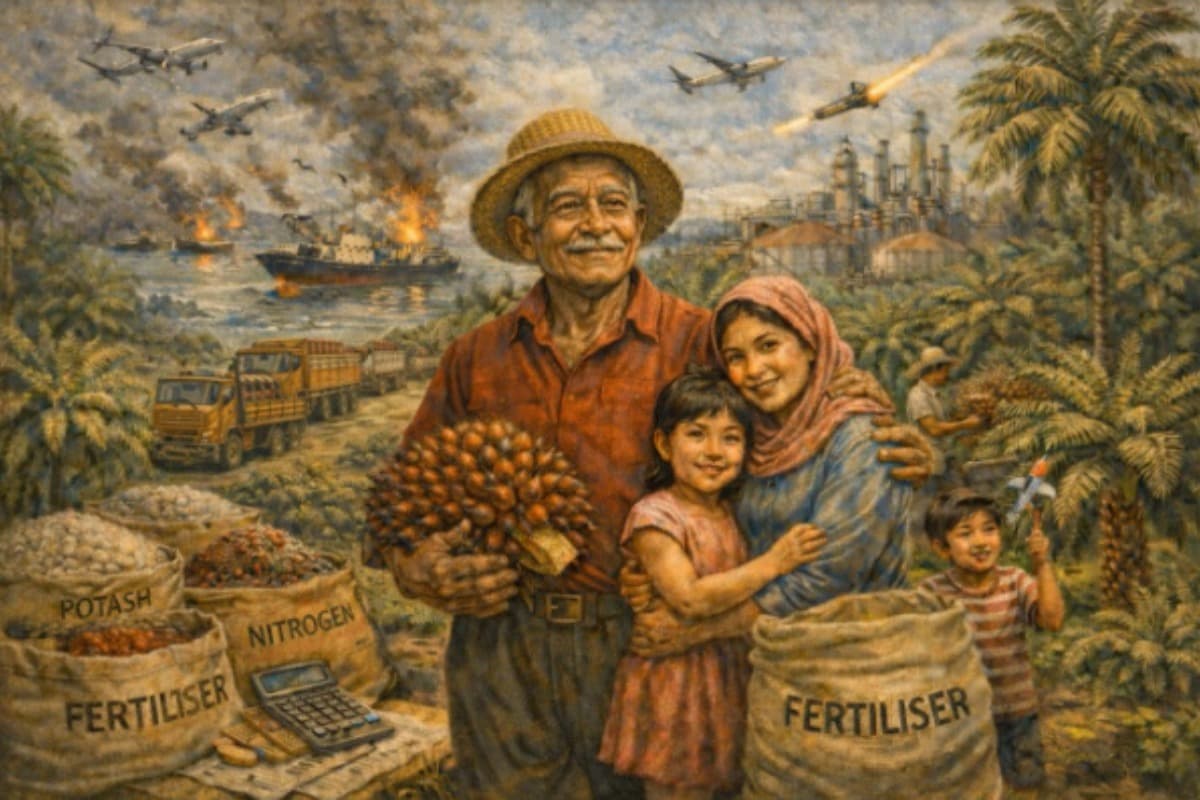
WHAT appears at first glance to be a story about war, shipping or fuel is, in truth, also a story about how a strategic crop, quietly rooted in Malaysian soil, becomes entangled with food security, energy policy, export earnings and national resilience all at once.
Hormuz affects shipping. Shipping affects fertiliser. Fertiliser affects oil palm yields, though not immediately. Higher crude prices reopen the biodiesel question. Biodiesel affects domestic diesel resilience, edible oil balances, export availability and, at the margin, CPO prices.
Now, with B15 adopted in principle and B12 as the opening step, that linkage is no longer theoretical. It has become policy. This is not a scatter of disconnected headlines. It is one story: how a strategic crop behaves when the world grows disorderly.
And here one should resist both vulgar triumphalism and unhelpful gloom.
Malaysia is not “winning” because other people’s shipping lanes are anxious. That would be a rather crude reading of the matter. But neither should we understate the strategic blessing of having a crop that remains edible, exportable, versatile and capable, under the
right conditions, of serving more than one national purpose.
In a tense and disordered world, that matters. The larger point is this: palm oil remains a strategic crop for Malaysia to have.
Palm oil — A blessing proven in hard times
In truth, Malaysia is blessed with palm oil — and not only in this present episode.
History has been trying to remind us of that for some time. During the Asian financial crisis, Bank Negara Malaysia recorded that palm oil export earnings rose 14.6% in 1997 to RM10.8 billion, making it the country’s single largest export earner that year. During the global financial crisis, Bank Negara again noted that stronger palm oil production supported the agriculture sector, with palm oil accounting for about 30% of agriculture’s value added in 2008.
Then came the pandemic years. The Malaysian Palm Oil Board (MPOB) reported that total export revenue from palm oil and other palm-based products surged 48% in 2021 to RM108.52 billion, largely because prices rose sharply. Palm oil did not solve those crises. But in each case, it helped cushion the national blow. It provided ballast when other parts of the economy were under strain.
That is not a small thing.
It means Malaysia has long carried, in its fields, a crop that has repeatedly generated export earnings, fiscal revenues, rural livelihoods and employment across a wide value chain stretching from nurseries to estates, mills, refineries, ports and the many services orbiting the industry.
Palm oil has often been more than a commodity. In difficult times, it has been a buffer, a ballast and, at moments, a quiet economic shock absorber.
So when one says Malaysia is blessed with palm oil, one need not become mystical. One need only be numerate.
Policy must match the blessing
And that is precisely why such long service should be reciprocated with seriousness by the relevant authorities and by government more broadly.
A sector that has so often helped steady the country in difficult times should not be treated merely as a convenient tax handle, a target for occasional speeches, or an easy political afterthought. It deserves enabling policy, clear engagement and practical assistance and reinvestment across the board — from foreign worker policy and fair, plantation-sensitive taxation to research and development, pragmatic replanting, mechanisation, logistics,marketing, promotion and long-term competitiveness.
The point is not that government must indulge the industry. The point is that it should engage it more coherently, more constructively and with a stronger sense of partnership than extraction.
If palm oil has repeatedly stood by Malaysia, then Malaysia must also be seen to stand by palm oil — not blindly, not defensively, and certainly not by pretending the sector has no homework of its own. Rather, by ensuring that public policy does not work at cross
purposes.
Foreign labour bottlenecks cannot be discussed in one ministry as though they have nothing to do with fruit evacuation and export earnings. Taxation cannot be handled as though a strategic industry is merely an endlessly compliant revenue tap. R&D cannot be praised in speeches and then undernourished in practice. Marketing and promotion cannot be treated as optional adornments when the sector continues to face scrutiny, misunderstanding and unfair attack abroad.
The biodiesel episode itself offers a useful lesson. Where policy is phased, infrastructure-backed and fiscally aware, movement becomes possible. Where ambition outruns readiness, it stalls. That principle applies well beyond biofuel. Long-term strategy in palm oil must be built on operational realism, institutional coordination and steady policy signals — not just periodic declarations.
In short, if gratitude is to mean anything in economics, it must take the form of good policy: enabling, effective and sustained.
That means engaging more effectively to industry realities, especially in times of stress. It means better inter-agency coordination. It means developing effective long-term strategies for the sector, with clearer signals on labour, faster decisions on strategic matters, stronger support for science-based productivity and more intelligent engagement with stakeholders across the value chain. It means recognising that palm oil is not merely something to regulate after the fact, but something to steward in real time.
Stewardship, not complacency
When the world grows rough, the real test is not whether a crop looks strategic in a newspaper column. The test is whether the country around it has the vision, clarity, discipline and common sense to manage that strategy well — in the field, in the fertiliser store, in the mill, in the port, in the tank and at the national table.
Malaysia, in truth, is blessed to have oil palm. But blessings, too, come with responsibilities. And perhaps the most measured conclusion of all is this: a sector that has repeatedly helped carry the country should never be romanticised, but neither should it be taken for granted.
It should be challenged where necessary, helped where sensible, and engaged always with the seriousness due to something that has, more than once, helped Malaysia keep its footing when the wider world lost its balance.
Joseph Tek Choon Yee is a former president of the Malaysian Estate Owners’ Association and past chief executive of the Malaysian Palm Oil Association.