

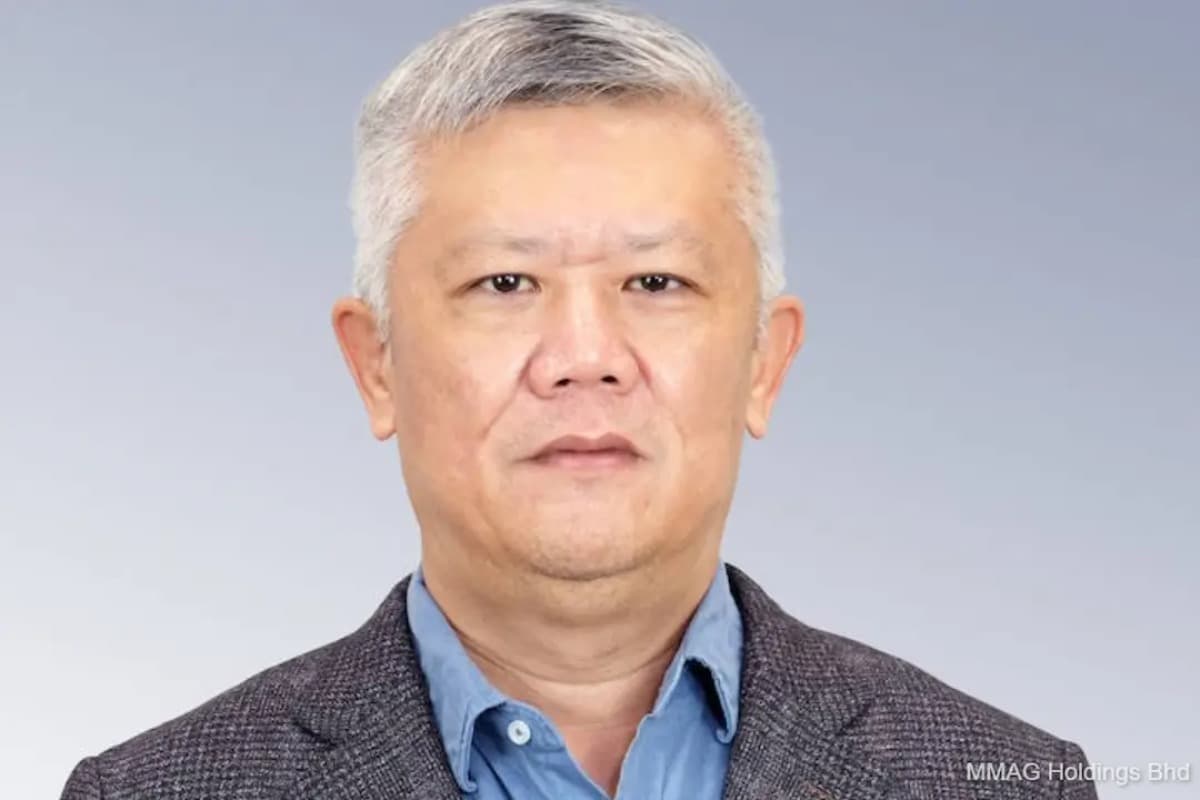
KUALA LUMPUR (April 16): The High Court on Thursday dismissed controversial businessman Victor Chin Boon Leong’s application to testify in court using remote communication technology.
Judge Leong Wai Hong, in dismissing the application, said Chin’s application was only made via a letter, instead of through proper application that requires a sworn affidavit supported by a Notice of Application.
“Without a sworn statement, the application was dismissed, but the court noted that assuming a letter could be valid, it would proceed to consider the reasons. The reasons for remote testimony and the court’s evaluation concerns from media coverage, public allegations and threats linked to broader corporate misconduct.
“The court found his safety fears unsubstantiated by police or official reports and noted no arrests warrants or criminal charges are made against him,” the judge said, emphasising the need to follow proper court procedures in submitting a proper Notice of Application, and not just a letter.
Leong said Chin, the first defendant in the suit filed by M Gunasekar and Philip Phang Kin Ming, claimed that he is not a fugitive but had sought to give evidence remotely.
Gunasekar and Phang are former directors of MMAG Holdings Bhd’s (KL:MMAG) 80%-owned cargo subsidiary M Jets Sdn Bhd, who filed a RM49.85 million counter-suit in July 2023 against MMAG and several others, including Chin, alleging conspiracy over the group’s attempted takeover of M Jets.
The dispute began after they were suspended in February 2023, following a Malaysian Anti-Corruption Commission (MACC) probe and raid on M Jets’ office, and later removed from their roles. MMAG subsequently sued them in April for alleged breach of fiduciary duties, seeking RM23.17 million in damages.
Leong said he heard Chin’s application on April 13, which was opposed by Gunasekar and Phang’s lawyers.
He added that the trial had entered its third day, having begun July 18 last year, with Phang testifying under cross-examination.
On April 8, Chin’s lawyers sent a letter to the court, seeking to give his evidence by way of remote communication technology.
“Chin claimed that his application was made in good faith, driven by practical considerations and genuine safety concerns and was not intended to delay, disrupt or prejudice the proceedings.
“He is currently not within Malaysia, having left jurisdiction due to serious and genuine concerns for his personal safety arising from extensive media coverage and public allegations made against him…where he reasonably fears harm being done on his return to Malaysia,” the judge noted.
Leong said Chin’s application is premised on exceptional circumstances which affect his ability to attend the trial physically.
Two issues before the court
The judge said there are two issues for the court’s consideration, namely: (i) whether an application to be made by way of remote communication technology should be submitted by letter or a Notice of Application supported by an affidavit; and (ii) whether Chin’s reasons are acceptable by the court.
Leong said while Chin’s lawyers contend that giving evidence through remote technology is allowed as stipulated under paragraph 2(e) of the Chief Justice’s Practice Direction 2/2025 dated Nov 13 last year, the court has to respectfully disagree.
“This paragraph is applicable only to a party who wishes to attend a proceeding to be conducted using the video platform. It is not applicable to a party or witness who wishes to apply to give evidence by way of remote communication technology.”
“The practice direction states the application to give evidence by way of remote communication technology is by way of a written application. It does not say it by way of letter. This surely must mean the “written application” is a Notice of application supported by an affidavit. The applicant must swear an affidavit to aver on grounds to support his application,” the judge said.
Hence, the judge said he is constrained by the fact that a proper application by Chin was not forthcoming due to the absence of evidence of a sworn affidavit.
“Hence the application by Chin has to be dismissed,” Leong said, adding that Chin is to pay RM10,000 costs.
Leong further reasoned that the court was not satisfied that Chin is not able to testify physically in court, as his allegation of concern for his safety is a bare allegation.
“The mere filing of a police report by a third party on his behalf alleging concerns for his safety or similar allegations made in a civil suit do not mean that the allegations therein are credible or true.”
The judge said Chin is one of several individuals arrested by the police in December 2025 in an operation known as “Ops Viking” on suspicion of being connected to a money laundering syndicate known as the “corporate mafia”, involving a complex network of offences, ranging from illegal money lending and stock market manipulation to breaches of corporate disclosure requirements.
“The courts cannot condone situations where individuals manipulate or abuse the legal system to their own advantage to avoid prosecution and thus undermine the proper administration of justice. Such instances would be when these individuals apply to court to testify via Zoom to avoid arrest if they return to the country to testify in court physically.
“This would severely compromise the integrity of the justice system and undermine public trust in the rule of law,” Leong said.
In the matter, Gunasekar and Phang were represented by Alex De Silva, Teo Ju-li and Kang Zhen Leong of Messrs Alvin Tang Law Office, while Wong Kah Hui, of Messrs KH Wong & Co, appeared for Chin.