

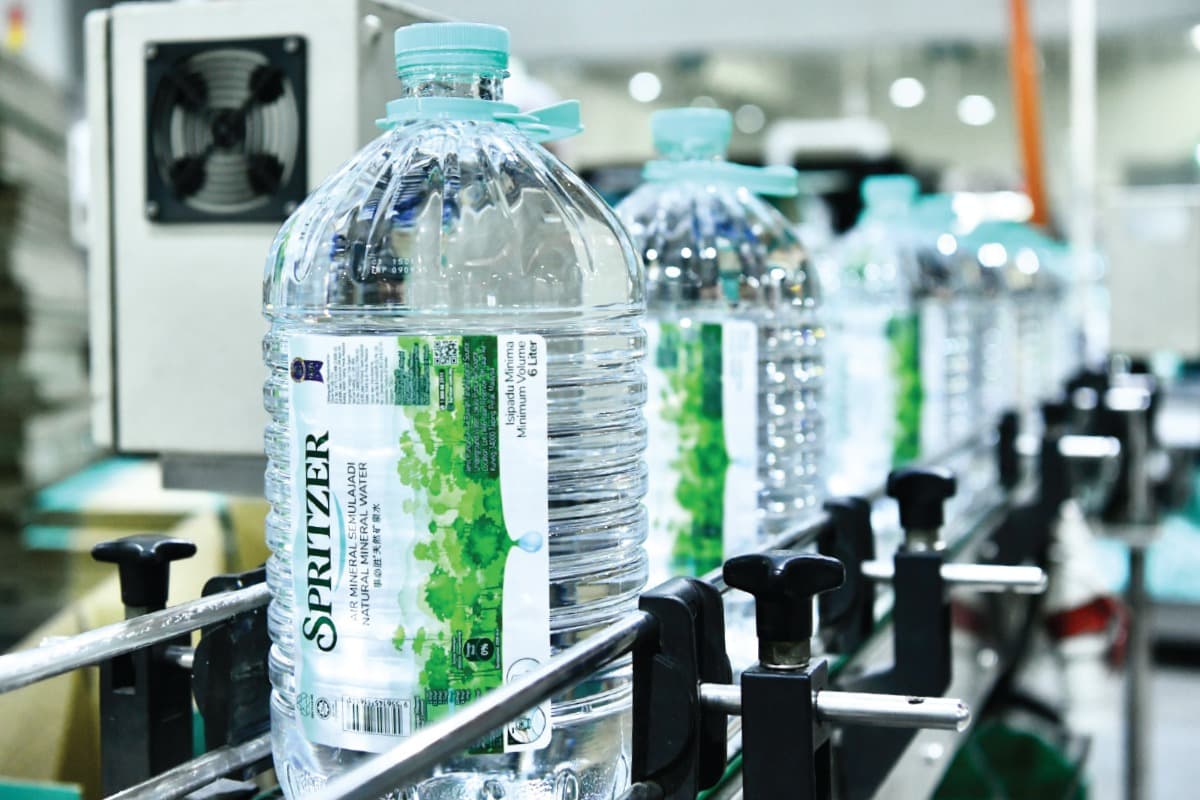
This article first appeared in The Edge Malaysia Weekly on April 13, 2026 - April 19, 2026
SPRITZER Bhd (KL:SPRITZER) was projected to be in a sweet spot this year, supported by stabilising raw material costs and a boost from increased tourist arrivals because of Visit Malaysia 2026 (VM2026).
But like companies in a number of industries, the producer of bottled water products is now operating in a sharply different landscape, following the war in the Middle East, which has dampened expectations of greater tourist arrivals this year.
At the same time, the war in the Middle East and closure of the Strait of Hormuz in March have driven up the prices of crude oil and polyethylene terephthalate (PET) resin, an ingredient commonly used in making packaging materials.
As 30% to 40% of Spritzer’s product costs comes from packaging, it raises the question of whether the sharp increase in PET resin prices would exert pressure on Spritzer’s margins.
The spot prices of three variants of Southeast Asia polymers have increased by 66% to 72% since the start of the war, exceeding US$1,000 per tonne as at April 3 (see chart).
While the US and Iran had agreed to a two-week ceasefire at press time, the situation remains fragile, with the only guarantee being continued volatility in prices.

Analysts believe Spritzer’s market dominance in the mineral water space in Malaysia provides some cushion from soaring PET resin prices.
“Spritzer’s dominant market share of 40% to 45% gives it decent pricing power to pass on the higher PET costs. Spritzer also buys its PET three months forward; so, it has some time to plan for the higher costs and price hike,” says New Paradigm Securities head of research Ben Shane Lim, noting that the company has historically refrained from price hikes unless it was to defend margins from cost pressures.
He asserts that bottled water can be seen as a non-discretionary product in many situations, making core demand inelastic.
“A moderate hike in prices should not have a significant impact on demand,” says Lim.
Known for its flagship Spritzer mineral water that it sources from its naturally conserved land bank in Taiping, the group also produces the Cactus brand of mineral water and has diversified its offering to include sparkling water and flavoured water.
BIMB Research analyst Sabariah Mohamad Akhair observes that Spritzer’s in-house bottle manufacturing facilities mean that it has strong cost visibility, as it affords direct resin purchases, forward buying and avoidance of third-party mark-ups and thereby partially gives the group the ability to cushion margin compression.
Spritzer declined to comment when contacted by The Edge.
Spritzer’s gross profit margin has been improving over the years, expanding from 43% in FY2023 to 51% in FY2025. This comes as revenue increased from RM490.74 million in FY2023 to RM656.85 million in FY2025.
But the incremental sales increase that Spritzer was forecast to receive from improved international tourist arrivals may not materialise this year.
Malaysia had targeted 46 million visitors this year but recently announced it would extend VM2026 to end-2027 in the light of the Middle East conflict. The announcement, first made by Deputy Prime Minister Datuk Seri Ahmad Zahid Hamidi — chair of VM2026 — noted that the conflict has had a significant impact on regional stability and the global tourism sector.
Zahid pointed out that global tourism flows could be affected in the near term, as the conflict has disrupted international flight routes, increased travel costs and affected traveller confidence.
Still, BIMB’s Sabariah believes the bigger concern for Spritzer is how increased costs — the result of higher PET resin prices — will hit earnings more directly, rather than the softness in the hospitality channel. “Weaker international arrivals would trim some of the VM2026 upside we have assumed, but Spritzer’s core volume is driven by domestic consumption, not tourists. It is an incremental headwind, not a structural one,” she observes.
Room for correction
Spritzer’s share price performed well last year, appreciating significantly between August and October, gaining 87% from RM1.62 to RM3.04 and traded at a forward price-earnings ratio of 20 times, far above its historical PER of 12 to 14 times.
It traded between RM2.68 and RM3.08 until the start of the war, when a sell-off pushed its shares down to RM2.37 by end-March, an outcome analysts describe as natural.
“The valuations are correcting from a high level, almost 20 times forward PER at its peak. Historically, the stock has traded at 12 to 14 times. With the tourism thematic hamstrung by the war, Spritzer lacks the catalysts to support its current elevated valuations and is likely to see more mean reversion for now,” says Lim.
Sabariah agrees, noting that profit-taking was inevitable, as the stock had already priced in the good news. She believes the company’s fundamentals remain solid, evident from its FY2025 record earnings, improved margins and higher dividend.
“What changed was sentiment, not substance. The Iran war just accelerated the selldown. We’d treat this as a valuation reset and look to accumulate closer to our target price of RM2.30,” she notes.
In FY2025, Spritzer’s net profit increased 27% to RM90.76 million while revenue grew 13% to RM656.85 million. It declared a dividend of five sen per share, against four sen in the previous year.
Of the four analysts who cover the stock, one has a “buy” call, two a “hold” and one a “sell”, according to Bloomberg data. The average target price for the stock is RM2.80, on a forward PER of 13.78 times.
Last Thursday, Spritzer closed at RM2.54, which translates into a market capitalisation of RM1.63 billion.

Save by subscribing to us for your print and/or digital copy.
P/S: The Edge is also available on Apple's App Store and Android's Google Play.