

This article first appeared in City & Country, The Edge Malaysia Weekly on April 13, 2026 - April 19, 2026
Penang’s property market exhibited strong fundamentals in 2025, helping it end the year on a positive note.
“The secondary residential property market in Penang saw relative stability, with modest price growth observed in both landed and high-rise segments. Overall, the market can be characterised as resilient but measured, reflecting cautious buyer sentiment amid evolving lifestyle preferences and affordability considerations,” says Nawawi Tie Leung (NTL) Property Consultants Sdn Bhd executive director and regional head of research and consulting Saleha Yusoff when presenting The Edge Malaysia | Nawawi Tie Leung Property Consultants Penang Housing Property Monitor 4Q2025.
She notes that landed property on both the mainland and island saw stable prices, with some areas registering marginal increases. High-rise units saw active interest among younger buyers.
Furthermore, there was a clear price differential between mainland and island properties for both types. This was due to the limited land available on the island and the higher level of employment opportunities and commercial activities there. Meanwhile, the mainland market offered cost-conscious buyers properties with potential for capital growth.
“In short, 2025 can be viewed as a year of steady and stable performance for Penang’s secondary residential market. There were no significant price corrections, but neither were there any rapid escalations. Instead, the market reflected a recalibration in buyer priorities — greater sensitivity to affordability and maintenance costs, and a discernible tilt towards high-rise living — while prime landed properties, particularly on the island, retained their enduring appeal and value stability,” says Saleha.
According to the National Property Information Centre’s (Napic) data, the secondary market showed a softer trajectory heading into the quarter in review, both year on year (y-o-y) and quarter on quarter (q-o-q).
In comparing the y-o-y performance, Saleha says 4,912 transactions valued at RM2.23 billion were recorded in 4Q2024 while 4,843 transactions were registered in 4Q2025, indicating that the transaction volume for residential properties was broadly stable y-o-y, with only a slight decline of 1.4%.

“Total transactions were 18,122 in 2024 compared with 17,419 in 2025. This points to a moderation in market activity compared to the stronger rebound phase observed in late 2023 and parts of 2024. As such, on a y-o-y basis, 4Q2025 saw a decline of 3.9% in volume of transactions,” she adds.
“A comparison between 3Q2025 and 4Q2025 performance shows that transaction volume rebounded in 4Q2025, rising 6.5% q-o-q to 4,843 units from 4,548 units, signalling a recovery in market activity after earlier softness.”
Saleha points out several broad factors that influenced the secondary market in 4Q2025 while providing a high-level view of what buyers and investors need to keep in mind in 2026. She says the overall moderation in transaction activity throughout 2025 indicates that the market had moved into a more normalised, post-rebound phase following the stronger performance in 2023.
“Buyers remained sensitive to financing costs and household commitments, which moderated speculative activity and kept demand largely driven by owner-occupiers. The growing preference among younger purchasers for high-rise living — due to affordability and lower maintenance — helped sustain selected condominium schemes, while older or less well-maintained projects faced slower absorption,” she points out.
What to expect in 1Q2026
According to Saleha, Penang’s secondary residential market is expected to remain stable in 1Q2026 with pockets of outperformance, rather than showing a broad-based upswing. The key reason is that 2025 ended with softer transaction momentum and largely flat-to-stable pricing, which sets a conservative baseline going into early 2026.
“According to Napic data, overall transactions showed flat market performance y-o-y in 2025 versus 2024, while prices remained generally stable with only a slight improvement in selected schemes.”
She highlights that on the island, the overall secondary market prices are expected to remain stable with transactions focused on mid-market locations.
“Buyer behaviour is expected to remain cautious and value-driven, indicating that well-maintained schemes with strong connectivity and proximity to employment nodes will continue to see transactions, while older or less competitive stock may need price flexibility to move,” says Saleha, adding that rents will remain strong with support from young professionals and households whose relocations are linked to the industrial and tech sectors.
“On the mainland, 1Q2026 is likely to see more consistent buyer interest in growth corridors, especially where affordability intersects with job creation and accessibility to the island. In practical terms, Batu Kawan and the wider southern Seberang Perai belt are expected to remain among the most active submarkets for both owner-occupiers and yield-focused investors,” she says.
According to Saleha, areas to keep an eye on in 1Q2026 are the Batu Kawan/Bandar Cassia area, which is in close proximity to major industrial zones (Batu Kawan Industrial Park, Bandar Cassia Technology Park, Batu Kawan Industrial Park 3, Penang Science Park and Bukit Minyak Industrial Park) and the upcoming Medi-City.
She also highlights Bayan Lepas, Bayan Baru, Relau and Sungai Ara, which are near Bayan Lepas Industrial Park. There will be strong rental demand from workers of multinational corporations, she notes.
“Investors and buyers can focus on auction properties in high-density developments as the prices are relatively low and present good buying opportunities, although caution is advised,” says Saleha.
Landed and high-rise properties show no to slight price growth
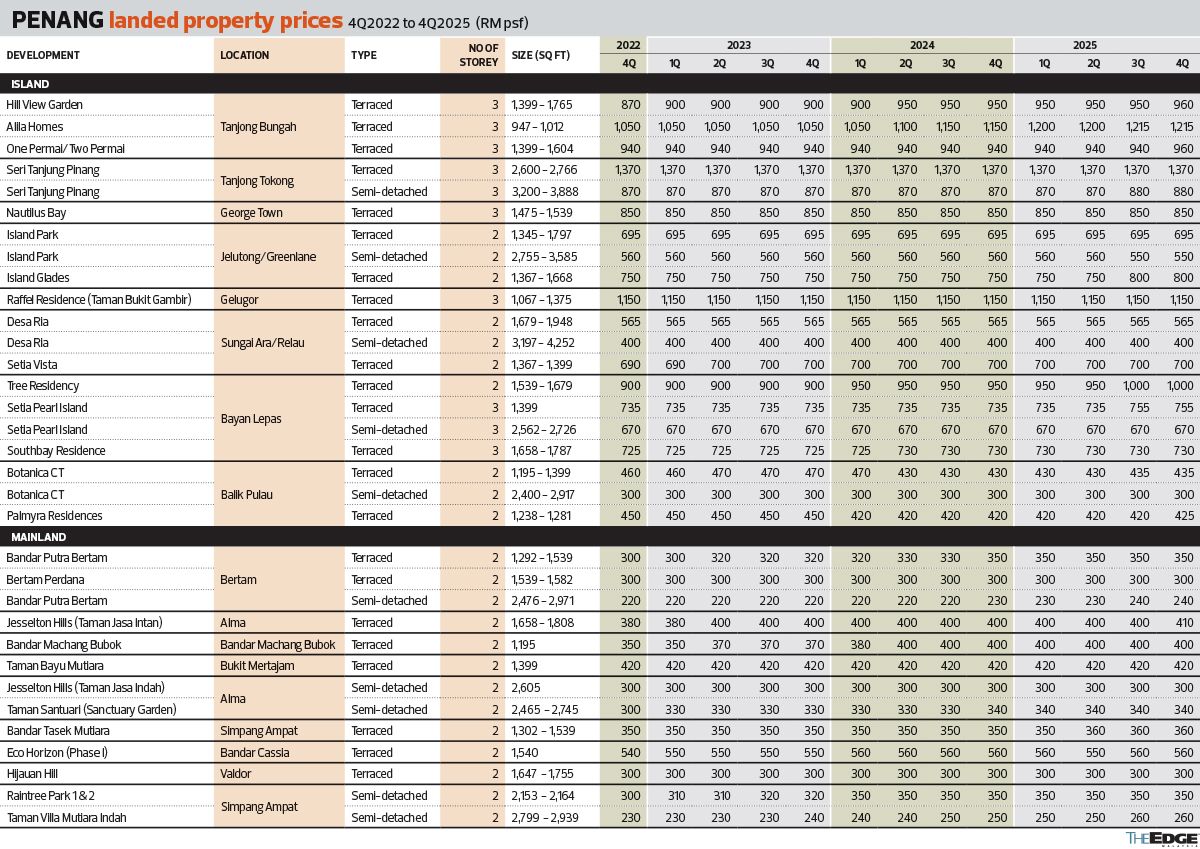
During the quarter in review, the market for landed residential properties on both the mainland and island was stable q-o-q and y-o-y.
Saleha attributes the absence of significant movements in value across the schemes covered by the monitor in 4Q2025 to a combination of macroeconomic caution and competitive supply dynamics in the residential market.
The broader economic uncertainty in 2025 continued to weigh on buyer confidence, and while there were no sharp downturns, households remained cautious in their financial commitments amid concerns about cost of living, financing affordability and global economic volatility.
Purchasing power constraints played a significant role. Although employment conditions in Penang remained relatively stable, supported by industrial expansion, income growth did not accelerate at a pace that was sufficient to justify a substantial price escalation in the secondary residential segment, says Saleha.
“Another key factor was the volume of newly completed and incoming developments. Over the past few years, a steady pipeline of high-rise residential projects, particularly in Bayan Lepas, Batu Maung, Batu Kawan and parts of the mainland, has increased competition. Buyers had more options in 4Q2025 between subsale units and developer stock, including units offering rebates, flexible packages or newer facilities,” she adds.
“In addition, the quality and age differentiation between schemes became more pronounced. Well-maintained and strategically located developments generally held their value, but older schemes without refurbishment or strong management faced stiffer competition from newer stock.
“Furthermore, investor participation remained measured. Compared to the post-pandemic rebound period, speculative demand had normalised, and the market in 4Q2025 was largely driven by genuine owner-occupiers and buyers motivated by necessity.”
Regarding landed properties on the island, some key y-o-y price growth was seen in Alila Homes, with a 6% increase to RM1,215 psf from RM1,150 psf; Island Glades homes, with a 7% increase to RM800 psf from RM750 psf; and Tree Residency homes, with a 5% increase to RM1,000 psf from RM950 psf.

For landed properties on the mainland, only four areas showed y-o-y price increases, namely Bandar Putra Bertam (4% to RM240 psf), Jesselton Hills (Taman Jasa Intan) (3% to RM410 psf), Bandar Tasek Mutiara (3% to RM360 psf) and Taman Villa Mutiara Indah (4% to RM260 psf).
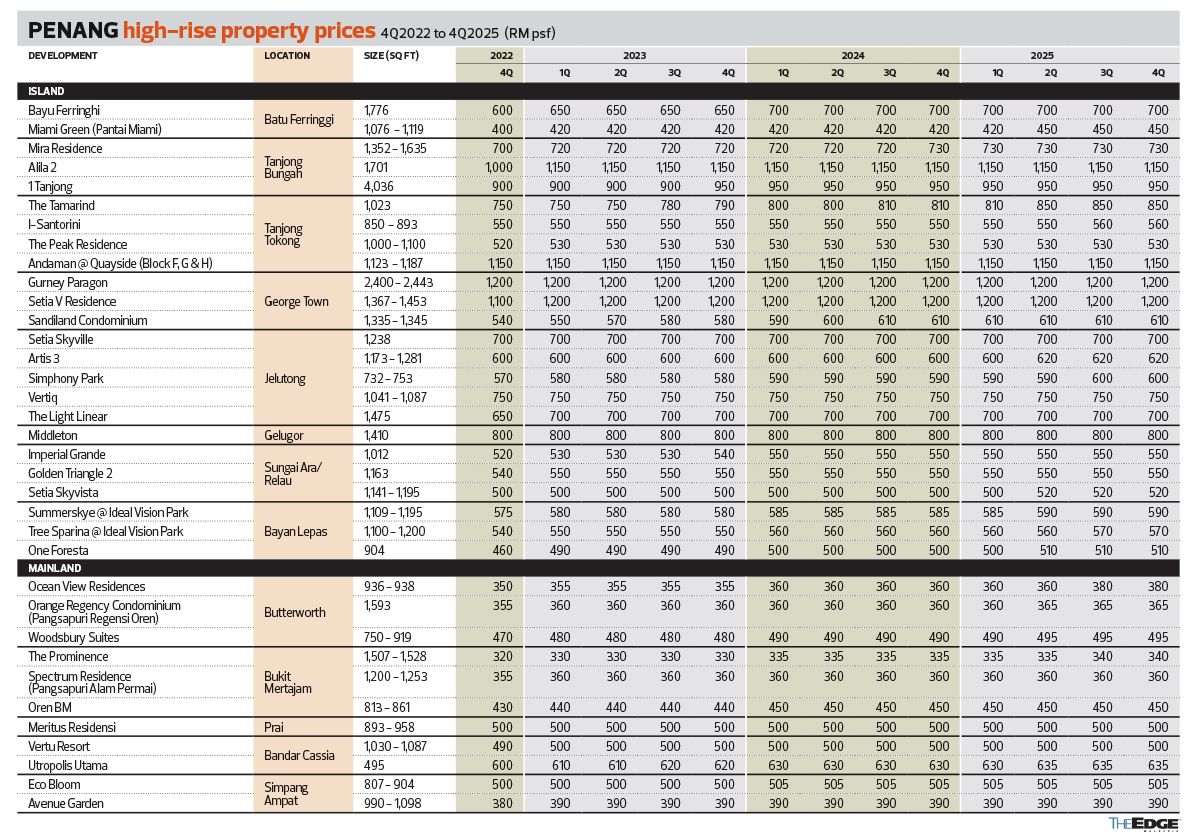
As for high-rise developments on the mainland and island, the monitor shows no price movements q-o-q, but a slight movement y-o-y.
On the island, notable increases were seen at Miami Green (Pantai Miami), up 7% to RM450 psf from RM420 psf, and The Tamarind, by 5% to RM850 psf from RM810 psf. “The price increase [in The Tamarind] may be due to its status as affordable serviced apartments by E&O in the prime Seri Tanjung Pinang area,” says Saleha.
For high-rises on the mainland, the notable increase came from Ocean View Residences, by 6% to RM380 psf from RM360 psf. “The marginal price increase is likely driven by the proximity to Penang Sentral and infrastructure developments such as the Juru-Sungai Dua elevated highway,” she highlights.
Industrial developments to impact property market
Industrial developments are having an impact on the property market and investors should keep tabs on where the action is.
According to Saleha, Penang recorded RM12.5 billion in approved manufacturing investments in 1H2025, and the momentum from these approvals continued to filter through to the second half of last year, particularly in the electrical and electronics, semiconductor and high-value manufacturing segments. In the second half of 2025, occupancy for industrial properties remained firm on both the island and mainland.


This sustained industrial performance has had a clear spillover effect on the secondary residential market. On Penang Island, areas such as Bayan Lepas, Sungai Ara and Relau continued to benefit directly from their proximity to the Free Industrial Zone and technology parks.
In 4Q2025, mid-market condominiums and landed homes in these locations saw steady enquiry levels and relatively resilient transaction activity compared to the peripheral areas.
“Rental demand remained healthy, supported by engineers, technicians and managerial staff seeking accommodation close to their workplaces. As a result, rental rates for well-maintained high-rise units in these neighbourhoods were generally stable, with selected schemes recording slight improvements due to tight vacancy levels,” says Saleha.
On the mainland, Batu Kawan has emerged as a parallel growth node to Bayan Lepas. With the continued expansion of industrial parks and improving infrastructure connectivity via the Second Bridge, Batu Kawan’s residential market has matured significantly.
“By 4Q2025, property prices in Batu Kawan, particularly for newer stratified and landed developments, were increasingly comparable to those in parts of Bayan Lepas, excluding premium seafront projects such as Queens Residences. This convergence reflects stronger market confidence in Batu Kawan as a long-term employment and residential hub rather than merely a lower-cost alternative to the island,” she says.
The rental market in Penang is expected to remain stable, with hotspots close to industrial areas (Bayan Lepas, Bayan Baru, Relau/Sungai Ara), Universiti Sains Malaysia (Sungai Dua, Bukit Gambir, Batu Uban) and expatriate hubs (Tanjong Tokong/Seri Tanjung Pinang, Pulau Tikus/Gurney).
Save by subscribing to us for your print and/or digital copy.
P/S: The Edge is also available on Apple's App Store and Android's Google Play.