

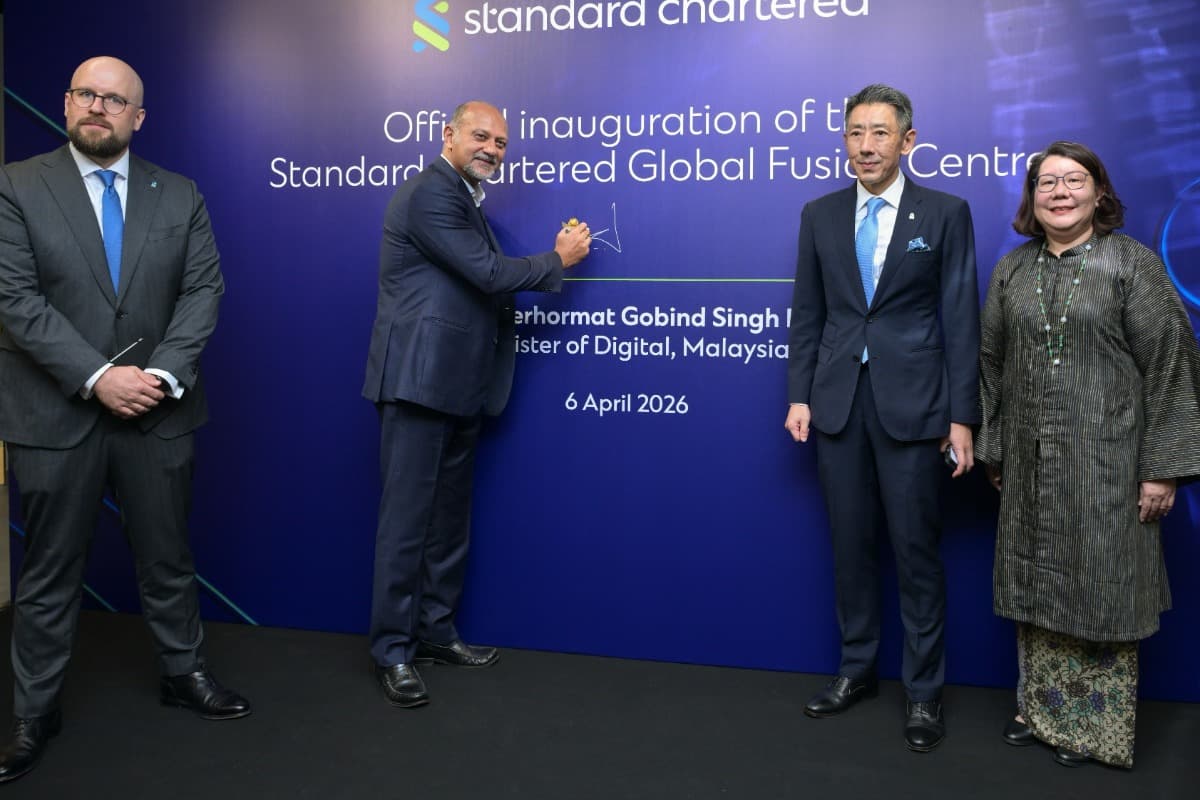
KUALA LUMPUR (April 6): As sophisticated and fast-moving cyber threats intensify, Standard Chartered Bank Malaysia Bhd has launched its first global fusion centre in Malaysia to strengthen real-time incident response, enhance operational efficiency and address emerging risks.
“In today's environment where cyber fraud and physical threats increasingly overlap, the centre enables the bank to fuse the signals into one picture and connect the dots faster. This capability has been shaped through close alignment across local and global teams guided by Standard Chartered,” said Standard Chartered GBS Malaysia interim location head Sharon Chung during her opening address at the inauguration and tour of Standard Chartered Global Fusion Centre held at Wisma Standard Chartered on Monday.
The global fusion centre is said to be the country’s first multi-disciplinary global business service (GBS) hub of an international bank. The centre located at Wisma Standard Chartered in Bukit Jalil, Kuala Lumpur is the second largest GBS footprint globally after India, employing more than 4,400 people with local talents making up to 85% of its workforce.
Chief information security officer Cezary Piekarski said as cyber threats continue to grow, the demand for cyber-defence models that are pre-emptive, proactive and able to disrupt threats before they reach clients or critical systems is also increasing.
“The fusion centre is designed to better protect both the bank and the communities we serve. It does this by monitoring and analysing criminal activity across multiple channels, whether internal or external, digital or physical. This includes cybercrime, digital fraud, traditional fraud, as well as physical security threats such as robberies,” he told DigitalEdge at the sidelines of the event.

“In large financial institutions, different types of crime have traditionally been managed in silos. Teams responsible for protecting internal systems operate separately from those safeguarding clients, as well as those handling the physical security of branches. As a result, these functions have historically worked in isolation,” he said.
Recognising this gap, the organisation identified an opportunity to establish a fusion centre that brings these various domains together into a single, coherent system. This integrated approach enables the generation of higher-quality insights into emerging threats.
“For instance, in more sophisticated attack scenarios, a perpetrator may gain unauthorised access to a branch after hours not to steal money, but to maybe install a malicious USB device. This represents an example of physical and digital threat which is a breach of physical security followed by a potential compromise of the network,” said Piekarski.
By viewing such incidents not as isolated events but as part of a connected chain of attack, the fusion centre helps the bank to detect, understand and immediately respond to complex forms of cyber crimes.
Additionally, he said, Malaysia was chosen for the fusion centre due to availability of talent, the bank’s long-standing presence in the country and Malaysia’s strategic location.
“We are building similar capabilities in India, Poland and in Europe. We are celebrating 25 years of GBS Malaysia, but as an organisation [Standard Chartered] has been present here for much longer,” he added.
Meanwhile, Minister of Digital Gobind Singh Deo said Malaysia’s GBS sector has grown significantly in recent years, with a 66.8% increase in companies since 2022, now exceeding 700 entities mirroring Malaysia’s transformation from a cost-based economy to one driven by value, innovation and intelligence.
GBS is touted as a centralised hub within multinational companies that manages shared functions such as information technology, finance, human resources and procurement for worldwide operations to improve efficiency and innovation, and to reduce costs.
“Investments [in GBS] have surged from RM730 million in 2021 to RM9.87 billion in 2024. We currently rank third globally in the Global Services Location Index, a position sustained through continuous innovation, talent development and investor confidence,” he added.
Gobind stated that the fusion centre is an example of what the ministry envisions operations that are human-centric, AI-driven and impact-focused to be.
“It also aligns closely with the work of our National AI Office, which is advancing standards to ensure that our digital ecosystem remains both innovative and secure. By centralising capabilities and strengthening response mechanisms, this fusion centre sets a new benchmark for operational resilience in the financial sector,” he said.