

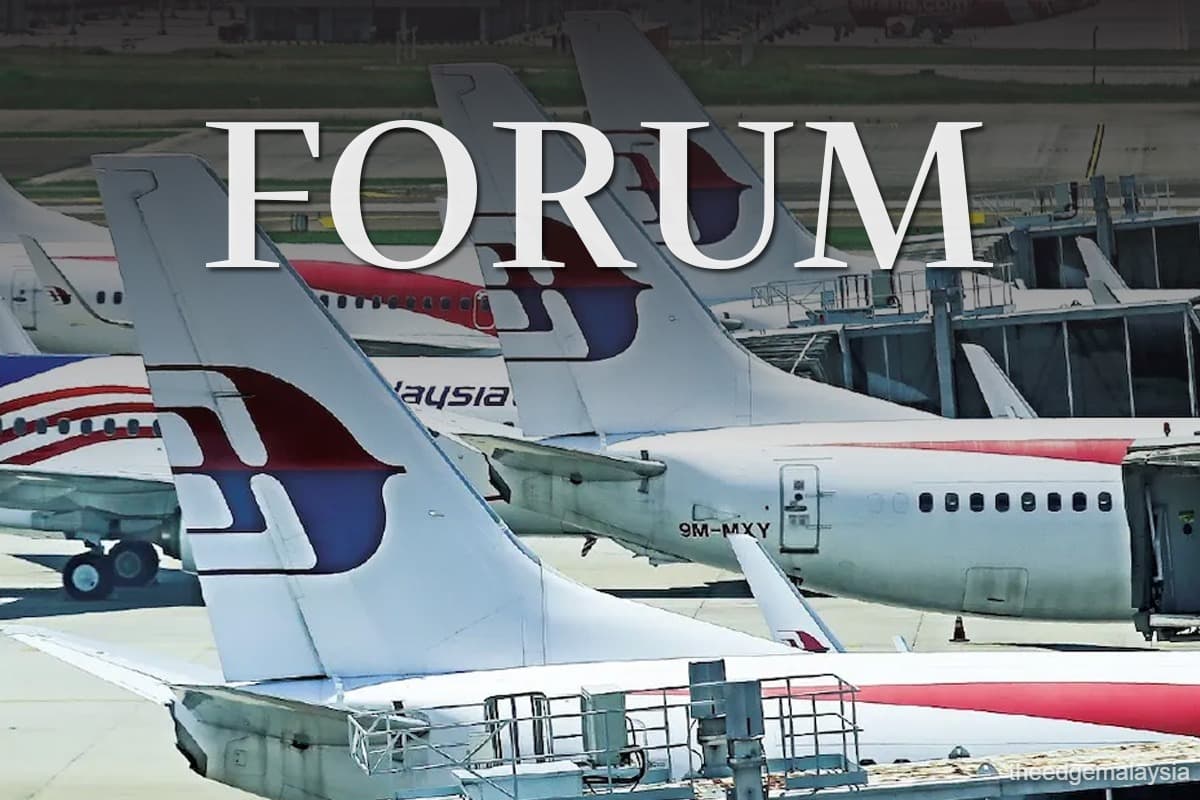
This article first appeared in Forum, The Edge Malaysia Weekly on April 6, 2026 - April 12, 2026
The current escalation in the Middle East has moved past a temporary disruption into a structural crisis for the global aviation industry. For the Asia-Pacific region, which serves as one end of the world’s most critical long-haul corridors, the implications of the US-Iran conflict are both immediate and profound.
A new map for Asia-Pacific aviation
For decades, the “Grand Central” hubs of Dubai, Doha and Abu Dhabi have been the undisputed linchpins of Asia-Europe connectivity. Today, that geography is being forcibly rewritten. As of late March, the closure of Iranian and Iraqi airspace — coupled with severe restrictions across the Gulf — has effectively severed the shortest, most fuel-efficient routes for Asian carriers.
The Great Sky Bypass: Redrawing the world’s busiest air corridor
In the high-stakes theatre of global aviation, the map of the sky is being rewritten in real time. As of late March, the escalation of the Middle East conflict has moved past a temporary disruption into a structural “Conflict-Adaptive” era. For the Asia-Pacific, the implications are profound: the traditional “Grand Central” hubs of Dubai, Doha and Abu Dhabi — once the undisputed linchpins of global travel — are being bypassed by a new, northern geography born of necessity.
The Kabul Corridor: High-stakes navigation
With Iranian and Iraqi airspace effectively closed and Gulf hubs operating at 30% to 50% capacity due to intermittent missile threats, the “Northern Lifeline” via the Kabul Flight Information Region (Afghanistan) has transitioned from a niche detour to a mandatory corridor.
The twin challenges: Fuel and floor space
• The “Jet-Crude” Asymmetry: While Brent crude hovers near US$100 per barrel, the price of refined Jet A1 in Singapore has decoupled, surging towards US$200 per barrel. Regional refiners are cutting runs due to crude supply disruptions, creating a physical shortage that hedging programmes — mostly based on crude — cannot fully mitigate.
• The Hub Vacuum: With the “Big Three” Gulf hubs operating at 30% to 50% capacity, nearly 40 million annual Asia-Europe seats are in jeopardy. This has triggered an immediate flight to safety, with direct-flight yields from hubs like Singapore, Kuala Lumpur and Hong Kong reaching record highs.

Executive navigation: A crisis playbook
To navigate this “High Intensity-Persistence” phase, airline executives in the Asia-Pacific must pivot from reactive management to predictive strategy:
• Currency as a strategic hedge: With the ringgit and other regional currencies showing unexpected resilience (for example, USD/MYR at 3.91), executives should use this window to pre-pay US dollar-denominated liabilities — leases and MRO (maintenance, repair and operations) contracts — to lock in gains before potential volatility in the second half of the year.
• The “Cargo Bridge” Opportunity: The closure of the Strait of Hormuz has paralysed maritime trade. Airlines must aggressively reconfigure widebody belly space for a “Sea-to-Air” bridge. Implementing a conflict surcharge is no longer just a cost-recovery mechanism, it is a necessity to manage the payload penalties incurred by longer detours.
• Loyalty poaching: This is a generational window to capture “displaced” premium travellers. Airlines should launch immediate status matches for frequent flyers of Gulf carriers who are currently stranded or facing repeated cancellations.
• Operational resilience over efficiency: In the Kabul Corridor, efficiency takes a back seat to survival. Mandating extra fuel buffers (tankering at home hubs) and front-loading MRO cycles is critical as the extra 2+ hours per rotation on Europe routes will accelerate heavy maintenance checks by 12% to 15% this year.
Fleet Redeployment Plan: 2026 Crisis Optimisation
The ‘High-Yield Surgeon’
Most of Europe connecting Asia and Oceania has been disrupted due to Middle Eastern airlines limitations. This presents an opportunity for Asia-Pacific airlines, utilising Central Asia as its hub and spoke and can be used as a precision instrument to capture displaced premium traffic.
• Deployment: Shift to smaller or mid-size range widebody.
• Payload strategy: Use the newer generation widebody delivering 14% to 25% fuel-burn advantage to absorb the two-hour detour via the Kabul FIR (OAKX). With Brent crude at US$100+, newer technology airframe is capable of maintaining a full passenger load plus high-margin “Sea-to-Air” belly cargo (semiconductors/pharma) on these extended rotations.
The ‘Regional Shield’
The smaller widebody, such as A330neo, is the most powerful weapon against US$180 per barrel jet fuel in the mid-haul and regional sectors.
• Deployment: Deploy on “Thin-Long” bypass routes such as KUL-Istanbul or KUL-Tashkent (technical stop).
• The “Currency Play”: With USD/MYR at 3.91 to 4.01, the A330neo’s 14% lower fuel burn versus the A330ceo is amplified. Use the A330neo to “underprice” Gulf competitors on the Kangaroo Route (Australia-Europe via KUL/SIN).
• Cargo conversion: Utilise the 251t MTOW variant for dedicated “Hormuz Bypass” cargo runs to North Asia, bypassing the blocked sea lanes with 12% lower trip costs.
Immediate executive actions (The ‘No-Regret’ Moves)
1. Fuel strategy (tankering): Order all long-haul flights to tanker 100% of return fuel. With the ringgit near 3.91, buying fuel in the local currency at home is a massive cost savings compared to the US$1,260 per tonne spot prices currently seen in European hubs.
2. MRO acceleration: Use the currency window to pre-purchase components and spare parts. The extra 120 minutes per rotation on Europe routes will hit the 2026 maintenance budget 15% earlier than planned.
3. The “Safety Brand” Pivot: Update the passenger booking interface to show the “Safe Haven Corridor” (avoiding Middle East conflict zones).
As the conflict in the Middle East forces a structural remapping of global flight paths, the Asia-Pacific MRO sector — and Malaysia in particular — is standing at a critical inflection point.
The traditional MRO dominance of the Middle East, centred in Dubai and Doha, is currently compromised by airspace closures, security risks and supply chain fragility. This has created a “maintenance vacuum” that Asia-Pacific facilities are perfectly positioned to fill.
The vacuum: Why MRO is shifting east
The conflict has introduced three primary disruptions to the Middle East MRO ecosystem:
• Logistical paralysis: The closure of the Strait of Hormuz has slowed the sea freight of heavy engine components and spare parts into Gulf hubs, leading to grounded aircraft and “AOG” (aircraft on ground) spikes.
• Security premia: Insurance surcharges for aircraft entering Gulf-based hangars have made routine maintenance in the region significantly more expensive than in stable Asia-Pacific alternatives.
• Capacity displacement: Gulf carriers are prioritising their own internal maintenance to keep their reduced fleets operational, leaving “third-party” airline customers (from Europe and Asia) looking for new service partners.
Asia-Pacific’s strategic ‘resilience dividend’
As regional carriers reroute through the Kabul FIR or Central Asian corridors, the extra flight hours are accelerating maintenance cycles. This has triggered a “supercycle” for Asia-Pacific MRO service providers.
Malaysia: The emerging centre of gravity
Malaysia is uniquely positioned to capture the “displaced” Middle East business due to three key developments as at March:
• The GE Aerospace Surge: GE Aerospace Engine Services Malaysia (GEESM) is currently seeing record shop-visit volumes. Its recent US$1 billion global MRO investment includes significant capacity expansion in Selangor to support the LEAP engines that power the world’s narrowbody fleets.
• Subang Regeneration Plan (SARP): The unveiling of state-of-the-art facilities like the ExecuJet (Dassault) MRO in Subang has signalled Malaysia’s transition to a high-end business aviation and regional airline hub.
• The “Currency Sweet Spot”: Because MRO contracts are typically US dollar-denominated but labour and local overheads are ringgit-based, the 3.91 exchange rate allows Malaysian MRO service providers to offer competitive pricing while maintaining higher margins than competitors in Singapore or the Middle East.
The bottom line
The 2026 crisis is a stress test of regional agility. The winners will be the airlines that stop waiting for the Middle East to “return to normal” and instead treat the current geography as the permanent reality. Vast opportunities are right in front of Asia-Pacific airlines and MRO players to capture. Capture the displaced volume now. By leveraging local currency strength and capturing the vacuum in premium capacity, Asia-Pacific carriers can transform a geopolitical disaster into a structural market-share gain.
Datuk Captain Izham Ismail is a former group managing director of Malaysia Aviation Group Bhd
Save by subscribing to us for your print and/or digital copy.
P/S: The Edge is also available on Apple's App Store and Android's Google Play.