

This article first appeared in City & Country, The Edge Malaysia Weekly on March 30, 2026 - April 5, 2026
Johor Bahru’s residential property prices generally rose in the fourth quarter of last year, led by serviced apartments and driven by strong sales and pricing for new launches, says Olive Tree Property Consultants (Johor) Sdn Bhd CEO Samuel Tan when presenting The Edge Malaysia | Olive Tree Property Consultants Johor Bahru Housing Property Monitor 4Q2025.
He adds that growth has been driven by both quality launches and investor interest, especially in developments marketed in higher-end and well-located segments. This has helped Johor Bahru outperform other major Malaysian cities in terms of price in 2025.
In terms of supply, high-rise segments continue to dominate the market. As at 4Q2025, Johor had a future supply of 38,448 landed homes compared with 70,177 high-rise units, representing a ratio of 35:65. Tan attributes this to developers’ preference for high-rise development due to affordability considerations and land scarcity, which necessitate higher-density projects.
The segment also represents the bulk of overhang units, with 10,560 high-rise units remaining unsold compared with only 825 landed homes. Tan adds that unsold high-rise units with ongoing construction have risen 36% to 8,435 units, up from 6,180 units in 3Q2025.
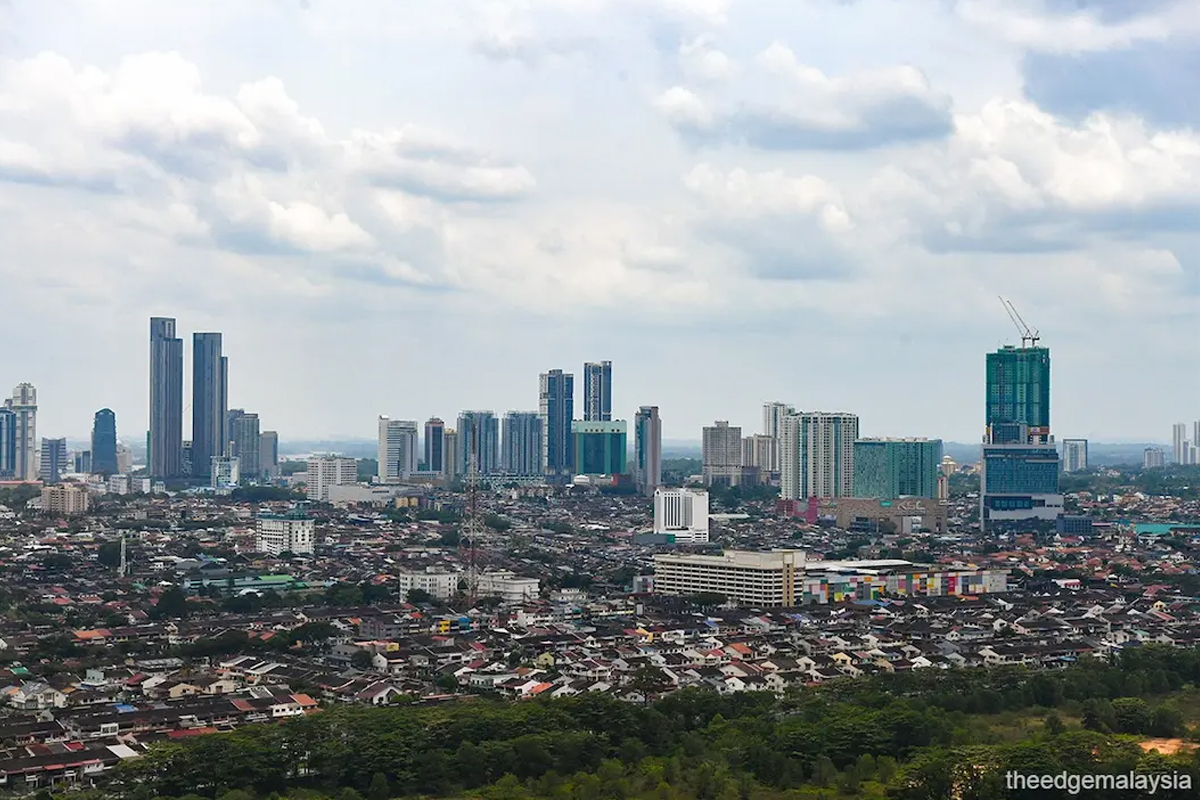
“This indicates there is a potential increase of overhang numbers for high-rise residential properties if sale momentum starts to slow down,” Tan says, warning of a potential structural and urban-systems issue with the increasing concentration of high-rise residential developments in the core Johor Bahru city centre.

“Johor is experiencing an unprecedented concentration of high-rise residential developments, with an estimated 60,000 units in the pipeline, recently completed or under construction.”
He foresees that the city core will be even denser as more high-rise developments are completed between 2029 and 2030.
The majority of these are studio, 1-bedroom and compact 2-bedroom units aimed primarily at commuters travelling between Johor Bahru and Singapore, and at investors banking on future rental demand once the Johor Bahru-Singapore Rapid Transit System (RTS) is in operation.
“The cumulative impact of tens of thousands of units being delivered within a compact city core will place severe strain on existing urban infrastructure,” Tan says.
It will exacerbate traffic congestion, as many residents rely on private vehicles because of weak last-mile connectivity, leading to bottlenecks at the RTS and Customs, Immigration and Quarantine Complex nodes during peak hours, while pedestrian crowds at transport hubs, retail podiums and lift lobbies will further degrade the user experience.

The planned Elevated Autonomous Rail Transit is expected to enhance connectivity, though it remains in the planning stage and is still some time from being operational.
He adds that many of these high-rise developments were approved based on minimum parking standards that do not reflect commuting behaviour.
“In practice, many RTS users will still require private vehicles to reach the stations, especially residents from developments beyond a comfortable walking distance. With parking provisions already tight, overflow will spill into roadside and informal parking, leading to traffic obstruction and enforcement challenges,” he says, adding that this will progressively undermine the city core’s liveability.
Tan cautions that “planning ahead is crucial”, noting that certain areas require special attention to ensure public transport-readiness for traffic dispersal and to enhance visitors’ experience in navigating the city centre.
“It is pertinent to have an ample sky-linked bridge and covered walkway to connect and integrate new and existing developments.”
He says there is a need to expedite measures such as park-and-ride and mechanical parking in dedicated buildings as car park lots become insufficient, with many existing open-air car parks acquired by developers for high-rise projects.
Tan notes that while high-rise living in Johor Bahru appeals to commuters and investors, a thorough assessment of density, parking and facilities is crucial. “Careful and constant monitoring by the local authorities is needed to ensure there is no overpopulation after the completion of serviced apartments.”

ETS could spur regional growth
On Dec 12, 2025, the direct Electric Train Service (ETS) between JB Sentral and KL Sentral began operations, marking a key milestone in rail connectivity between Johor and the Klang Valley. The journey takes four to 4½ hours, providing a convenient inter-city travel option.
The ETS also improves access to secondary towns in Johor, including Kulai, Layang-Layang, Rengam, Kluang, Paloh, Bekok, Labis, Segamat and Gemas. This enhanced connectivity is expected to drive property development, tourism and local commerce, while increasing the appeal of these towns for industrial, logistics, residential and hospitality investments.
Tan notes that the service could support “balanced regional growth rather than concentrating development only in Johor Bahru and Kuala Lumpur”.

Launches in 4Q2025
There were six new launches in the fourth quarter: five serviced apartments — Residensi Maxim, Coronade Twins, CTC SkyOne, Mandolin Residences and The Straits View DUO Residence — and a landed development called Hijauan Kews.
The 1,026-unit Residensi Maxim by Maxim Global Bhd (KL:MAXIM) in Taman Pelangi was launched in November with three unit sizes — 450 sq ft, 660 sq ft and 865 sq ft — priced from RM426,000, RM617,000 and RM816,000 respectively.
Coronade Twins, part of Coronade Properties Sdn Bhd’s integrated development Coronation Square, comprises 539 units, with built-ups ranging from 280 to 1,230 sq ft and prices starting from RM476,000. Launched in November, it has achieved a sales rate of about 60%.
Projects launched in December were CTC SkyOne by CTC Development, Mandolin Residences by Plenitude Bhd (KL:PLENITU) and The Straits View DUO Residence by BRDB Development Sdn Bhd.
The 1,605-unit CTC SkyOne in Bukit Chagar will have eight layout types and built-up areas of 452 to 1,626 sq ft. The selling price is about RM1,300 psf and about 70% of the units have been sold.
Mandolin Residences in Taman Desa Tebrau has a total of 712 units. There are five unit types — 542 sq ft, 763 sq ft, 906 sq ft, 924 sq ft and 1,017 sq ft — and gross prices start from RM383,000 (RM707 psf), RM517,000 (RM678 psf), RM617,000 (RM681 psf), RM639,000 (RM692 psf) and RM679,000 (RM668 psf) respectively.
The Straits View DUO Residence in Permas Jaya has a total of 715 units spread across two towers. There are three unit types — 645 sq ft, 882 sq ft and 1,291 sq ft — and prices start from RM398,000 (RM617 psf), RM540,000 (RM612 psf) and RM711,000 (RM551 psf) respectively.
Hijauan Kews, which is Phase 2 of Kew Green — a landed development in the 270-acre The Kews by WM Senibong Sdn Bhd — was launched in October in Pulai and will comprise 160 terraced and semi-detached houses.

Price trends
Property prices in the resale market continued to trend upward in the fourth quarter, with most properties either maintaining their value or seeing price increases across all segments, says Tan.
Prices of 2-storey terraced houses rose between 2.5% and 6.7%. For instance, a 1,400 sq ft home in Taman Bukit Indah increased 4.17% from RM720,000 to RM750,000; a 1,400 sq ft unit in Taman Mount Austin rose 2.5% from RM800,000 to RM820,000; a 1,400 sq ft Horizon Hills unit gained 6.67% from RM750,000 to RM800,000; a 1,540 sq ft unit in Bandar Seri Alam increased 4.84% from RM620,000 to RM650,000; and a 1,916 sq ft unit in Taman Ponderosa rose 6.67% from RM750,000 to RM800,000.
The 2-storey semi-detached segment saw stronger growth, with prices rising between 5.6% and 8.3%. A 2,380 sq ft Bandar Seri Alam unit was transacted at RM950,000 (up 5.56%); a 3,780 sq ft unit at Senibong Cove was sold for RM1.8 million (up 5.88%); a 3,400 sq ft Taman Bukit Indah home changed hands at RM1.5 million (up 7.14%); and a 3,200 sq ft Taman Setia Eco Garden unit increased to RM1.3 million, from RM1.2 million.
Among 2-storey cluster homes, a 2,240 sq ft Taman Bukit Indah unit gained 6.7% from RM1.2 mil to RM1.28 mil; and a 2,240 sq ft home in Horizon Hills increased 8.3% to RM1.3 million, from RM1.2 million.
Serviced apartments experienced more modest gains, with a 872 sq ft unit at Twin Tower Residence, Bukit Chagar, registering 2.4% growth from RM820,000 to RM840,000 and a 958 sq ft unit in Tropez, Danga Bay, climbing 4.2% from RM480,000 to RM500,000.

On the rental front, most properties remained stable with selective increases.
Only one unit each at Taman Molek and Bandar Seri Alam saw its rental rate rise 8% to RM2,700 and 9.1% to RM2,400 respectively.
Rents for 2-storey semi-detached homes have generally increased, except for one location. In Taman Bukit Indah, a 3,400 sq ft unit recorded a 5.3% rise from RM3,800 to RM4,000. Both Taman Molek and Taman Impian saw an 8.6% increase, with rents rising from RM3,500 to RM3,800. The outlier was Austin Heights, where rent for a 3,595 sq ft, 2-storey semi-detached unit fell 7% from RM4,300 to RM4,000 per month.
A 750 sq ft Sky Executive unit in the high-rise segment posted 5.6% growth, from RM1,800 to RM1,900 per month.
Save by subscribing to us for your print and/or digital copy.
P/S: The Edge is also available on Apple's App Store and Android's Google Play.