

This article first appeared in City & Country, The Edge Malaysia Weekly on March 30, 2026 - April 5, 2026
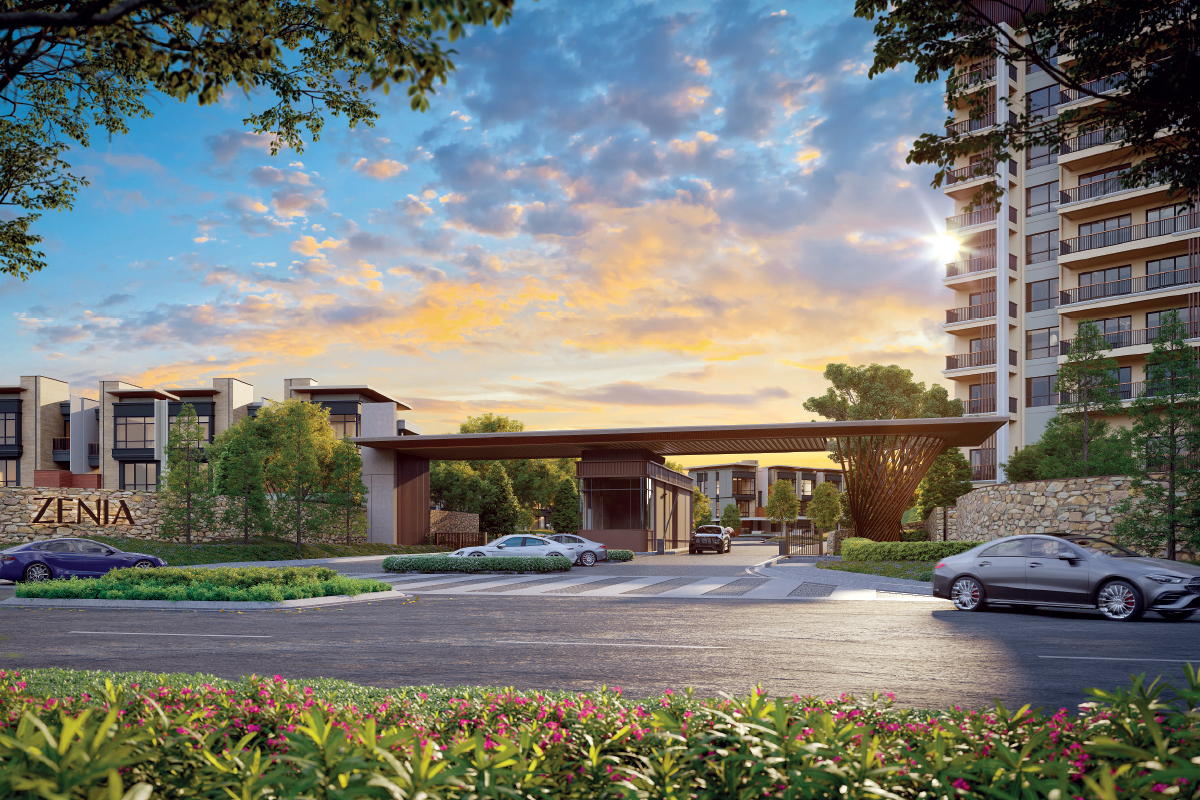
Desa ParkCity in Kuala Lumpur has long been hailed as one of the best master-planned townships in the country. Now, its developer ParkCity Group is gearing up to develop ParkCity Damansara, its first township in Petaling Jaya (PJ), Selangor. It launched the first phase Zenia — a mix of three-storey landed ParkHomes and mid- to high-rise CondoVillas — on March 28.
The 600-acre ParkCity Damansara will be developed on one of the large tracts in Kwasa Damansara, which are among the few remaining large land parcels in the Klang Valley capable of accommodating a fully planned township. The parcel was acquired from Kwasa Land Sdn Bhd.
For ParkCity Group, the project represents both an opportunity and a progression of its expertise, as well as an extension of the model it has spent more than two decades refining at its flagship Desa ParkCity.
“We had been interested in the land for a long time. It’s been a long process to get to where we are today,” says group CEO Datuk Joseph Lau. “Really, what you’re getting is a continuation of Desa ParkCity, but [it’s] a better version. It’s the same primary market, just in a different location.”
It is a point Lau returns to often: commitment to consistency. According to him, securing the site as a private developer came with challenges, particularly when trying to demonstrate that ParkCity Group was the right fit for the land. “We had to communicate that we could contribute something different to [Petaling Jaya].”

The land, previously a rubber plantation, will be developed over the next 20 years. “What are the possibilities of finding such a [large] tract of land?It’s quite a challenge in the Klang Valley to find an area that could cater to what we want [for a township development].”
For ParkCity Group, Petaling Jaya is a familiar market, one that it understands and sees as a natural extension of its existing base, an area where it is confident in contributing meaningfully. Just as importantly, it aligns with the group’s understanding of its core customer base.
“People who live in PJ will always live in PJ. If you ask them to go somewhere else, they won’t. You must be clear who you are building for,” Lau says, excitement clear in his voice.
ParkCity Group has spent more than two decades building townships such as Desa ParkCity, Marina ParkCity in Miri and ParkCity Hanoi in Vietnam, alongside developments in Kuching.

An ecosystem approach
The group’s approach to ParkCity Damansara remains consistent with that of its earlier developments: building a community. “At ParkCity Group, we’re not just putting up homes, we’re creating a whole ecosystem. The retail, the school, parks, all the things required,” says Lau.
He draws a distinction between building individual projects and shaping how a place is experienced as a whole. “The difference is that we create the whole ecosystem — from the landscaping, walkways, trees, tenants — you name it, we will take care of it. That includes the sense of arrival. This is important and we will continue to do it this way.”
The focus, he emphasises, remains on the end-user. “[We] cater to the people who are going to stay there. Investors are different. If you’re talking about the persons living there, they have specific needs.”
The undulating land itself presents a different set of considerations, according to chief operating officer David Goh. “The level difference across the land is quite significant.
“Instead of flattening everything, we will work with the topography and make it part of the design. We won’t just level everything. We will try to maintain the natural topography and make it part of the design,” he explains.
Beyond planning and positioning, environmental and sustainability considerations are being integrated into ParkCity Damansara. “We are allocating one-third of the township for green spaces and we will try to maintain the current habitats,” says Goh. About 22% (or about 13 acres) of Zenia has been allocated as green space, he adds.
“We will also create a wetland sanctuary that will progress into future phases,” he says. Materials will be reused where possible. “We will take the timber [from the existing rubber trees] and recycle it to do something more meaningful,” Goh says, adding that this might include making furniture for common areas and décor elements in the homes.
At the same time, the township’s planning is shaped by its wider surroundings. Located in an established area, ParkCity Damansara is surrounded by existing amenities, including hospitals such as Thomson Hospital and Sunway Medical Centre Damansara, as well as schools such as Sri KDU Schools in Kota Damansara, and St Joseph’s Institution International School in Tropicana Indah.
In terms of connectivity, the township sits within the Klang Valley’s well-connected corridor, bordering Kota Damansara to the north and Ara Damansara to the south.
It is connected via several major road networks, including Jalan Sungai Buloh, Damansara-Shah Alam Elevated Expressway (DASH), New Klang Valley Expressway (NKVE), Damansara-Puchong Expressway (LDP), Guthrie Corridor Expressway (GCE) and North-South Expressway (PLUS).
ParkCity Damansara will be developed over the next two decades. Its phases will be rolled out gradually in response to market demand.
“I think the beautiful thing about this piece of land is its size. We’re talking about 600 acres in prime PJ. This project will be built over 20 years, so it’s subject to market demand,” says Goh.

Building community living with Zenia
The vision for the 55-acre Zenia, which has an estimated gross development value of RM2 billion, is deeply rooted in connected living. The 442 ParkHomes will have built-ups of 3,150 to 3,980 sq ft, with prices ranging from RM2.4 million to RM4.3 million. The 643 CondoVillas will be spread across five blocks, with built-ups ranging from 1,691 to 4,247 sq ft, and prices starting from RM1.3 million.
The maintenance fee is estimated at RM3.30 per share unit, or about 33 sen psf.
Facilities that will be scattered around Zenia include a linear park, swimming pool, leisure pool, children’s pool, multipurpose hall, games room, music room, lounge, gym, pickleball court and badminton court. Density is planned at 20 units per acre.
From a design standpoint, flexibility will be built into the houses. “The house grows together with you,” says Goh. “When you are young, you use it one way. And when you are older, you can change it.”

Structural provisions also allow for future modifications. “We will future-proof the structure,” he adds. “If you need to add a lift later, you can. The homes are designed for multi-generations. For units with a courtyard, in the centre, that area can be used to install a lift when you’re older.
“If you think that you need more rooms, you can actually extend the slab over the double-volume area. You can create another usable functional space.”
The planning also reflects how shared spaces are integrated into the township. “We don’t treat green spaces separately. They are part of how people move through the development,” Goh explains.
Sustainability remains part of the approach. “[We] will continue to provide wide walkways, trees and the required facilities. A lot of people say it’s not as hot in Desa ParkCity. It’s mainly because of the trees,” Lau says.
Sustainable features will be incorporated across both products. The landed ParkHomes include 20ft double-volume living areas in selected units, internal courtyards, solar hot water systems, solar panels and rainwater harvesting. Selected CondoVillas units are designed with cross ventilation to reduce reliance on air conditioning.

A township built to last for generations
ParkCity Damansara is planned with long-term living patterns in mind, shaped not just by how it is built, but how it is lived over time.
For Lau, the aim is to create an environment in which people choose to remain — often across generations — within the same community even if not under the same roof.
“[In Desa ParkCity,] what I saw was grandfathers buying for their children, then the children started buying, and then the grandfathers buying for the grandchildren,” he says. “You would be close enough to each other within the same community, but also not too close.
This reflects the group’s broader approach to living environments. “People have different needs. Some are just starting out, some have families, some are older. You have to cater for all of them,” says Lau.
Daily life, in his view, is shaped by proximity. “You can even let your kids walk to school. In Desa ParkCity, 70% of our students [at The International School @ DPC] actually live in the township. When they finish school, they walk home.”
This emphasis on convenience is built into ParkCity Damansara’s planning. “If your kids can walk to school, if your supermarket is nearby, if everything is within the township, then you don’t need to drive as much,” he says.
To support this, the township integrates relevant components to sustain both lifestyle and operations. “We have to create an ecosystem where there’s revenue to support the township. That’s where retail and schools come in,” says Lau.
Elements associated with earlier ParkCity townships are expected to be introduced over time, including plans for its signature The Waterfront commercial strip, a 20-acre central park and two lakes.
The group is taking a measured approach for its future phases. “The good thing about this location is there are already many amenities outside. Whether more [amenities] will be introduced depends on market demand,” Lau notes.
“We’re not looking at short-term speculation. It’s about long-term value creation,” adds Goh.
Lau describes it as a “journey of residence” — a way of thinking that begins from the point of entry and carries through to how the township is experienced and maintained over time.
“The key is maintenance. As the developer, we keep that commitment. Our main focus is to make sure we are creating the community. Because our role as a developer is to make sure that the moment you arrive in a township until you reach your house, you feel at home,” Lau says.
Save by subscribing to us for your print and/or digital copy.
P/S: The Edge is also available on Apple's App Store and Android's Google Play.