

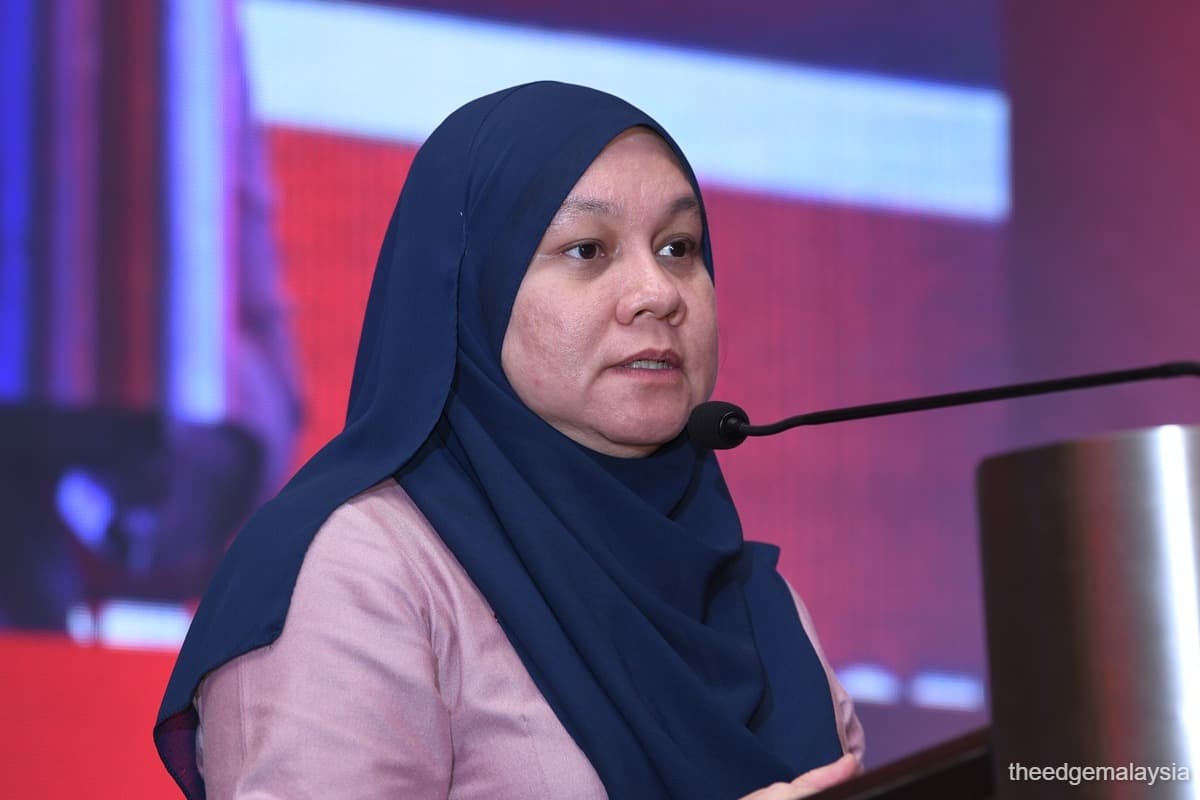
PUTRAJAYA (April 1): The Energy Commission (EC) is reviewing its electricity transmission and distribution third-party access (TPA) policies for further enhancements, said its chief executive officer Siti Safinah Salleh.
She told the press at the annual review meeting that the move is part of its efforts to ensure they remain aligned with future requirements amid a dynamic energy landscape.
This includes recent programmes such as CRESS, which allows large scale solar (LSS) farms to pay a fee to the grid operator in order to sell electricity directly to specific customers.
Also being enhanced is CREAM, a rooftop solar programme which allows the aggregation of solar-generated electricity from a number of homes to be sold directly to a large customer within a certain radius.
The commission, which oversees both the electricity and natural gas sectors, is also developing the power sector’s incentive-based regulation mechanism for Regulatory Period 5 (RP5 2028-2030) that dictates things like tariff structures.
The regulatory body also reviewed mechanisms for electricity cross-order trading that is expected to complete its pilot phase of green energy exports soon.
“These efforts are aimed at ensuring that the regulatory framework remains relevant, robust and capable of supporting a more complex and dynamic energy landscape,” said Siti Safinah.
WATCH: Energy Commission addresses slow green energy uptake
The review comes as CRESS has seen a slow uptake, even after a reduction in the system access charge — a “toll” fee to use the grid — by five sen per kWh in response to grouses from industry players. For CREAM, the access charge was reduced by six sen/kWh.
Similarly, Malaysia’s solar energy exports to Singapore under ENEGEM has also seen slow uptake as of last year, according to The Edge's checks with industry players at the time.
They cited the prevailing gap between Singapore energy prices and the auction price from Malaysia, though the gap would have narrowed due to the recent jump in global natural gas prices.
“Our view is this; there has been a slow uptake primarily because most of the users keep comparing the total cost of energy with the current tariff [which] does not have a green energy premium,” Siti Safinah said.
“Current tariff depends on fuel rates… when fuel rates are high then [the renewable energy (RE) programmes] become more commercially viable,” she said.
“I think the way that you need to think about investing in RE is to look at how [it] allows to mitigate the risks from fuel price volatility over the long term. It cannot be looked at on a shorter [term] and just based on the current tariffs alone, and definitely not [by] comparing green energy with brown energy costs.”
On ENEGEM, Siti Safinah said “there have been some discussions” with offtakers.
“It (the talks) is still in an ongoing discussion [stage], so that will continue because it is really about willing buyer and seller,” she said.
On the latest Solar ATAP rooftop solar programme covering residentials and commercial and industrial (C&I) buildings, the EC chief said it received 44MW of applications for homes and another 29MW for C&I buildings since it was introduced this year.