

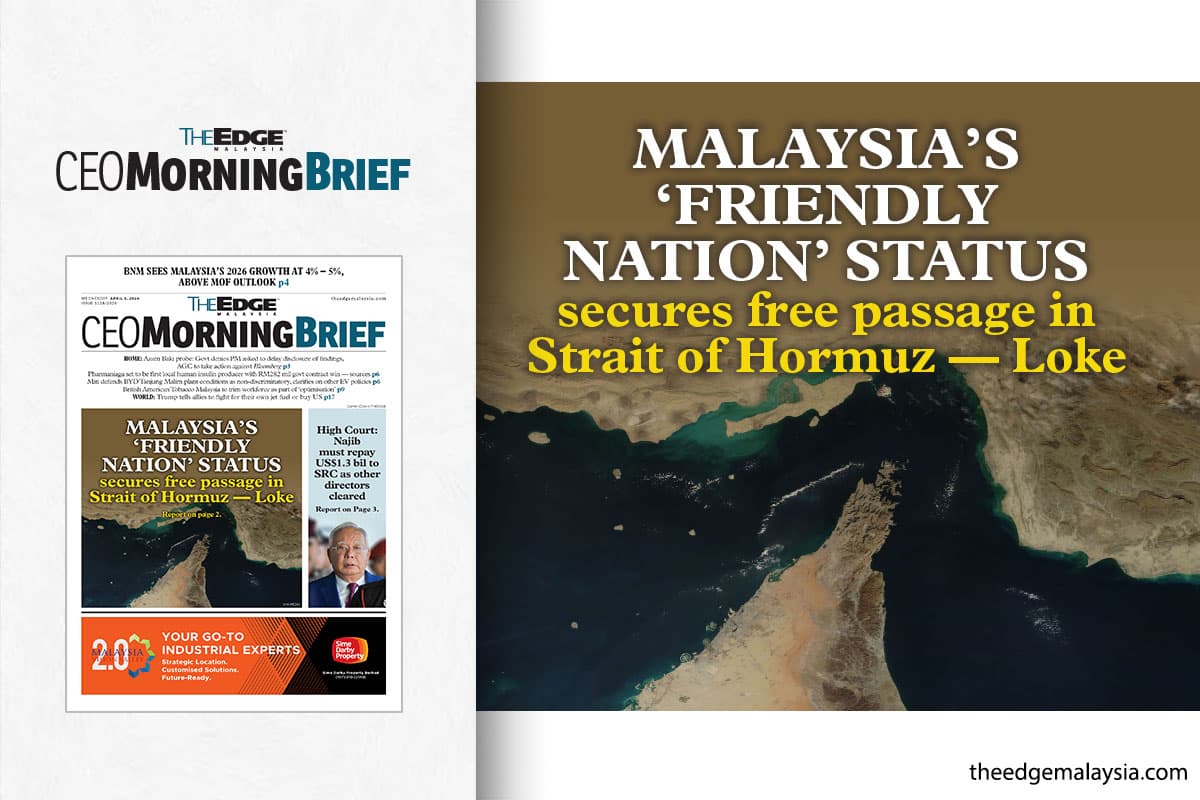
KUALA LUMPUR (March 31): Malaysian vessels have been granted free passage through the Strait of Hormuz as the country is regarded by Iran as a "friendly nation", Transport Minister Anthony Loke Siew Fook confirmed on Tuesday.
“Iran’s Ambassador to Malaysia Valiollah Mohammadi Nasrabadi has informed us that Malaysia is regarded as a friendly nation with strong diplomatic ties, and no toll is being imposed on Malaysian vessels," Loke told reporters after an event on Tuesday, according to Bernama.
He said the prime minister shared this at the National Economic Action Council (MTEN) meeting earlier in the day. MTEN meetings are now held weekly, according to Loke, as the government has shifted into "crisis mode" to navigate the economic volatility caused by the ongoing war in Iran.
His comments come after the New Straits Times reported, citing Valiollah, that at least seven Malaysian-owned vessels are set to sail safely through the Strait of Hormuz within days. They would be allowed to transit the strait free of charge.
"We received information from Malaysia's foreign minister that several Malaysian ships are in the Persian Gulf and want to pass through. We have considered this, and InshaAllah they will pass.
"It is no problem as Malaysia is a friendly country, and friendly countries can use the strait," Valiollah told the English daily in an interview published on Tuesday. "Of course (Malaysian ships are free to pass). We will not charge," he added.
It was previously reported that seven Malaysian-owned tankers were awaiting clearance to transit the strait: three owned by Malaysia's national oil company Petroliam Nasional Bhd or PETRONAS, two by its subsidiary MISC Bhd (KL:MISC), and one each by Sapura Energy and Shapadu Corporation Sdn Bhd.
No major disruptions to domestic aviation so far
Loke also said there are currently no major disruptions to the domestic aviation sector, apart from rising fuel costs, according to Bernama. The ministry is holding regular engagements with industry players to manage the situation, he said.
“Some airlines have indicated they may rationalise their operations, including merging flights to improve efficiency. If load factors are low, they will need to reduce services on certain routes,” the minister was quoted as saying, adding that these are temporary measures to help airlines manage higher jet fuel costs.
As for the shipping sector, Loke said the government is in talks with industry stakeholders to introduce a more structured and standardised surcharge mechanism to ensure fair and sustainable pricing. This follows the Malaysia Shipowners Association's call for better management and governance of surcharges, which has been presented to the MTEN.
In maritime trade, surcharges are additional costs added to the base freight rates to cover unexpected spikes in operational costs, such as the recent surge in insurance premium and fuel prices triggered by the outbreak of war in Iran.
Priorities on projects with greatest benefit to people
While Loke said no projects under the ministry will be halted, implementation priorities will be given to projects that carry the greatest potential benefit to the people and the economy, as directed by the prime minister.
“At this point, there are no budget cuts and no projects are being stopped. However, we are closely monitoring the situation and prioritising projects that deliver the most value to the country,” Loke was quoted as saying.
The government's focus is to ensure fuel supply remains stable, he said, adding that the ongoing conflict, depending on how long it lasts, could have prolonged economic effects that last between six and 24 months.
On that note, a meeting with e-hailing operators will be held to explore initiatives such as carpooling to improve fuel efficiency, Loke said.