

This article first appeared in The Edge Malaysia Weekly on March 30, 2026 - April 5, 2026
WITH the monthly fuel subsidy bill ballooning to RM4 billion from RM700 million before the Iran war broke out four weeks ago, Putrajaya last week took baby steps towards reining in costs without burdening most Malaysian drivers.
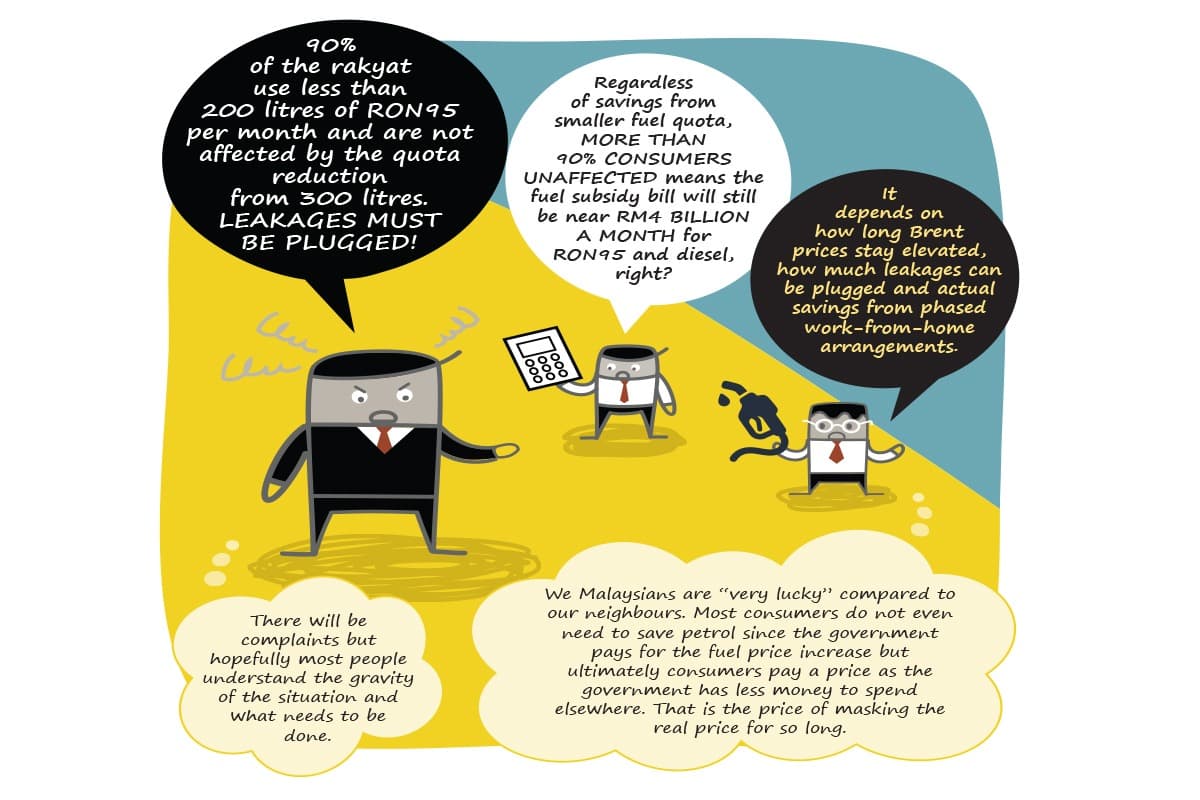
At least 90% of Malaysian drivers use less than 100 litres of RON95 fuel monthly and would remain unaffected by the reduced quota of 200 litres starting April 1, down from 300 litres currently, Prime Minister Datuk Seri Anwar Ibrahim said in a live telecast on March 26, confirming The Edge’s report earlier that day. He urged the people understand the gravity of the economic consequences from the blockade of the Strait of Hormuz that had sent Brent crude oil above US$100 per litre.
Economists at TA Securities aptly observed that “policymakers are effectively buying time” in extending the RM1.99 per litre RON95 rate and only adjusting the eligibility quota, thus avoiding an immediate pass-through on headline inflation.
They calculated that Putrajaya’s “gross fiscal savings” at about RM5 billion annually, assuming 2.7 billion litres of RON95 no longer require subsidies at the current rate of RM1.88 per litre (unsubsidised price of RM3.87 minus Budi95 subsidised price of RM1.99). However, they conceded that “realised savings are likely to be lower” as behavioural shifts — such as government encouraged flexible work arrangements — reduce excess consumption and the volume subject to market pricing.
That RM5 billion savings works out to RM416.7 million a month, or just over 10% of Putrajaya’s expected RM4 billion monthly subsidy bill for RON95 and diesel with Brent crude oil at US$100 per litre.
Yet, that offers scant comfort when a fuel subsidy bill of RM4 billion equals 0.2% of gross domestic product a month and could potentially turn out to be RM48 billion or 2.3% of GDP a year, should global oil prices stay elevated above US$100 per barrel for an extended period.

Even six months of a subsidy bill that size is significant relative to the fiscal deficit of 3.5% of GDP targeted in Budget 2026, tabled last October, that assumed Brent crude oil prices at US$60 to US$65 per barrel and only pencilled in Petroliam Nasional Bhd (PETRONAS) dividend of RM20 billion. PETRONAS paid RM32 billion in dividends to the government in 2024 and 2025.
On March 13, Finance Minister II Datuk Seri Amir Hamzah told reporters that Putrajaya’s monthly fuel subsidy bill had risen to RM3.2 billion (RM2 billion for RON95 and RM1.2 billion for diesel).
Going by the implied subsidy of RM1.28 per litre for RON95 and RM2.57 per litre for diesel from March 12 to 25, Putrajaya may be subsidising about 1.6 billion litres of RON95 and 467 million litres of diesel a month, our back-of-the-envelope calculations show. If true, the prevailing implied subsidy of RM1.88 per litre for RON95 and RM3.37 per litre for diesel points to a subsidy bill of about RM4.5 billion before savings from the latest measures.
That would also mean every 10 sen increase in the Budi95 subsidised price could result in savings of RM160 million a month and nearly RM2 billion a year. An average consumption of 98.2 litres per month for 90% of consumers would, in turn, translate into a RM9.82 increase in RON95 bill for every 10 sen, simple workings show. Reverting RON95 to the pre-Sept 30, 2025 subsidised price of RM2.05 per litre represents a six sen per litre increase or about RM5.90 per month for 90% of drivers, potentially saving Putrajaya RM1.2 billion annually.
The Ministry of Finance on March 26 said fuel subsidies were about RM3 billion a month with Brent at US$90 per litre and RM4 billion a month with Brent at US$100 per litre. From March 17, Malaysia had increased the Budi diesel assistance to RM300 a month from RM200 a month for eligible individuals, including farmers. E-hailing drivers continue to enjoy 800 litres of RON95 quota a month.
In Sabah and Sarawak, where diesel is still sold at a subsidised price of RM2.15 per litre, light vehicles can only buy 50 litres of subsidised fuel at any one time while large vehicles not exceeding 100 litres (below three tonnes) and 150 litres (above three tonnes) per purchase, respectively.
If the situation in Iran is prolonged, Putrajaya would need to face up to the need to adjust the subsidised RON95 fuel price of RM1.99 per litre — which is essentially cheaper than the price of mineral water.
“Overconsumption is not sustainable … It is very expensive to sustain artificially low prices, especially when [government revenue] are not growing faster than demand for those highly subsidised goods and services … When what was once given becomes a right, when people feel entitled to cash handouts, cheap fuel … it becomes a recurring cost on the annual budget, a hot potato for politicians that would be very hard to correct,” an observer says.
Indeed, when Thailand announced a fuel price hike from lower subsidies and targeted assistance for the poor on March 25,Thai Finance Minister Ekniti Nitithanprapas said price caps led to market distortions, hoarding and unnecessary budget losses, citing how diesel consumption rose from 65 million litres per day before the Iran war to 100 million litres per day.
For now, Putrajaya’s move would allow Bank Negara Malaysia to say when announcing its 2026 GDP forecast and inflation guidance on March 31 that policymakers are ready to act when necessary.

Save by subscribing to us for your print and/or digital copy.
P/S: The Edge is also available on Apple's App Store and Android's Google Play.